Richard H. Weisberg - Böcker
Visar alla böcker från författaren Richard H. Weisberg. Handla med fri frakt och snabb leverans.
5 produkter
5 produkter
442 kr
Skickas inom 5-8 vardagar
Flexibility is usually seen as a virtue in today's world. Even the dictionary seems to dislike those who stick too hard to their own positions. The thesaurus links "intransigence" to a whole host of words signifying a distaste for loyalty to fixed positions: intractable, stubborn, Pharisaic, close-minded, and stiff-necked, to name a few.In this short and provocative book, constitutional law professor Richard H. Weisberg asks us to reexamine our collective cultural bias toward flexibility, open-mindedness, and compromise. He argues that flexibility has not fared well over the course of history. Indeed, emergencies both real and imagined have led people to betray their soundest traditions.Weisberg explores the rise of flexibility, which he traces not only to the Enlightenment but further back to early Christian reinterpretation of Jewish sacred texts. He illustrates his argument with historical examples from Vichy France and the occupation of the British Channel Islands during World War II as well as post-9/11 betrayals of sound American traditions against torture, eavesdropping, unlimited detention, and drone killings.Despite the damage wrought by Western society's incautious embrace of flexibility over the past two millennia, Weisberg does not make the case for unthinking rigidity. Rather, he argues that a willingness to embrace intransigence allows us to recognize that we have beliefs worth holding on to -- without compromise.
478 kr
Skickas inom 5-8 vardagar
The cruel power of misdirected words, artfully structured but spiritually empty and bearing the stamp of law or legalistic reasoning, is a persistent theme in the modern novel. Richard Weisberg, who has written extensively on both literature and law, explores the role of legalism and its abuses in eight major novels of the nineteenth and twentieth centuries. Beginning with Dostoevski and moving by way of trenchant analyses of Flaubert and Camus, Weisberg culminates his argument in a brilliantly revisionist reading of Melville’s Billy Budd. In each of the novels treated, Weisberg sees a verbally gifted central character relying on wordiness to avoid or distort previously revealed truths. He argues that the malaise Nietzsche called ressentiment goads these characters to verbalizations that do violence to others and, ironically, indict their very creators. He identifies the legalistic theme as the major mode of iconoclasm in modern fiction and the source of its holocaustic vision. Writers, he reflects, viewed with profound skepticism their culture’s tendency to substitute complex narrative formalism for earlier, absolute approaches to justice. In this, Weisberg concludes, their works anticipated the jurisprudential discourse of today. “The Failure of the Word is a creative, provocative, and learned work, written with style and feeling. Weisberg brings to bear on his core themes (the legalistic proclivity and ressentiment) a wide body of knowledge and thought in law and philosophy, literary history and theory.”—Robert L. Jackson, Yale University
2 176 kr
Skickas inom 10-15 vardagar
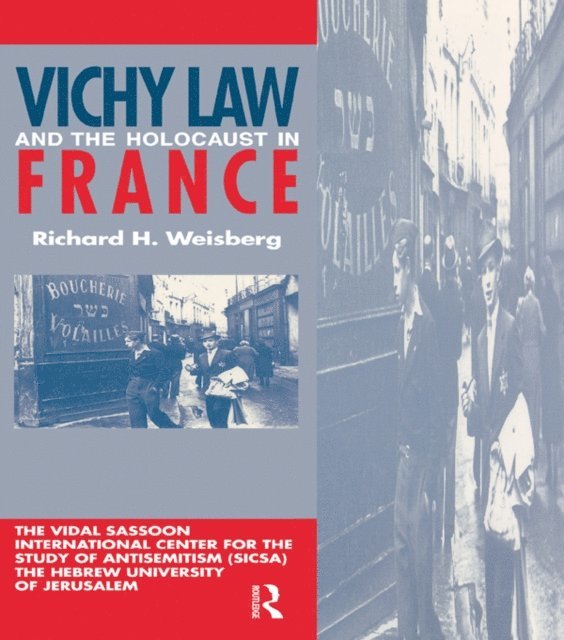
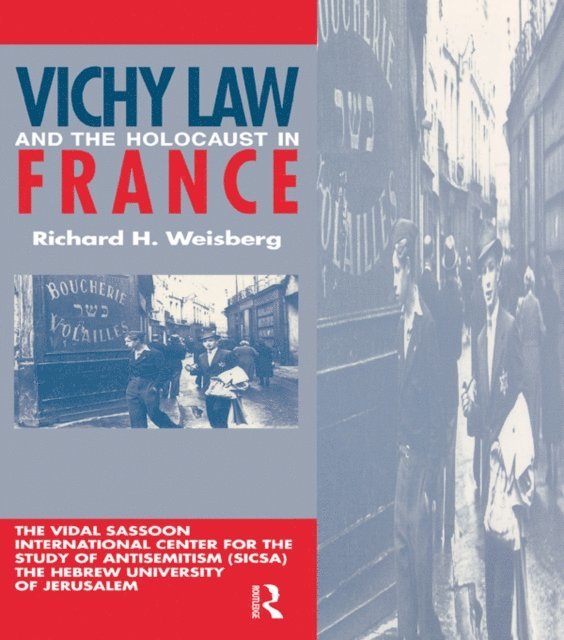
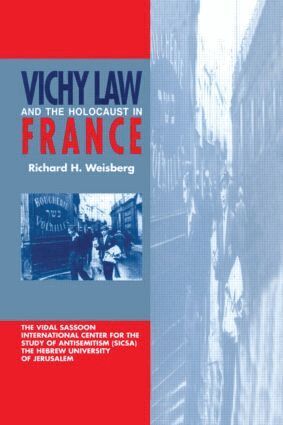
The involvement of Vichy France with Nazi Germany's anti-Jewish policy has long been a source of debate and contention. At a time when France, after decades of denial, has finally acknowledged responsibility for its role in the deportation and murder of 75,000 Jews from France during the Holocaust, Richard H. Weisberg here provides us with a comprehensive and devastating account of the French legal system's complicity with its German occupiers during the dark period known as 'Vichy'.As in Germany, the exclusionary laws passed during the Vichy period normalized institutional antisemitism. Anti-Jewish laws entered the legal canon with little resistance, and private lawyers quickly absorbed the discourse of exclusion into the conventional legal framework, expanding the laws beyond their simple intentions, their literal sense, and even their German precedents.Drawing on newly-available archival sources, personal interviews, and historical research, Weisberg reveals how legalized persecution actually operated on a practical level, often exceeding German expectations. Further, he presents a persuasive argument for Vichy law as an acquired Catholic response to a flase notion of Jewish Talmudism. The book also compares Vichy experience to American legal precedents and practices and opens up the possibility that postmodern modes of thinking ironically adopt the complexity of Vichy reasoning to a host of reading and thinking strategies.Vichy Law and the Holocaust in France raises fundamental and disturbing questions about the ease with which democratic legal systems can be subverted.
Del 2 - International Studies in Law and Literature
Law, Literature, and History
A Fateful Rendezvous with the Shoah
Inbunden, Engelska, 2025
2 978 kr
Skickas inom 3-6 vardagar
Close readings of acclaimed 20th century novels and lesser known but stunning works of popular culture uniquely situate us to understand the clash of religious values that led to genocide in World War II Europe (including Great Britain). The author further engages pre-Shoah writers, such as Shakespeare and Melville, signposts to seismic conflicts in law and religion. Law and Literature methods permit the author to uncover the falsehood and antisemitic violence emerging from longstanding religious differences. Inspired by James Carroll (Constantine’s Sword), Harold Bloom (Jesus and Yahweh), and Franklin Littell (The Crucifixion of the Jews), Weisberg provokes readers, through reengagement with a series of superb stories, to see in all of them millennia of atrocities disguised as “Judeo-Christian” affinity. As in his Vichy Law and the Holocaust in France (NYU; Gordon & Breach), the author again utilizes archival materials from the wartime period, integrating them into his close readings of fiction."Richard Weisberg's standing as a sage of the Law and Literature Movement is augmented in this masterful book."Anthony Julius, Deputy Chairman Mishcon de Reya LLP, Professor, Faculty of Laws, University College London. "In this masterful book, Richard Weisberg brings his extraordinary learning to bear on a group of stories, written both before and after the Holocaust, to explore some of its deepest, and most hidden causes. The Holocaust, Weisberg argues, was fueled by Christianity-infused interpretations of religious and legal texts, which have been deployed for centuries against Jewish traditions, intellectual histories, customs, Jewish Law, and legalist ideals. Weisberg builds his case through literary and legal analyses of (among others) Malamud’s The Fixer, Shakespeare’s Merchant of Venice, Melville’s Billy Budd Sailor, Gunter Grass’s The Tin Drum, The Old Testament, Nietzsche’s meditations on morals, and holocaust-era legal texts from Germany, Britain and Vichy France. We are ill-served by attempts to paper over and distort this history with bromides about “Judeo-Christian” values and shared aspirations. Weisberg’s elegant and straightforward scholarship takes us on a path toward a truer accounting."Professor Robin West, Georgetown Law."Richard Weisberg has written an incisive critique of the idea that there is a coherent “Judeo-Christian” tradition. Instead, he emphasizes both the chasms that separate the two religions and goes on to suggest that classical Christian mischaracterization of Judaism contributed to the zeitgeist that made the Holocaust possible. One need not agree with every aspect of his argument to find it illuminating and very much worth extensive discussion. That is especially the case with regard to his truly brilliant analyses of The Merchant of Venice, which is compelling and transformative with regard to the oft-debated assertion, which Weisberg denies, that the play is “anti-Semitic.” Sanford Levinson, University of Texas Law School, author of Written in Stone: Public Monuments and Changing Societies.
595 kr
Skickas inom 10-15 vardagar
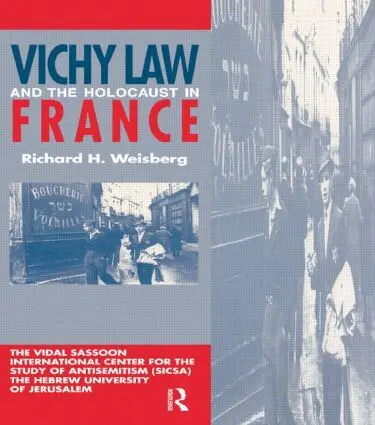
First Published in 1998. Weisberg provides a comprehensive account of the French legal system's complicity with its German occupiers during the dark period known as 'Vichy'. Drawing on archival sources, personal interviews, and historical research, this book reveals how legalized persecution operated on a practical level, often exceeding German expectations. All while comparing the Vichy experience to American legal precedents and practices, opening the possibility that postmodern modes of thinking ironically adopt the complexity of Vichy reasoning to a host of reading and thinking strategies.