Richard L. Greaves - Böcker
Visar alla böcker från författaren Richard L. Greaves. Handla med fri frakt och snabb leverans.
8 produkter
8 produkter
1 361 kr
Skickas inom 5-8 vardagar
After more than two decades of unprecedented political, social, and religious upheaval, revolutionary thought and activity in Britain continued to thrive even after the restoration of the monarchy in 1660. This highly original study, which draws on the reports of both police and informers, follows the "radical underground" in England from the eve of the Restoration to the collapse of the northern rebellion in 1663. In a tale that winds its way across England andinto Scotland, Ireland, the Netherlands, and Switzerland, Greaves examines how radicals remained united in their common animosity to monarchy, prelacy, taxes, and popery. Although ultimatelyunsuccessful, their conspiracies and rebellions nonetheless fueled the drive for the repression of Nonconformists, prompted the state to cultivate an elaborate network of informers, and heightened the concern for domestic security.
The Miscellaneous Works of John Bunyan: Volume II: The Doctrine of the Law and Grace Unfolded; I Will Pray with the Spirit
Inbunden, Engelska, 1975
2 413 kr
Skickas inom 7-10 vardagar
A scholarly edition of Miscellaneous Works of John Bunyan: Doctrine of the Law and Grace Unfolded and I will Pray with the Spirit by Richard L Greaves. The edition presents an authoritative text, together with an introduction, commentary notes, and scholarly apparatus.
The Miscellaneous Works of John Bunyan: Volume VIII: Instruction for the Ignorant; Light for them that sit in Darkness; Saved by Grace; Come, and Welcome to Jesus Christ
Inbunden, Engelska, 1979
2 413 kr
Skickas inom 7-10 vardagar
A scholarly edition of The Miscellaneous Works of John Bunyan: Instruction for the Ignorant; Light for Them That Sit in Darkness; Saved by Grace; Come and Welcome to Jesus Christ by Richard L. Greaves. The edition presents an authoritative text, together with an introduction, commentary notes, and scholarly apparatus.
The Miscellaneous Works of John Bunyan: Volume IX: A Treatise of the Fear of God; The Greatness of the Soul; A Holy Life
Inbunden, Engelska, 1981
2 413 kr
Skickas inom 7-10 vardagar
A scholarly edition of The Miscellaneous Works of John Bunyan: Treatise of the Fear of God; Greatness of the Soul; Holy Life by Richard L. Greaves. The edition presents an authoritative text, together with an introduction, commentary notes, and scholarly apparatus.
The Miscellaneous Works of John Bunyan: Volume XI: Good News for the Vilest of Men; The Advocateship of Jesus Christ
Inbunden, Engelska, 1985
1 647 kr
Skickas inom 7-10 vardagar
A scholarly edition of The Miscellaneous Works of John Bunyan: Good News for the Vilest of Men; The Advocateship of Jesus Christ by Richard L. Greaves. The edition presents an authoritative text, together with an introduction, commentary notes, and scholarly apparatus.
675 kr
Skickas inom 10-15 vardagar
This timely and fascinating historical study of Protestant women will increase the appreciation of their continuing struggle for acceptance within their churches and of their contribution to the success of the Protestant movement. An introductory chapter traces the origins of female subordination and exclusion from the preaching ministry, a practice that was reinforced by Protestant interpretations of Scripture. In essays contributed by recognized specialists, women's roles both in the early development of Protestant sects and in supporting established churches are examined, and their contributions--through teaching, charitable activities, donations, writing, speech making and publishing--are noted. This volume includes an account of Protestant women's involvement in reform movements and their prolonged struggle for ordination and acceptance in the preaching ministry.
God's Other Children
Protestant Nonconformists and the Emergence of Denominational Churches in Ireland, 1660-1700
Inbunden, Engelska, 1997
968 kr
Skickas inom 10-15 vardagar
Winner of the 1996 Albert C. Outler Prize in Ecumenical Church History of the American Society of Church HistoryThis is the first full-length work on the fate of the Protestant nonconformists in Ireland following the restoration of the monarchy and the Church of Ireland in 1660. Of the religious groups studied in this book—the Scottish and English Presbyterians, the Congregationalists, the Baptists, and the Friends—only the Scottish Presbyterians had established themselves prior to the revolutionary upheavals of the 1640's and 1650's.The Congregationalists and Baptists arrived in the train of the English armies dispatched to quell the Irish rebellion. Neither group established firm roots outside the military and civilian republicans, and survived only as shadows of their former selves after 1660. This was also the case for the English Presbyterians. In contrast, the Friends, whose work in Ireland began in 1654, crisscrossed the island in their search for converts, and thus established a much stronger foundation on which to build in the later decades of the century. In addition to examining the internal history of these groups from the restoration to the eve of the penal laws in the early eighteenth century, the author also explores the relationships between the civil authorities and the restored state church and the nonconformists.Only the Scottish Presbyterians and the Friends extended and solidified their bases, and by the end of the century had evolved from sects into denominational churches. Beginning around 1668, both groups underwent a rationalizing process that entailed the development of institutionalized authority, structured systems of discipline, multiregional networks of spiritual leaders, and means to raise funds, found schools, and, in the case of the Friends, establish agencies to censor, publish, and disseminate religious literature. The two groups—their organizations intact, their members yoked together in striking cohesiveness—were thus well positioned to withstand the penal laws in the eighteenth century.
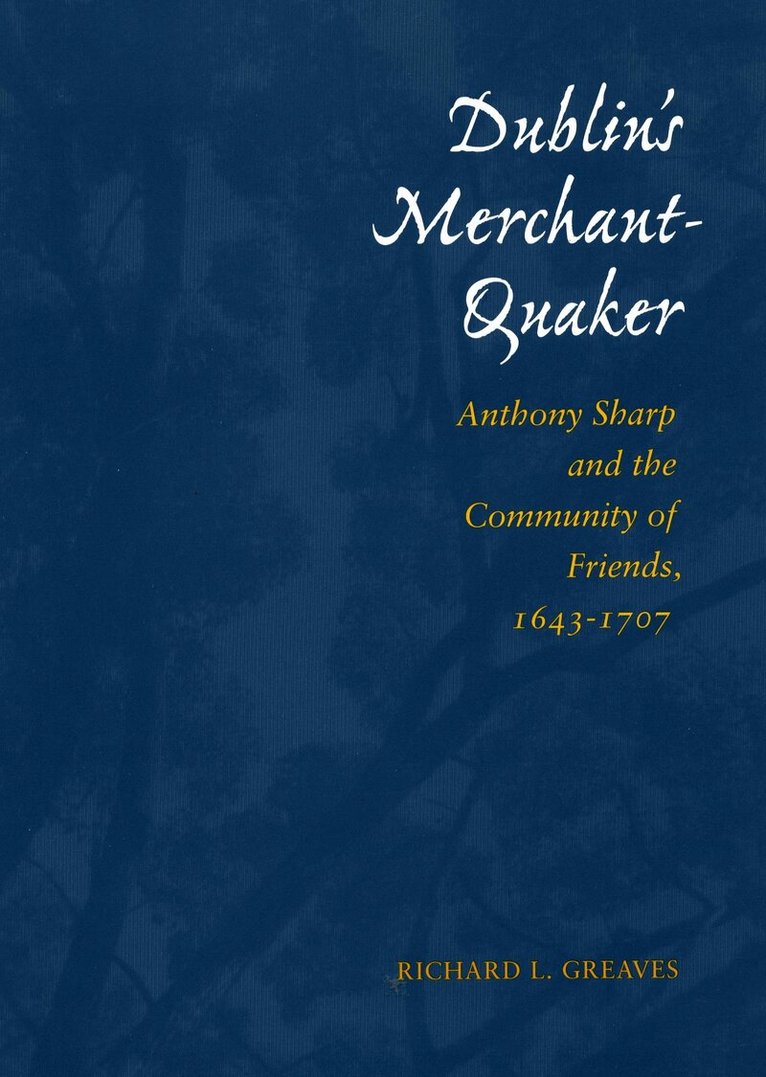
Dublin's Merchant-Quaker
Anthony Sharp and the Community of Friends, 1643-1707
Inbunden, Engelska, 1998
968 kr
Skickas inom 10-15 vardagar
A towering figure in the history of Irish Quakerism, and friend of William Penn and William Edmundson, Anthony Sharp left England in 1669 to settle in Dublin and carve a place for himself in the woolen trade. As a businessman he succeeded brilliantly, employing some 500 workers and amassing a fortune that included lands in Ireland, England, and New Jersey. His economic success helped him gain entree to prominent political and ecclesiastical officials, from whom he sought relief for persecuted Quakers.Without peer among Irish Friends as an organizer, Sharp played a key role in assisting fellow Quakers to survive repression and to evolve from a small sect into a denomination. With his second wife, Ann, he helped shape the rigorous style of dress and home furnishings that set the Irish Friends apart from their coreligionists in England. Tireless in his work as a secretary, treasurer, and fund-raiser, he served on the committee that monitored the proceedings of the Irish Parliament and helped pioneer the Friends' home and shop visitations. Sharp took up his pen to defend Quakers in "the Lamb's war" against critics on all sides—Catholics, Anglicans, nonconformists, and sectarian extremists.When James II extended toleration to nonconformists, Sharp seized the opportunity to become a Dublin alderman and sit on committees whose purview ranged from cleaning the city streets to overseeing the workhouse for the indigent. He attained prominence in the weavers' guild, serving as master in 1688-89 and sitting on its council for years. Notwithstanding his distinctive dress, his refusal to take oaths or pay tithes, and his plain speech, he enjoyed the respect of the rich and powerful.Dublin's Merchant-Quaker is not only a biography of Sharp but a portrait of Dublin's community of Friends. The author explains in detail the functioning of national, provincial, and local meetings; the Friends' work in educating and disciplining their members; their provision of charity to the needy; and their efforts to ransom captives in Muslim lands. In undertaking these activities, Sharp and his fellow Quakers expressed the driving force of their faith and built a society that sustained the Friends for centuries to come as a minority within another minority, the Protestants of Ireland.