Richard M. Weiss - Böcker
Visar alla böcker från författaren Richard M. Weiss. Handla med fri frakt och snabb leverans.
8 produkter
8 produkter
1 009 kr
Skickas inom 10-15 vardagar
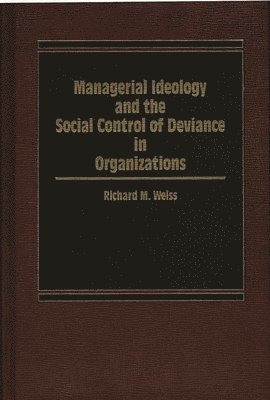
Weiss examines the disease model of alcoholism and how bureaucratically rigid organizations use it to justify their control of employee behavior. He looks at the relations among control programs encountered by management and their inclination to have an alcoholism program based on this disease model. The results of his research suggest that those companies faced with greater control problems tend to have a more bureaucratic organizational structure and are more likely to base their alcoholism program on the view that it is a progressive, fatal disease characterized by poor on-the-job performance.
1 413 kr
Skickas inom 3-6 vardagar
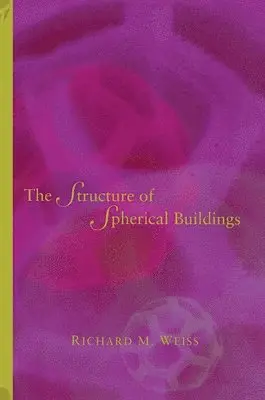
This book provides a clear and authoritative introduction to the theory of buildings, a topic of central importance to mathematicians interested in the geometric aspects of group theory. Its detailed presentation makes it suitable for graduate students as well as specialists. Richard Weiss begins with an introduction to Coxeter groups and goes on to present basic properties of arbitrary buildings before specializing to the spherical case. Buildings are described throughout in the language of graph theory. The Structure of Spherical Buildings includes a reworking of the proof of Jacques Tits's Theorem 4.1.2. upon which Tits's classification of thick irreducible spherical buildings of rank at least three is based. In fact, this is the first book to include a proof of this famous result since its original publication. Theorem 4.1.2 is followed by a systematic study of the structure of spherical buildings and their automorphism groups based on the Moufang property. Moufang buildings of rank two were recently classified by Tits and Weiss. The last chapter provides an overview of the classification of spherical buildings, one that reflects these and other important developments.
691 kr
Skickas inom 7-10 vardagar
This book introduces a new class of non-associative algebras related to certain exceptional algebraic groups and their associated buildings. Richard Weiss develops a theory of these "quadrangular algebras" that opens the first purely algebraic approach to the exceptional Moufang quadrangles. These quadrangles include both those that arise as the spherical buildings associated to groups of type E6, E7, and E8 as well as the exotic quadrangles "of type F4" discovered earlier by Weiss. Based on their relationship to exceptional algebraic groups, quadrangular algebras belong in a series together with alternative and Jordan division algebras. Formally, the notion of a quadrangular algebra is derived from the notion of a pseudo-quadratic space (introduced by Jacques Tits in the study of classical groups) over a quaternion division ring. This book contains the complete classification of quadrangular algebras starting from first principles. It also shows how this classification can be made to yield the classification of exceptional Moufang quadrangles as a consequence. The book closes with a chapter on isotopes and the structure group of a quadrangular algebra.Quadrangular Algebras is intended for graduate students of mathematics as well as specialists in buildings, exceptional algebraic groups, and related algebraic structures including Jordan algebras and the algebraic theory of quadratic forms.
738 kr
Skickas inom 7-10 vardagar
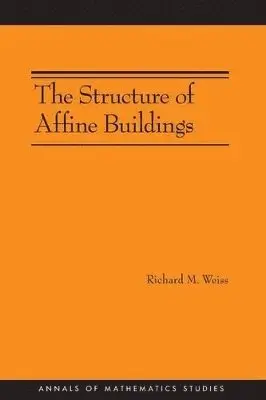
In The Structure of Affine Buildings, Richard Weiss gives a detailed presentation of the complete proof of the classification of Bruhat-Tits buildings first completed by Jacques Tits in 1986. The book includes numerous results about automorphisms, completions, and residues of these buildings. It also includes tables correlating the results in the locally finite case with the results of Tits's classification of absolutely simple algebraic groups defined over a local field. A companion to Weiss's The Structure of Spherical Buildings, The Structure of Affine Buildings is organized around the classification of spherical buildings and their root data as it is carried out in Tits and Weiss's Moufang Polygons.
1 536 kr
Tillfälligt slut
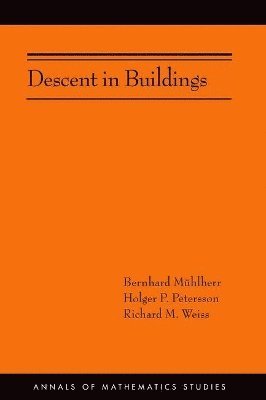
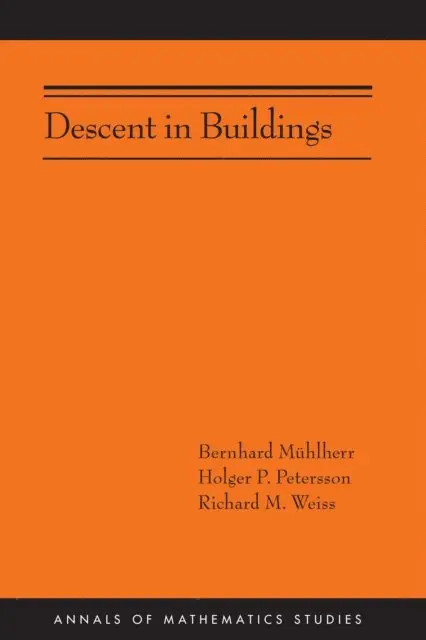
Descent in Buildings begins with the resolution of a major open question about the local structure of Bruhat-Tits buildings. The authors then put their algebraic solution into a geometric context by developing a general fixed point theory for groups acting on buildings of arbitrary type, giving necessary and sufficient conditions for the residues fixed by a group to form a kind of subbuilding or "form" of the original building. At the center of this theory is the notion of a Tits index, a combinatorial version of the notion of an index in the relative theory of algebraic groups. These results are combined at the end to show that every exceptional Bruhat-Tits building arises as a form of a "residually pseudo-split" Bruhat-Tits building. The book concludes with a display of the Tits indices associated with each of these exceptional forms. This is the third and final volume of a trilogy that began with Richard Weiss' The Structure of Spherical Buildings and The Structure of Affine Buildings.
738 kr
Skickas inom 7-10 vardagar
Descent in Buildings begins with the resolution of a major open question about the local structure of Bruhat-Tits buildings. The authors then put their algebraic solution into a geometric context by developing a general fixed point theory for groups acting on buildings of arbitrary type, giving necessary and sufficient conditions for the residues fixed by a group to form a kind of subbuilding or "form" of the original building. At the center of this theory is the notion of a Tits index, a combinatorial version of the notion of an index in the relative theory of algebraic groups. These results are combined at the end to show that every exceptional Bruhat-Tits building arises as a form of a "residually pseudo-split" Bruhat-Tits building. The book concludes with a display of the Tits indices associated with each of these exceptional forms. This is the third and final volume of a trilogy that began with Richard Weiss' The Structure of Spherical Buildings and The Structure of Affine Buildings.
1 064 kr
Skickas inom 10-15 vardagar
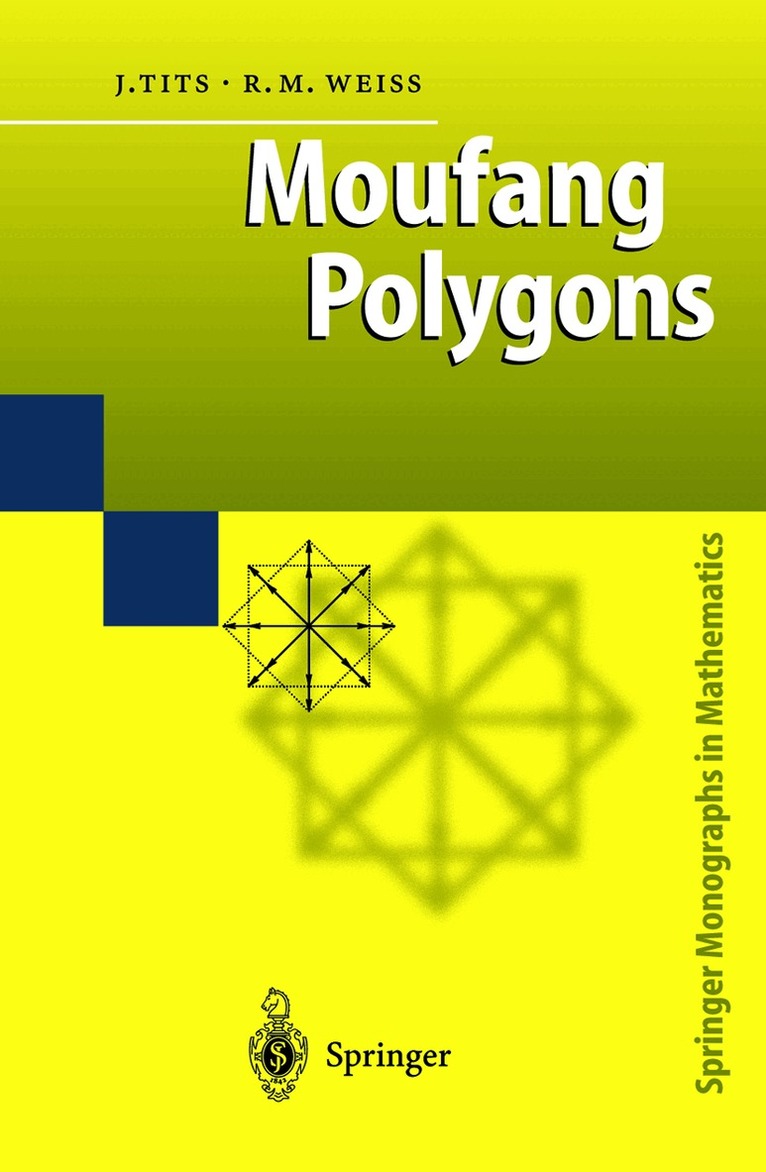
Spherical buildings are certain combinatorial simplicial complexes intro duced, at first in the language of "incidence geometries," to provide a sys tematic geometric interpretation of the exceptional complex Lie groups. (The definition of a building in terms of chamber systems and definitions of the various related notions used in this introduction such as "thick," "residue," "rank," "spherical," etc. are given in Chapter 39. ) Via the notion of a BN-pair, the theory turned out to apply to simple algebraic groups over an arbitrary field. More precisely, to any absolutely simple algebraic group of positive rela tive rank £ is associated a thick irreducible spherical building of the same rank (these are the algebraic spherical buildings) and the main result of Buildings of Spherical Type and Finite BN-Pairs [101] is that the converse, for £ ::::: 3, is almost true: (1. 1) Theorem. Every thick irreducible spherical building of rank at least three is classical, algebraic' or mixed. Classical buildings are those defined in terms of the geometry of a classical group (e. g. unitary, orthogonal, etc. of finite Witt index or linear of finite dimension) over an arbitrary field or skew-field. (These are not algebraic if, for instance, the skew-field is of infinite dimension over its center. ) Mixed buildings are more exotic; they are related to groups which are in some sense algebraic groups defined over a pair of fields k and K of characteristic p, where KP eke K and p is two or (in one case) three.
1 064 kr
Skickas inom 10-15 vardagar
Spherical buildings are certain combinatorial simplicial complexes intro duced, at first in the language of "incidence geometries," to provide a sys tematic geometric interpretation of the exceptional complex Lie groups. (The definition of a building in terms of chamber systems and definitions of the various related notions used in this introduction such as "thick," "residue," "rank," "spherical," etc. are given in Chapter 39. ) Via the notion of a BN-pair, the theory turned out to apply to simple algebraic groups over an arbitrary field. More precisely, to any absolutely simple algebraic group of positive rela tive rank £ is associated a thick irreducible spherical building of the same rank (these are the algebraic spherical buildings) and the main result of Buildings of Spherical Type and Finite BN-Pairs [101] is that the converse, for £ ::::: 3, is almost true: (1. 1) Theorem. Every thick irreducible spherical building of rank at least three is classical, algebraic' or mixed. Classical buildings are those defined in terms of the geometry of a classical group (e. g. unitary, orthogonal, etc. of finite Witt index or linear of finite dimension) over an arbitrary field or skew-field. (These are not algebraic if, for instance, the skew-field is of infinite dimension over its center. ) Mixed buildings are more exotic; they are related to groups which are in some sense algebraic groups defined over a pair of fields k and K of characteristic p, where KP eke K and p is two or (in one case) three.