Richard R. Lau - Böcker
Visar alla böcker från författaren Richard R. Lau. Handla med fri frakt och snabb leverans.
3 produkter
3 produkter
410 kr
Skickas inom 7-10 vardagar
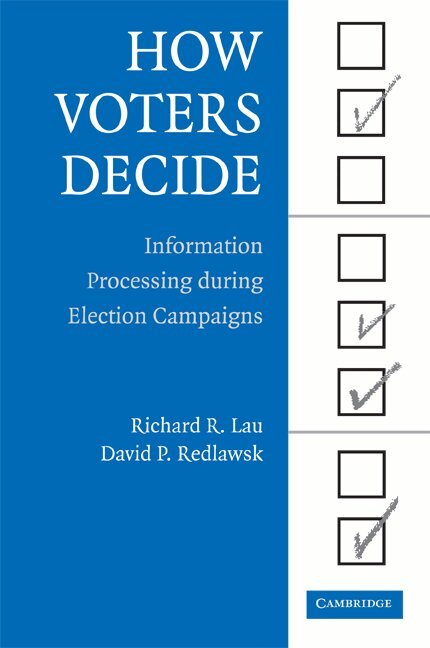
This book attempts to redirect the field of voting behavior research by proposing a paradigm-shifting framework for studying voter decision making. An innovative experimental methodology is presented for getting 'inside the heads' of citizens as they confront the overwhelming rush of information from modern presidential election campaigns. Four broad theoretically-defined types of decision strategies that voters employ to help decide which candidate to support are described and operationally-defined. Individual and campaign-related factors that lead voters to adopt one or another of these strategies are examined. Most importantly, this research proposes a new normative focus for the scientific study of voting behavior: we should care about not just which candidate received the most votes, but also how many citizens voted correctly - that is, in accordance with their own fully-informed preferences.
1 166 kr
Skickas inom 7-10 vardagar
This book attempts to redirect the field of voting behavior research by proposing a paradigm-shifting framework for studying voter decision making. An innovative experimental methodology is presented for getting 'inside the heads' of citizens as they confront the overwhelming rush of information from modern presidential election campaigns. Four broad theoretically-defined types of decision strategies that voters employ to help decide which candidate to support are described and operationally-defined. Individual and campaign-related factors that lead voters to adopt one or another of these strategies are examined. Most importantly, this research proposes a new normative focus for the scientific study of voting behavior: we should care about not just which candidate received the most votes, but also how many citizens voted correctly - that is, in accordance with their own fully-informed preferences.
619 kr
Skickas inom 5-8 vardagar
Negative campaigning is frequently denounced, but it is not well understood. Who conducts negative campaigns? Do they work? What is their effect on voter turnout and attitudes toward government? Just in time for an assessment of election 2004, two distinguished political scientists bring us a sophisticated analysis of negative campaigns for the Senate from 1992 to 2002. The results of their study are surprising and challenge conventional wisdom: negative campaigning has dominated relatively few elections over the past dozen years, there is little evidence that it has had a deleterious effect on our political system, and it is not a particularly effective campaign strategy. These analyses bring novel empirical techniques to the study of basic normative questions of democratic theory and practice.