• Fri frakt över 249 kr
  • •
  • Snabba leveranser
  • •
  • Billiga böcker
Kundservice

Du är på sajten för privatpersoner.

Företag, bibliotek eller offentlig verksamhet?

Du handlar på classic.bokus.com, där alla dina funktioner finns intakta.
Till classic.bokus.com
Bokus logotyp. Gå till startsidan.
  • Erbjudanden
  • Nyheter
  • Student
  • Topplistor
  • Barn & ungdom
  • Bokus Play
  • E-böcker
  • Pocketböcker
  • Spel & pussel

10% rabatt på allt med kod NYSTART10 →

Sidfot

Mina sidor

    Hjälp

    • Kundservice
    • Vanliga frågor och svar
    • Frakt och leverans
    • Retur vid ångerrätt
    • Reklamera vara
    • Betalning
    • Köpvillkor
    • Allmänna villkor
    • Information om webbplatsens tillgänglighet

    Om Bokus

    • Om oss
    • Pressrum
    • För studenter
    • För företag
    • För bibliotek och offentlig verksamhet
    • För leverantörer
    • Hållbarhet

    Populärt

    • Aktuella erbjudanden
    • Presentkort
    • Studentlitteratur
    • Nya böcker
    • Topplistor
    • Signerade böcker
    • Engelska böcker

    Inspiration

    • Boktips
    • BookTok
    • Populära bokserier
    • Barnbokskaraktärer
    • Populära författare
    Logotyp för Bokus
    Följ oss på Facebook (extern länk)Följ oss på Instagram (extern länk)Följ oss på YouTube (extern länk)Följ oss på TikTok (extern länk)
    bokus @ CookiesAnpassa cookiesIntegritetspolicyKöpvillkor
    Till Citymail hemsida (extern länk)Till Budbee hemsida (extern länk)Till Postnord hemsida (extern länk)Till Schenker hemsida (extern länk)Till Early Bird hemsida (extern länk)Till Walleys hemsida (extern länk)
    1. Samhälle och politik
    2. Politik och statsskick

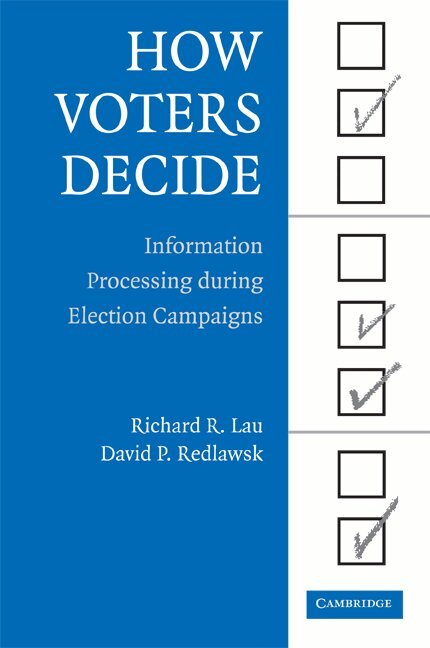
    How Voters Decide

    Information Processing in Election Campaigns

    AvRichard R. Lau,David P. Redlawsk

    Häftad, Engelska, 2006

    Del i serien Cambridge Studies in Public Opinion and Political Psychology

    443 kr

    Beställningsvara. Skickas inom 10-15 vardagar. Fri frakt över 249 kr.

    Fler format och utgåvor

    Inbunden

    1 241 kr

    Beskrivning

    This book attempts to redirect the field of voting behavior research by proposing a paradigm-shifting framework for studying voter decision making. An innovative experimental methodology is presented for getting 'inside the heads' of citizens as they confront the overwhelming rush of information from modern presidential election campaigns. Four broad theoretically-defined types of decision strategies that voters employ to help decide which candidate to support are described and operationally-defined. Individual and campaign-related factors that lead voters to adopt one or another of these strategies are examined. Most importantly, this research proposes a new normative focus for the scientific study of voting behavior: we should care about not just which candidate received the most votes, but also how many citizens voted correctly - that is, in accordance with their own fully-informed preferences.

    Produktinformation

    • Utgivningsdatum:2006-06-26
    • Mått:152 x 228 x 21 mm
    • Vikt:500 g
    • Format:Häftad
    • Språk:Engelska
    • Serie:Cambridge Studies in Public Opinion and Political Psychology
    • Antal sidor:366
    • Förlag:Cambridge University Press
    • ISBN:9780521613064

    Utforska kategorier

    • Politik och statsskick inom Samhälle och politik

    Mer om författaren

    Richard Lau is Professor of Political Science and Director of the Walt Whitman Center for the Study of Democracy in the Political Science Department at Rutgers University. His research has been supported by the National Institute of Health, the National Science Foundation, the Ford Foundation, and the Carnegie Corporation. He has published in all of the major journals in political science and social psychology, and recently wrote (with Gerald Pomper) Negative Campaigning: An Analysis of U.S. Senate Elections (2004). David P. Redlawsk is Associate Professor of Political Science at the University of Iowa. Prior to completing his Ph.D. and arriving at the University of Iowa in 1999, Redlawsk spent nearly ten years in the technology industry, managing information systems for colleges, and working as a management consultant. As a political scientist, he has published in the American Political Science Review, the American Journal of Political Science, the Journal of Politics and Political Psychology, among others. He twice received the Roberta Sigel Best Paper Award from the International Society of Political Psychology. He co-edited Hate Speech on Campus: Cases, Commentary, and Case Studies (1997) with Milton Heumann and Thomas Church, and is currently completing an edited volume on emotion in politics to be published in 2006. His research has been supported by the National Science Foundation.

    Recensioner i media

    "How Voters Decide: Information Processing during Election Campaigns is a major contribution to our understanding of voting behavior, decision making, and political psychology. Richard Lau and David Redlawsk have employed an innovative methodology to investigate the processes by which voters make sense of the enormous flow of information in a election campaign. The research is carefully designed and analyzed and the results yield insights into mechanisms of political information processing that are normally hidden from view by the standard research methods used in political science. This research shows how the strategies that people use to process information affect the electoral decisions they make and, ultimately, the extent to which elections truly represent the interests of voters." Stanley Feldman, Stony Brook University

    Innehållsförteckning

    • Part I. Theory and Methods: 1. Introduction; 2. A new theory of voter decision making; 3. Studying voting as a process; 4. What is correct voting?; Part II. Information Processing: 5. What voters do - a first cut; 6. Individual differences in information processing; 7. Campaign effects on information processing; Part III. Politics: 8. Evaluating candidates; 9. Voting; 10. Voting correctly; 11. Political heuristics; Part IV. Conclusion: 12. A look back, and a look forward; Part V. Appendices and References.