Richard W. Miller - Böcker
Visar alla böcker från författaren Richard W. Miller. Handla med fri frakt och snabb leverans.
11 produkter
11 produkter
308 kr
Kommande
Many people in modern democracies support capitalism and multi-party representative government, with civil and political liberties protected by their country's constitution. They also support political measures to improve citizens' lives and to substantially reduce the economic inequalities that capitalist enterprise would otherwise create. They support policies for taxation, government expenditure, and economic growth that favor those with lower incomes over those who are well-off. This includes preference not only for the poor, but for any citizen who lacks effective access to medical care, advanced education, and cultural enrichment. This political program is often labeled "social democracy."In The Ethics of Social Democracy Richard W. Miller offers a moral justification for the pursuit of social democracy in advanced capitalist democracies, and he addresses how people living outside of that socioeconomic context should respond to local conflicts between the economic and the political goals that ought to guide social democrats. Miller also investigates the question of what social democratic ethics requires when it comes to the treatment of foreigners by its laws and policies-and what impact the experience of foreigners has on the moral foundations and political consequences of social democracy. The Ethics of Social Democracy is an important and timely statement by one of the foremost political philosophers of his generation.
1 479 kr
Skickas inom 5-8 vardagar
Combining deep moral argument with extensive factual inquiry, Richard Miller constructs a new account of international justice. Though a critic of demanding principles of kindness toward the global poor and an advocate of special concern for compatriots, he argues for standards of responsible conduct in transnational relations that create vast unmet obligations. Governments, firms and people in developed countries, above all, the United States, by failing to live up to these responsibilities, take advantage of people in developing countries. Miller's proposed standards of responsible conduct offer answers to such questions as: What must be done to avoid exploitation in transnational manufacturing? What framework for world trade and investment would be fair? What duties do we have to limit global warming? What responsibilities to help meet basic needs arise when foreign powers steer the course of development? What obligations are created by uses of violence to sustain American global power? Globalizing Justice provides new philosophical foundations for political responsibility, a unified agenda of policies for responding to major global problems, a distinctive appraisal of 'the American empire', and realistic strategies for a global social movement that helps to move humanity toward genuine global cooperation.

485 kr
Skickas inom 5-8 vardagar
Combining deep moral argument with extensive factual inquiry, Richard Miller constructs a new account of international justice. Though a critic of demanding principles of kindness toward the global poor and an advocate of special concern for compatriots, he argues for standards of responsible conduct in transnational relations that create vast unmet obligations. Governments, firms and people in developed countries, above all, the United States, by failing to live up to these responsibilities, take advantage of people in developing countries. Miller's proposed standards of responsible conduct offer answers to such questions as: What must be done to avoid exploitation in transnational manufacturing? What framework for world trade and investment would be fair? What duties do we have to limit global warming? What responsibilities to help meet basic needs arise when foreign powers steer the course of development? What obligations are created by uses of violence to sustain American global power? Globalizing Justice provides new philosophical foundations for political responsibility, a unified agenda of policies for responding to major global problems, a distinctive appraisal of 'the American empire', and realistic strategies for a global social movement that helps to move humanity toward genuine global cooperation.

463 kr
Skickas inom 7-10 vardagar
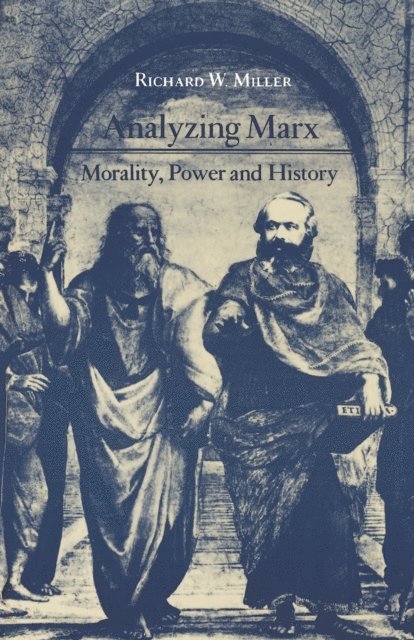
In this book Marx is revealed as a powerful contributor to the debates that now dominate philosophy and political theory. Using the techniques of analytic philosophy to unite Marx's general statements with his practice as historian and activist, Richard W. Miller derives important arguments about the rational basis of morality, the nature of power, and the logic of testing and explanation. The book also makes Marx's theory of change useful for current social science, by replacing economic determinist readings with a new interpretation in which systems of power relations are the basis of change. Part One discusses Marx's criticisms of the moral point of view as a basis for social choice. The outlook that emerges is humane but antimoral. Part Two argues that Marx's concept of the ruling class is a means, of measuring political power that is ignored yet urgently needed by present-day social science. Part Three bases Marx's theory of history on the dynamics of power, challenging both the standard, economic determinist readings of the theory and standard conceptions of science.
Fact and Method
Explanation, Confirmation and Reality in the Natural and the Social Sciences
Häftad, Engelska, 1988
872 kr
Skickas inom 7-10 vardagar
In this bold work, of broad scope and rich erudition, Richard Miller sets out to reorient the philosophy of science. By questioning both positivism and its leading critics, he develops new solutions to the most urgent problems about justification, explanation, and truth. Using a wealth of examples from both the natural and the social sciences, Fact and Method applies the new account of scientific reason to specific questions of method in virtually every field of inquiry, including biology, physics, history, sociology, anthropology, economics, psychology, and literary theory. Explicit and up-to-date analysis of leading alternative views and a wealth of examples make it an ideal introduction to the philosophy of science, as well as a powerful attempt to change the field. Like the works of Hempel, Reichenbach, and Nagel in an earlier generation, it will challenge, instruct, and help anyone with an interest in science and its limits. For the past quarter-century, the philosophy of science has been in a crisis brought on by the failure of the positivist project of resolving all basic methodological questions by applying absolutely general rules, valid for all fields at all times.Professor Miller presents a new view in which what counts as an explanation, a cause, a confirming test, or a compelling case for the existence of an unobservable is determined by frameworks of specific substantive principles, rationally adopted in the light of the actual history of inquiry. While the history of science has usually been the material for relativism, Professor Miller uses arguments of Darwin, Newton, Einstein, Galileo, and others both to undermine positivist conceptions of rationality and to support the positivists' optimism that important theoretical findings are often justifiable from all reasonable perspectives.
1 081 kr
Skickas inom 3-6 vardagar
In a wide-ranging inquiry Richard W. Miller provides new resources for coping with the most troubling types of moral conflict: disagreements in moral conviction, conflicting interests, and the tension between conscience and desires. Drawing on most fields in philosophy and the social sciences, including his previous work in the philosophy of science, he presents an account of our access to moral truth, and, within this framework, develops a theory of justice and an assessment of the role of morality in rational choice. In Miller's view, we are often in a position to claim that our moral judgments are true descriptions of moral facts. But others, relying on contrary ways of moral learning, would reject truths that we are in a position to assert, in dissent that does not depend on irrationality or ignorance of relevant evidence or arguments. With this mixed verdict on "moral realism," Miller challenges many received views of rationality, scientific method, and the relation between moral belief and moral choice.In his discussion of justice, Miller defends the adequacy, for modern political choices, of a widely shared demand that institutions be freely and rationally acceptable to all. Drawing on social research and economic theories, he argues that this demand has dramatically egalitarian consequences, even though it is a premise of liberals and conservatives alike. In the final chapters, Miller investigates the role and limits of morality in the choice of conduct, arguing for new perspectives on reason and impartiality. Originally published in 1992. The Princeton Legacy Library uses the latest print-on-demand technology to again make available previously out-of-print books from the distinguished backlist of Princeton University Press. These editions preserve the original texts of these important books while presenting them in durable paperback and hardcover editions. The goal of the Princeton Legacy Library is to vastly increase access to the rich scholarly heritage found in the thousands of books published by Princeton University Press since its founding in 1905.
2 636 kr
Skickas inom 3-6 vardagar
In a wide-ranging inquiry Richard W. Miller provides new resources for coping with the most troubling types of moral conflict: disagreements in moral conviction, conflicting interests, and the tension between conscience and desires. Drawing on most fields in philosophy and the social sciences, including his previous work in the philosophy of science, he presents an account of our access to moral truth, and, within this framework, develops a theory of justice and an assessment of the role of morality in rational choice. In Miller's view, we are often in a position to claim that our moral judgments are true descriptions of moral facts. But others, relying on contrary ways of moral learning, would reject truths that we are in a position to assert, in dissent that does not depend on irrationality or ignorance of relevant evidence or arguments. With this mixed verdict on "moral realism," Miller challenges many received views of rationality, scientific method, and the relation between moral belief and moral choice.In his discussion of justice, Miller defends the adequacy, for modern political choices, of a widely shared demand that institutions be freely and rationally acceptable to all. Drawing on social research and economic theories, he argues that this demand has dramatically egalitarian consequences, even though it is a premise of liberals and conservatives alike. In the final chapters, Miller investigates the role and limits of morality in the choice of conduct, arguing for new perspectives on reason and impartiality. Originally published in 1992. The Princeton Legacy Library uses the latest print-on-demand technology to again make available previously out-of-print books from the distinguished backlist of Princeton University Press. These editions preserve the original texts of these important books while presenting them in durable paperback and hardcover editions. The goal of the Princeton Legacy Library is to vastly increase access to the rich scholarly heritage found in the thousands of books published by Princeton University Press since its founding in 1905.
246 kr
Skickas inom 5-8 vardagar
394 kr
Skickas inom 5-8 vardagar
345 kr
Skickas inom 5-8 vardagar
God, Creation and Climate Change
A Catholic Response to the Environmental Crisis
Häftad, Engelska, 2010
250 kr
Skickas inom 3-6 vardagar