Rita Chin - Böcker
Visar alla böcker från författaren Rita Chin. Handla med fri frakt och snabb leverans.
5 produkter
5 produkter
372 kr
Skickas inom 7-10 vardagar
"After the Nazi Racial State offers a comprehensive, persuasive, and ambitious argument in favor of making 'race' a more central analytical category for the writing of post-1945 history. This is an extremely important project, and the volume indeed has the potential to reshape the field of post-1945 German history."---Frank Biess, University of California, San DiegoWhat happened to "race," race thinking, and racial distinctions in Germany, and Europe more broadly, after the demise of the Nazi racial state? This book investigates the afterlife of "race" since 1945 and challenges the long-dominant assumption among historians that it disappeared from public discourse and policy-making with the defeat of the Third Reich and its genocidal European empire. Drawing on case studies of Afro-Germans, Jews, and Turks---arguably the three most important minority communities in postwar Germany---the authors detail continuities and change across the 1945 divide and offer the beginnings of a history of race and racialization after Hitler. A final chapter moves beyond the German context to consider the postwar engagement with "race" in France, Britain, Sweden, and the Netherlands, where waves of postwar, postcolonial, and labor migration troubled nativist notions of national and European identity. After the Nazi Racial State poses interpretative questions for the historical understanding of postwar societies and democratic transformation, both in Germany and throughout Europe. It elucidates key analytical categories, historicizes current discourse, and demonstrates how contemporary debates about immigration and integration---and about just how much "difference" a democracy can accommodate---are implicated in a longer history of "race." This book explores why the concept of "race" became taboo as a tool for understanding German society after 1945. Most crucially, it suggests the social and epistemic consequences of this determined retreat from "race" for Germany and Europe as a whole.Rita Chin is Associate Professor of History at the University of Michigan. Heide Fehrenbach is Presidential Research Professor at Northern Illinois University. Geoff Eley is Karl Pohrt Distinguished University Professor of Contemporary History at the University of Michigan. Atina Grossmann is Professor of History at Cooper Union.Cover illustration: Human eye, © Stockexpert.com.
309 kr
Skickas inom 7-10 vardagar
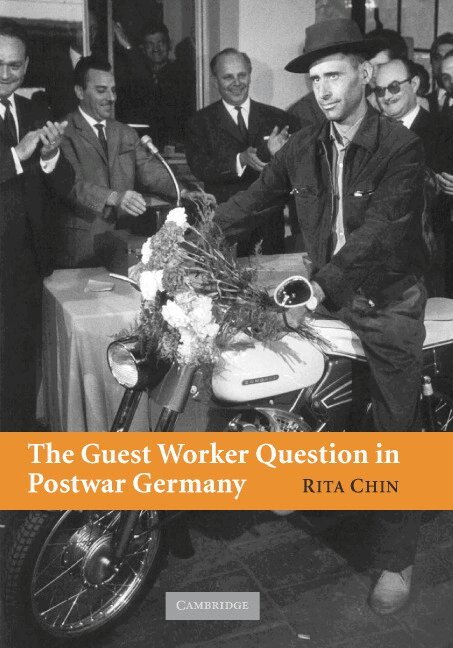
This book provides the first English-language history of the postwar labor migration to West Germany. Drawing on government bulletins, statements by political leaders, parliamentary arguments, industry newsletters, social welfare studies, press coverage, and the cultural production of immigrant artists and intellectuals, Rita Chin offers an account of West German public debate about guest workers. She traces the historical and ideological shifts around the meanings of the labor migration, moving from the concept of guest workers as a 'temporary labor supplement' in the 1950s and 1960s to early ideas about 'multiculturalism' by the end of the 1980s. She argues that the efforts to come to terms with the permanent residence of guest workers, especially Muslim Turks, forced a major rethinking of German identity, culture, and nation. What began as a policy initiative to fuel the economic miracle ultimately became a much broader discussion about the parameters of a specifically German brand of multiculturalism.
1 034 kr
Skickas inom 7-10 vardagar
This book provides the first English-language history of the postwar labor migration to West Germany. Drawing on government bulletins, statements by political leaders, parliamentary arguments, industry newsletters, social welfare studies, press coverage, and the cultural production of immigrant artists and intellectuals, Rita Chin offers an account of West German public debate about guest workers. She traces the historical and ideological shifts around the meanings of the labor migration, moving from the concept of guest workers as a 'temporary labor supplement' in the 1950s and 1960s to early ideas about 'multiculturalism' by the end of the 1980s. She argues that the efforts to come to terms with the permanent residence of guest workers, especially Muslim Turks, forced a major rethinking of German identity, culture, and nation. What began as a policy initiative to fuel the economic miracle ultimately became a much broader discussion about the parameters of a specifically German brand of multiculturalism.
400 kr
Skickas inom 7-10 vardagar
A history of modern European cultural pluralism, its current crisis, and its uncertain future In 2010, the leaders of Germany, Britain, and France each declared that multiculturalism had failed in their countries. Over the past decade, a growing consensus in Europe has voiced similar decrees. But what do these ominous proclamations, from across the political spectrum, mean? From the influx of immigrants in the 1950s to contemporary worries about refugees and terrorism, The Crisis of Multiculturalism in Europe examines the historical development of multiculturalism on the Continent. Rita Chin argues that there were few efforts to institute state-sponsored policies of multiculturalism, and those that emerged were pronounced failures virtually from their inception. She shows that today's crisis of support for cultural pluralism isn't new but actually has its roots in the 1980s. Chin looks at the touchstones of European multiculturalism, from the urgent need for laborers after World War II to the public furor over the publication of The Satanic Verses and the question of French girls wearing headscarves to school.While many Muslim immigrants had lived in Europe for decades, in the 1980s they came to be defined by their religion and the public's preoccupation with gender relations. Acceptance of sexual equality became the critical gauge of Muslims' compatibility with Western values. The convergence of left and right around the defense of such personal freedoms against a putatively illiberal Islam has threatened to undermine commitment to pluralism as a core ideal. Chin contends that renouncing the principles of diversity brings social costs, particularly for the left, and she considers how Europe might construct an effective political engagement with its varied population. Challenging the mounting opposition to a diverse society, The Crisis of Multiculturalism in Europe presents a historical investigation into one continent's troubled relationship with cultural difference.
228 kr
Skickas inom 7-10 vardagar
A history of modern European cultural pluralism, its current crisis, and its uncertain futureIn 2010, the leaders of Germany, Britain, and France each declared that multiculturalism had failed in their countries. Over the past decade, a growing consensus in Europe has voiced similar decrees. But what do these ominous proclamations, from across the political spectrum, mean? Looking at the touchstones of European multiculturalism, from the urgent need for laborers after World War II to the question of French girls wearing headscarves to school, The Crisis of Multiculturalism in Europe examines the historical development of multiculturalism on the Continent. Rita Chin argues that there were few efforts to institute state-sponsored policies of multiculturalism, and shows that today’s crisis of support for cultural pluralism isn’t new but actually has its roots in the 1980s. Contending that renouncing the principles of diversity brings social costs, Chin considers how Europe might construct an effective political engagement with its varied population.