Rob Bryer – författare
Visar alla böcker från författaren Rob Bryer. Handla med fri frakt och snabb leverans.
2 produkter
2 produkter
Del 1 - Frontiers Of Accounting And Financial History
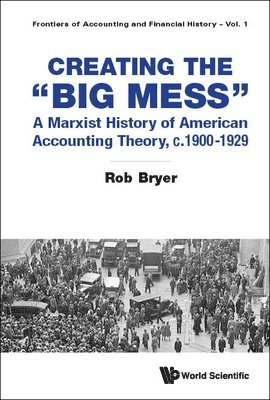
Creating The "Big Mess": A Marxist History Of American Accounting Theory, C.1900-1929
Inbunden, Engelska, 2021
2 089 kr
Skickas inom 3-6 vardagar
Creating the "Big Mess" and its sequel Accounting for Crises use Marx's theory of capitalism to explain why there is no generally accepted theory of financial accounting, and explore the consequences, by studying the history of American accounting theory from c.1900 to 2007. The answer, Creating the "Big Mess", is first that while late-19th century British accounting principles, founded on the going-concern concept, provided an objective basis for holding management accountable to shareholders for its stewardship of capital, and were accepted by the nascent American profession, they are inchoate. Second, Irving Fisher's economic theory of accounting, based on the assertion that present value is the accountants' measurement ideal, which is subjective, framed early-20th century American accounting theory, which undermined British principles, making them incoherent. In an unregulated, pro-business environment, leading theorists, particularly Henry Rand Hatfield and William A. Paton, Jr., became authorities for management discretion, creating the "big mess" Hatfield saw in late-1920s American accounting. Accounting for Crises examines the roles of Fisher's theory in promoting the speculation leading to the 1929 Great Crash, aggravating the Great Depression, hindering accounting regulation from the 1930s, producing the Financial Accounting Standard Board's conceptual framework, and facilitating the 2007-2008 Global Financial Crisis.
Del 2 - Frontiers Of Accounting And Financial History
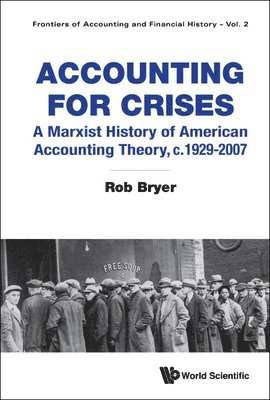
Accounting For Crises: A Marxist History Of American Accounting Theory, C.1929-2007
Inbunden, Engelska, 2023
2 160 kr
Skickas inom 3-6 vardagar
Historians have not convincingly explained modern capitalism's two major economic crises, the Great Depression of the 1930s, and the Global Financial Crisis (GFC) of 2008-2009. Accounting for Crises offers a new explanation, why both began and were more severe in the USA ("America"), based on an accounting interpretation of Marx's theory of crises. It explains their origins in capitalists' control of accumulation, which reveals important overlooked roles for Irving Fisher's accounting theory. This theory, by allowing discretion in accounts, in the context of falling rates of profit, encouraged "swindling", overstating reported profits, and understating their risk, which facilitated and aggravated both crises. Framed by Fisher's theory, during the 1920s American accounting theorists justified discretion, which Creating the "Big Mess" (the companion volume) concluded it management used to conservatively smooth earnings. Accounting for Crises shows that Fisher's theory , also underlays the popular new theory of investment that justified valuing shares using reported earnings, which encouraged their manipulation and legitimized "speculation". This, it argues, underlays America's exceptional late-1920s stock market boom, the 1929 Great Crash, and the depth and length of its Great Depression. Prominently associated with the boom, Fisher became unpopular after the crash, his name disappearing from public debate. Nevertheless, the book concludes, his theory hindered economic recovery, weakened 1930s reforms, undermined accounting regulation from the late-1930s, and following his rehabilitation from the late-1950s, underlies the Financial Accounting Standards Board's conceptual framework, which by allowing off-balance-sheet accounting for securitization-SPEs, fostered the 2007 "credit crunch" that triggered the 2008-2009 Global Financial Crisis (GFC).