Robert B. Cunningham - Böcker
Visar alla böcker från författaren Robert B. Cunningham. Handla med fri frakt och snabb leverans.
4 produkter
4 produkter
833 kr
Skickas inom 10-15 vardagar
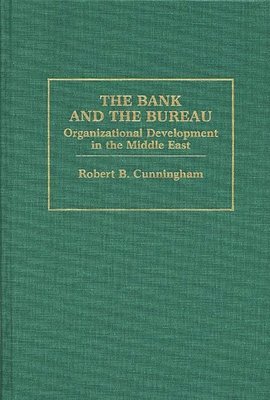
This landmark case study presents the first full-fledged examination of work organizations in Arab society. The author has chosen two organizations for study--a commercial bank and a tax bureau--focusing on organizational characteristics, employee attitudes, employee behaviors, similarities and discontinuities in societal values, and cultural context. His analysis vividly demonstrates that the values and behaviors displayed in work environments have implications for societal values, organization theory, and development theory.Divided into three sections, the book first offers a detailed picture of each organization within its cultural setting. The study also compares and contrasts the two organizations, paying particular attention to their structures. Successive chapters explore how each organization reflects or deviates from the wider cultural context in which it operates, and assess each in terms of a life cycle theory of organizational evolution. Concluding chapters utilize theories of change and economic development to help explicate each organization's particular dynamics and pattern of evolution.
1 343 kr
Skickas inom 10-15 vardagar
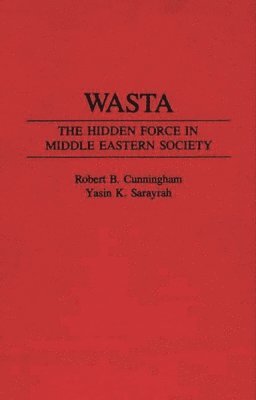
Wasta or mediation by a third party is traditional practice in most transactions in Middle Eastern societies. Senior members of the extended family intercede on behalf of younger or less privileged members in making arrangements for employment, overseas travel, business partnerships, university admissions, bank loans, marriages, and most other out-of-the-ordinary forms of negotiation. This book describes wasta's tribal foundation, its evolution in developing bureaucracies, and its present-day practice. The authors use Jordan as an example to illustrate the challenges of doing business with public organizations in Arab countries, where kinship, ethnicity, religion, locale, and class render some individuals more privileged than others.Some wasta practices are legal and moral within a cultural context, resembling the services provided by attorneys, real estate brokers, and accountants in the West. Other wasta acts are illegal or questionable, but are mandated by family members in a traditional web of inter-connecting obligations. After describing wasta, the authors show how it functions to allocate scarce resources and obtain peace and justice in a desert environment. They then show how it has changed to adapt to modern governmental and bureaucratic situations in which special skills are required to deal with new and complicated rules and procedures. Settings where wasta may be observed in action are described in detail, such as the customs office, the university, government ministries, and local businesses. Personal profiles and family situations lend color to the sociological and political analyses of wasta as it is shown in both its empowering and restrictive aspects. To summarize the impact of wasta, the authors use common theory to explain why persons turn public resources to private benefit, spreading the costs over the entire community and supporting the view that wasta can have a negative effect on economic development. The authors present a solution by suggesting that wastas themselves be enlisted in alleviating the social ills created by overdependence on the wasta system, and that past Arab and Islamic traditions should be explored for answers to modern problems.
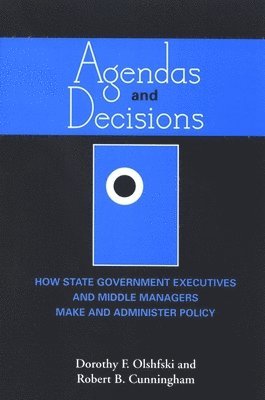
Agendas and Decisions
How State Government Executives and Middle Managers Make and Administer Policy
Inbunden, Engelska, 2008
1 057 kr
Tillfälligt slut
Studies how state-level public executives and managers in Tennessee decide and implement policy.Connecting theory and practice, Agendas and Decisions explores how state-level public executives and managers decide and implement policy. The authors focus on Tennessee Governor Lamar Alexander's (1979–1987) management system, which believed in and practiced the principles espoused by leadership theorists: focus on one or two important substantive problems or initiatives, work with stakeholders to protect the organization and to obtain necessary resources, hire good people, and authorize them to act. In addition to sending his cabinet members to the Kennedy School of Government to learn leadership principles, he also established the Tennessee Government Executive Institute (TGEI) to provide a similar program for mid-level executives. Authors Dorothy F. Olshfski and Robert B. Cunningham managed the TGEI during its first five years and had unprecedented access to state-level public executives and managers. Here, they explain the everyday workings of state-level bureaucracy within the context of a simple decision model and share managers' and executives' own stories. Their research questions several aspects of the current orthodoxy on decision-making processes, offers new thinking about executive leadership in implementation and evaluation, and compares executive and middle-manager thinking and behavior.
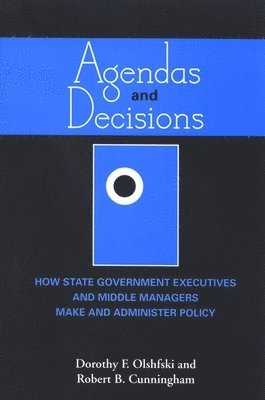
Agendas and Decisions
How State Government Executives and Middle Managers Make and Administer Policy
Häftad, Engelska, 2009
376 kr
Tillfälligt slut
Studies how state-level public executives and managers in Tennessee decide and implement policy.Connecting theory and practice, Agendas and Decisions explores how state-level public executives and managers decide and implement policy. The authors focus on Tennessee Governor Lamar Alexander's (1979–1987) management system, which believed in and practiced the principles espoused by leadership theorists: focus on one or two important substantive problems or initiatives, work with stakeholders to protect the organization and to obtain necessary resources, hire good people, and authorize them to act. In addition to sending his cabinet members to the Kennedy School of Government to learn leadership principles, he also established the Tennessee Government Executive Institute (TGEI) to provide a similar program for mid-level executives. Authors Dorothy F. Olshfski and Robert B. Cunningham managed the TGEI during its first five years and had unprecedented access to state-level public executives and managers. Here, they explain the everyday workings of state-level bureaucracy within the context of a simple decision model and share managers' and executives' own stories. Their research questions several aspects of the current orthodoxy on decision-making processes, offers new thinking about executive leadership in implementation and evaluation, and compares executive and middle-manager thinking and behavior.