Robert B. Gordon – författare
Visar alla böcker från författaren Robert B. Gordon. Handla med fri frakt och snabb leverans.
7 produkter
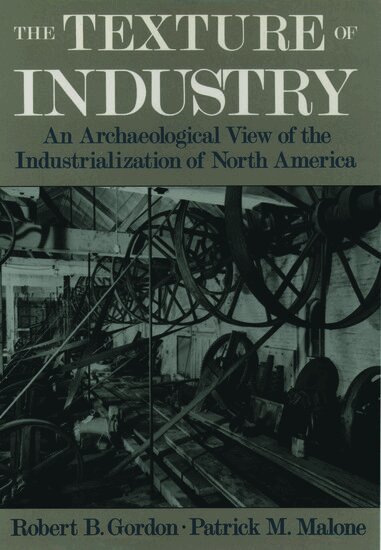
The Texture of Industry
An Archaeological View of the Industrialization of North America
Av Robert B. Gordon, Patrick M. Malone
Häftad, 1997
1190 kr
Lägg i varukorg
While historians have given ample attention to stories of entrepreneurship, invention, and labor conflict, they have told us little about actual work-places and how people worked. Workers seldom wrote about their daily employment. However, they did leave behind their tools, products, shops, and …
A Landscape Transformed
The Ironmaking District of Salisbury, Connecticut
Inbunden, 2000
2705 kr
Lägg i varukorg
This book examines the industrial ecology of 200 years of ironmaking with renewal energy resources in northwestern Connecticut. It focuses on the cultural context of people's decisions about technology and the environment, and the gradual transition they effected in their land from industrial …
Landscape Transformed
The Ironmaking District of Salisbury, Connecticut
E-bok, 2000
1699 kr
Lägg i varukorg
This book examines the industrial ecology of 200 years of ironmaking with renewal energy resources in northwestern Connecticut. It focuses on the cultural context of people''s decisions about technology and the environment, and the gradual transition they effected in their land from industrial …
Texture of Industry
An Archaeological View of the Industrialization of North America
Av Patrick M. Malone, Robert B. Gordon
E-bok, 1997
680 kr
Lägg i varukorg
While historians have given ample attention to stories of entrepreneurship, invention, and labor conflict, they have told us little about actual work-places and how people worked. Workers seldom wrote about their daily employment. However, they did leave behind their tools, products, shops, and …
Toward a New Iron Age?
Quantitative Modeling of Resource Exhaustion
Av Robert B. Gordon, Tjalling C. Koopmans m. fl.
Inbunden, 1987
474 kr
Lägg i varukorg
Experts agree that the earth will eventually run out of certain low-cost, nonrenewable resources, possibly as early as a century from now. Will the transition to reliance on other, more abundant resources be smooth or discontinuous? Might industrial societies experience a marked decline in living …
American Iron, 1607-1900
Häftad, 2020
636 kr
Lägg i varukorg
Winner of the Professional and Scholarly Publishing Award for General Engineering from the Association of American PublishersOriginally published in 1996. By applying their abundant natural resources to ironmaking early in the eighteenth century, Americans soon made themselves felt in world …
Global Cause Marketing: Future-Proof Your Brand
Av Robert B. Gordon, Peter L. Hirsch
Häftad
201 kr
Lägg i varukorg