Robert C. Post - Böcker
Visar alla böcker från författaren Robert C. Post. Handla med fri frakt och snabb leverans.
14 produkter
14 produkter
232 kr
Tillfälligt slut
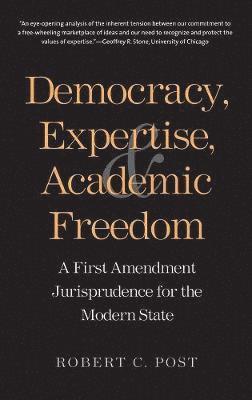
Democracy, Expertise, and Academic Freedom: A First Amendment Jurisprudence for the Modern State
Häftad, Engelska
270 kr
Tillfälligt slut
568 kr
Skickas inom 10-15 vardagar
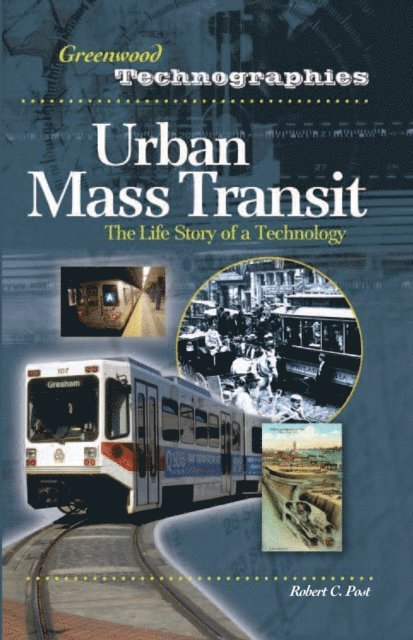
This volume in the Greenwood Technographies series covers urban mass transit - that is, the technologies that allow cities to move large numbers of people around. Just a few hundred years ago, the size of cities was limited by the time it took people to move from one part of the city to another. The development of successive technologies has forever altered the urban landscape. From horse-drawn omnibuses to subways to current light-rail, this volume highlights the technological and social struggles that have accompanied urbanization and the need for an efficient and cost-effective means of transportation in cities.The volume includes a timeline, a glossary, and a bibliography of resources useful for further research.
730 kr
Skickas inom 7-10 vardagar
In a series of remarkable forays, Robert Post develops an original account of how law functions in a democratic society. His work offers a radically new perspective on some of the most pressing constitutional issues of our day, such as the regulation of racist speech, pornography, and privacy.Drawing on work in sociology, philosophy, and political theory, Post demonstrates that the law establishes distinct and competing forms of social order: democracy, in which the law embodies the possibilities of collective self-determination; community, in which the law articulates and enforces a common social identity; and management, in which the law creates the conditions for accomplishing specific goals. Debates over the boundaries between these distinct domains, Post argues, are central to some of the most intractable problems of modern constitutional law. Here we see, for instance, how the controversy over the regulation of racist speech negotiates the boundary between communitarian and democratic forms of social ordering. We see how public forum doctrine, a crucial but notoriously mysterious component of First Amendment jurisprudence, arbitrates distinctions between the social domains of democracy and management. Taking up specific court cases, such as that against Hustler magazine and that allowing prayers before state legislatures, Post shows us what is actually at stake in these constitutional struggles.A highly complex and sophisticated account of the operation of constitutional law in modern society, Constitutional Domains is essential reading for lawyers, social theorists, and makers of public policy.
Del 8 - Tanner Lectures on Human Values
Citizens Divided
Campaign Finance Reform and the Constitution
Häftad, Engelska, 2016
274 kr
Skickas inom 10-15 vardagar
The Supreme Court’s 5–4 decision in Citizens United v. Federal Election Commission, which struck down a federal prohibition on independent corporate campaign expenditures, is one of the most controversial opinions in recent memory. Defenders of the First Amendment greeted the ruling with enthusiasm, while advocates of electoral reform recoiled in disbelief. Robert C. Post offers a new constitutional theory that seeks to reconcile these sharply divided camps.Post interprets constitutional conflict over campaign finance reform as an argument between those who believe self-government requires democratic participation in the formation of public opinion and those who believe that self-government requires a functioning system of representation. The former emphasize the value of free speech, while the latter emphasize the integrity of the electoral process. Each position has deep roots in American constitutional history. Post argues that both positions aim to nurture self-government, which in contemporary life can flourish only if elections are structured to create public confidence that elected officials are attentive to public opinion. Post spells out the many implications of this simple but profound insight. Critiquing the First Amendment reasoning of the Court in Citizens United, he also shows that the Court did not clearly grasp the constitutional dimensions of corporate speech.Blending history, constitutional law, and political theory, Citizens Divided explains how a Supreme Court case of far-reaching consequence might have been decided differently, in a manner that would have preserved both First Amendment rights and electoral integrity.
463 kr
Skickas inom 7-10 vardagar
Civil Society and Government brings together an unprecedented array of political, ethical, and religious perspectives to shed light on the complex and much-debated relationship between civil society and the state. Some argue that civil society is a bulwark against government; others see it as an indispensable support for government. Civil society has been portrayed both as a independent of the state and as dependent upon it. This book reveals the extraordinary diversity of views on the subject by examining how civil society has been treated in classical liberalism, liberal egalitarianism, critical theory, feminism, natural law, Christianity, Judaism, Islam, and Confucianism. The volume draws on the work of eminent scholars to address six questions: In terms of function and consequences, does it matter where the line is drawn between civil society and the state? What is the relationship of civil society to the state? In what contexts and under what conditions should government interact with individuals directly or instead indirectly through communal associations? What are the prerogatives and duties of citizenship, and what is the role of civil society in forming good citizens?How should a society handle the conflicts that sometimes arise between the demands of citizenship and those of membership in the non-governmental associations of civil society? A theoretical introduction by the editors--political theorist Nancy Rosenblum and legal scholar Robert Post--and a conclusion by religious ethicist Richard Miller, tie the book together. In addition to Rosenblum, the contributors are Kenneth Baynes, David Biale, John Coleman, Farhad Kazemi, John Kelsay, William Galston, Will Kymlicka, Tom Palmer, Fred Miller, Susan Moller Okin, Peter Nosco, Henry Rosemont, Steven Scalet, David Schmidtz, William Sullivan, Max Stackhouse, Stephen White, and Noam Zohar.
302 kr
Tillfälligt slut
Technological choices depend on, and are part of, contests over political power, as the history of mass transit vividly illustrates. From horse-drawn omnibuses to subways to light rail, this volume highlights the technological and social struggles that have accompanied urbanization and the need for an efficient and cost-effective means of transportation in cities. Post depicts mass transit as a technology-rather, as a technological system-that provided an essential complement to industrialization, urbanization, and, ultimately, to the rise of consumer culture. He begins his narrative with the omnibus and horsecar in the 1830s and takes it to the renaissance of urban mass transit at the turn of the 21st century. Post focuses on innovations in the United States as well as worldwide developments. At the heart of the story is the streetcar, a conveyance that played a central role in the development of all U.S. cities and towns. For generations of Americans, streetcars were essential to everyday life. Once dominating the urban landscape in towns and cities throughout the United States, the streetcar has all but disappeared.Post traces its evolution and demise, debunking the urban myth that the downfall of the electric streetcar was directly attributable to the corporate malfeasance of General Motors and others from the automotive world. Post concludes with a meditation on the prospects for mass transit in a postmodern society that must face up to the contradictions of privatized mobility and the reality of dwindling natural resources.
1 369 kr
Skickas inom 5-8 vardagar
The aura of passivity that has for centuries surrounded female sexuality in popular culture, psychology, and literature has, in recent years, dissipated. And yet fetishism, one of the most intriguing and mysterious forms of sexual expression, is still cast as an almost exclusively male domain. Most psychoanalytic thought, for instance, excludes the very possibility of female fetishism. The first book on the subject, Female Fetishism engagingly documents women's involvement in this form of sexuality. Lorraine Gamman and Merja Makinen describe a wide array of female fetishisms, from the obsessional behavior of pop fans (and pop performers such as Madonna) to fetishism in advertising to women's involvement in the world of dress clubs and fetish magazines. The authors provide provocative evidence of food fetishism among women, arguing that many eating disorders are best understood from this perspective. A latter portion of the book includes a discussion of how feminists have treated the political and cultural significance of female fetishism.
455 kr
Skickas inom 5-8 vardagar
The aura of passivity that has for centuries surrounded female sexuality in popular culture, psychology, and literature has, in recent years, dissipated. And yet fetishism, one of the most intriguing and mysterious forms of sexual expression, is still cast as an almost exclusively male domain. Most psychoanalytic thought, for instance, excludes the very possibility of female fetishism. The first book on the subject, Female Fetishism engagingly documents women's involvement in this form of sexuality. Lorraine Gamman and Merja Makinen describe a wide array of female fetishisms, from the obsessional behavior of pop fans (and pop performers such as Madonna) to fetishism in advertising to women's involvement in the world of dress clubs and fetish magazines. The authors provide provocative evidence of food fetishism among women, arguing that many eating disorders are best understood from this perspective. A latter portion of the book includes a discussion of how feminists have treated the political and cultural significance of female fetishism.
449 kr
Skickas inom 3-6 vardagar
In Prejudicial Appearances noted legal scholar Robert C. Post argues modern American antidiscrimination law should not be conceived as protecting the transcendental dignity of individual persons but instead as transforming social practices that define and sustain potentially oppressive categories like race or gender. Arguing that the prevailing logic of American antidiscrimination law is misleading, Post lobbies for deploying sociological understandings to reevaluate the antidiscrimination project in ways that would render the law more effective and just.Four distinguished commentators respond to Post’s provocative essay. Each adopts a distinctive perspective. K. Anthony Appiah investigates the philosophical logic of stereotyping and of equality. Questioning whether the law ought to endorse any social practices that define persons, Judith Butler explores the tension between sociological and postmodern approaches to antidiscrimination law. Thomas C. Grey examines whether Post’s proposal can be reconciled with the values of the rule of law. And Reva B. Siegel applies critical race theory to query whether antidiscrimination law’s reshaping of race and gender should best be understood in terms of practices of subordination and stratification.By illuminating the consequential rhetorical maneuvers at the heart of contemporary U.S. antidiscrimination law, Prejudical Appearances forces readers to reappraise the relationship between courts of law and social behavior. As such, it will enrich scholars interested in the relationships between law, rhetoric, postmodernism, race, and gender.
4 622 kr
Tillfälligt slut
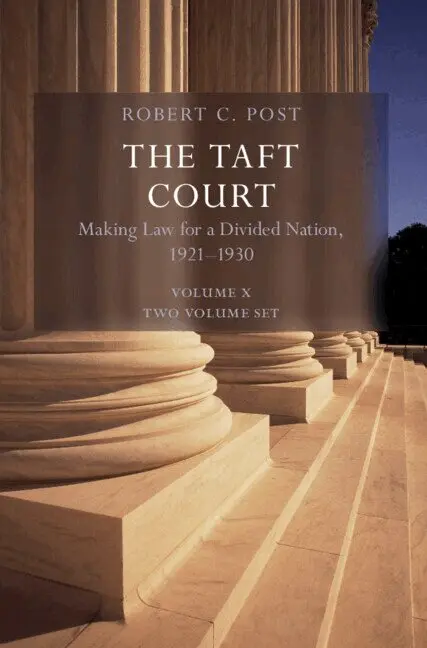
The Taft Court offers the definitive history of the Supreme Court from 1921 to 1930 when William Howard Taft was Chief Justice. Using untapped archival material, Robert C. Post engagingly recounts the ambivalent effort to create a modern American administrative state out of the institutional innovations of World War I. He shows how the Court sought to establish authoritative forms of constitutional interpretation despite the culture wars that enveloped prohibition and pervasive labor unrest. He explores in great detail how constitutional law responds to altered circumstances. The work provides comprehensive portraits of seminal figures such as Oliver Wendell Holmes Jr. and Louis Dembitz Brandeis. It describes William Howard Taft's many judicial reforms and his profound alteration of the role of Chief Justice. A critical and timely contribution, The Taft Court sheds light on jurisprudential debates that are just as relevant today as they were a century ago.
1 072 kr
Tillfälligt slut
The Taft Court offers the definitive history of the Supreme Court from 1921 to 1930 when William Howard Taft was Chief Justice. Using untapped archival material, Robert C. Post engagingly recounts the ambivalent effort to create a modern American administrative state out of the institutional innovations of World War I. He shows how the Court sought to establish authoritative forms of constitutional interpretation despite the culture wars that enveloped prohibition and pervasive labor unrest. He explores in great detail how constitutional law responds to altered circumstances. The work provides comprehensive portraits of seminal figures such as Oliver Wendell Holmes Jr. and Louis Dembitz Brandeis. It describes William Howard Taft's many judicial reforms and his profound alteration of the role of Chief Justice. A critical and timely contribution, The Taft Court sheds light on jurisprudential debates that are just as relevant today as they were a century ago.
358 kr
Skickas inom 7-10 vardagar
In 1994, when the National Air and Space Museum announced plans to display the Enola Gay, the B-29 sent to destroy Hiroshima with an atomic bomb, the ensuing political uproar caught the museum's parent Smithsonian Institution entirely unprepared. As the largest such complex in the world, the Smithsonian cares for millions of objects and has displayed everything from George Washington's sword to moon rocks to Dorothy's ruby slippers from The Wizard of Oz. Why did this particular object arouse such controversy? From an insider's perspective, Robert C. Post's Who Owns America's Past? offers insight into the politics of display and the interpretation of history. Never before has a book about the Smithsonian detailed the recent and dramatic shift from collection-driven shows, with artifacts meant to speak for themselves, to concept-driven exhibitions, in which objects aim to tell a story, displayed like illustrations in a book. Even more recently, the trend is to show artifacts along with props, sound effects, and interactive elements in order to create an immersive environment. Rather than looking at history, visitors are invited to experience it. Who Owns America's Past? examines the different ways that the Smithsonian's exhibitions have been conceived and designed-whether to educate visitors, celebrate an important historical moment, or satisfy donor demands or partisan agendas.Combining information from hitherto-untapped archival sources, extensive interviews, a thorough review of the secondary literature, and considerable personal experience, Post gives the reader a behind-the-scenes view of disputes among curators, academics, and stakeholders that were sometimes private and at other times burst into headline news.
309 kr
Skickas inom 7-10 vardagar
In 1994, when the National Air and Space Museum announced plans to display the Enola Gay, the B-29 sent to destroy Hiroshima with an atomic bomb, the ensuing political uproar caught the museum's parent Smithsonian Institution entirely unprepared. As the largest such complex in the world, the Smithsonian cares for millions of objects and has displayed everything from George Washington's sword to moon rocks to Dorothy's ruby slippers from The Wizard of Oz. Why did this particular object arouse such controversy? From an insider's perspective, Robert C. Post's Who Owns America's Past? offers insight into the politics of display and the interpretation of history. Never before has a book about the Smithsonian detailed the recent and dramatic shift from collection-driven shows, with artifacts meant to speak for themselves, to concept-driven exhibitions, in which objects aim to tell a story, displayed like illustrations in a book. Even more recently, the trend is to show artifacts along with props, sound effects, and interactive elements in order to create an immersive environment. Rather than looking at history, visitors are invited to experience it. Who Owns America's Past? examines the different ways that the Smithsonian's exhibitions have been conceived and designed-whether to educate visitors, celebrate an important historical moment, or satisfy donor demands or partisan agendas.Combining information from hitherto-untapped archival sources, extensive interviews, a thorough review of the secondary literature, and considerable personal experience, Post gives the reader a behind-the-scenes view of disputes among curators, academics, and stakeholders that were sometimes private and at other times burst into headline news.