Robert E. Newnham - Böcker
Visar alla böcker från författaren Robert E. Newnham. Handla med fri frakt och snabb leverans.
4 produkter
4 produkter
3 066 kr
Skickas inom 7-10 vardagar
Crystals are sometimes called 'Flowers of the Mineral Kingdom'. In addition to their great beauty, crystals and other textured materials are enormously useful in electronics, optics, acoustics and many other engineering applications. This richly illustrated text describes the underlying principles of crystal physics and chemistry, covering a wide range of topics and illustrating numerous applications in many fields of engineering using the most important materials today. Tensors, matrices, symmetry and structure-property relationships form the main subjects of the book. While tensors and matrices provide the mathematical framework for understanding anisotropy, on which the physical and chemical properties of crystals and textured materials often depend, atomistic arguments are also needed to quantify the property coefficients in various directions. The atomistic arguments are partly based on symmetry and partly on the basic physics and chemistry of materials. Afterintroducing the point groups appropriate for single crystals, textured materials and ordered magnetic structures, the directional properties of many different materials are described: linear and nonlinear elasticity, piezoelectricity and electrostriction, magnetic phenomena, diffusion and other transport properties, and both primary and secondary ferroic behavior. With crystal optics (its roots in classical mineralogy) having become an important component of the information age, nonlinear optics is described along with the piexo-optics, magneto-optics, and analogous linear and nonlinear acoustic wave phenomena. Enantiomorphism, optical activity, and chemical anisotropy are discussed in the final chapters of the book.
974 kr
Skickas inom 7-10 vardagar
Crystals are sometimes called 'Flowers of the Mineral Kingdom'. In addition to their great beauty, crystals and other textured materials are enormously useful in electronics, optics, acoustics, and many other engineering applications. This book describes the underlying principles of crystal physics and chemistry, covering a wide range of topics, and illustrating numerous applications in many fields of engineering using the most important materials. It has been written at a level suitable for science and engineering students and can be used for teaching a one- or two-semester course. Tensors, matrices, symmetry and structure-property relationships form the main subjects of the book. Whilst tensors and matrices provide the mathematical framework for understanding anisotropy, on which the physical and chemical properties of crystals and textured materials often depend, atomistic arguments are also needed to quantify the property coefficients in various directions. The atomistic arguments are partly based on symmetry and partly on the basic physics and chemistry of materials.After introducing the point groups appropriate for single crystals, textured materials and ordered magnetic structures, the directional properties of many different materials are described: linear and nonlinear elasticity, piezoelectricity and electrostriction, magnetic phenomena, diffusion and other transport properties, and both primary and secondary ferroic behaviour. With crystal optics (its roots in classical mineralogy) having become an important component of the information age, nonlinear optics is described along with the piezo-optics, magneto-optics and electro-optics, and analogous linear and nonlinear acoustic wave phenomena. Enantiomorphism, optical activity, and chemical anisotropy are discussed in the final chapters of the book.
Materials Engineering
Bonding, Structure, and Structure-Property Relationships
Inbunden, Engelska, 2017
1 084 kr
Skickas inom 7-10 vardagar
Designed for both one- and two-semester courses, this textbook provides a succinct and easy-to-read introduction to crystal structures and structure-property relations. By linking together the fundamentals of bond strength and the arrangement of atoms in space with the mechanical, optical, magnetic and electrical properties that they control, students will gain an intuitive understanding of how different materials are suited to particular applications. The systematics of crystal structures are described for both organic and inorganic materials, with coverage including small molecular crystals, polymers, metals, ceramics and semiconductors. Hundreds of figures and practice problems help students gain an advanced, 3D understanding of how structure governs behavior, and a wealth of examples throughout show how the underlying theory is translated into practical devices. With solutions, video lectures and overheads available online for instructors, this is an excellent resource for graduates and senior undergraduates studying materials science and engineering.
534 kr
Skickas inom 10-15 vardagar
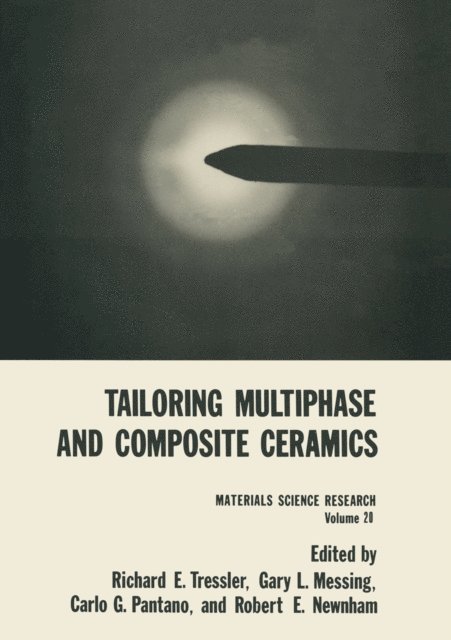
The proceedings of the Twenty-First University Conference on Ceramic Science held at The Pennsylvania State University, University Park, PA on July 17, 18 and 19, 1985 are compiled in this volume "Tailoring Multiphase and Composite Ceramics". This Conference emphasized the' discussion and analysis of the properties of multiphase ceramic materials in which the microstructure is deliberately tailored for specific applications or properties. Inter nationally recognized authorities presented keynote and invited lectures on topics dealing with processing and fabrication of multiphase and com posite electroceramics, fiber reinforced composites and high temperature multiphase ceramics. Results of recent research were presented in oral and poster sessions by leading researchers from several countries. This collection of papers represents the state of the art in our understand ing of the processing-structure-property interrelationships for these materials which possess unique and useful electrical, magnetic, optical, mechanical and thermal properties as a result of their multiphase nature. We are grateful for the financial support of the National Science Foundation, the Office of Naval Research, the Air Force Office of Scien tific Research, and the Defense Advanced Research Projects Agency for this conference. We gratefully acknowledge Prof. Robert Davis' leader ship role in steering and expanding this university conference series on ceramic science. We thank Ron Avillion and Linda Rose for their expert assistance in planning and coordinating the meeting. Thanks are due to Ms. Marian Reed, Ms. Judy Bell and Ms.