Robert F. Durden - Böcker
Visar alla böcker från författaren Robert F. Durden. Handla med fri frakt och snabb leverans.
5 produkter
5 produkter
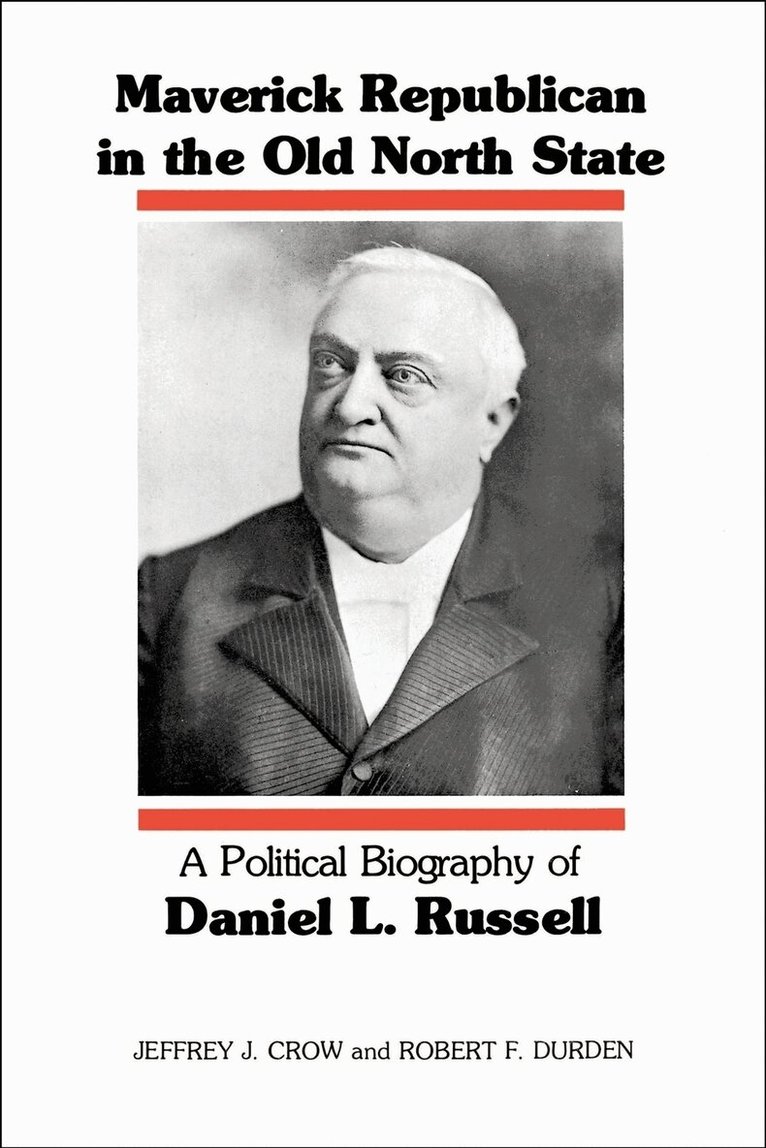
Maverick Republican in the Old North State
A Political Biography of Daniel L. Russell
Häftad, Engelska, 1999
276 kr
Skickas inom 10-15 vardagar
Daniel Russell is a good example of what Carl Degler has termed ""the other South."" The son of an aristocratic eastern North Carolina family of staunch Whig-Unionists, he entered politics when the Republican party first appeared in the state after the Civil War. For more than forty years thereafter he fought the solid South mentality of the Bourbon Democrats, first as a Radical Republican judge, then as a Greenbacker congressman, and finally as a Republican governor with Populist sympathies-the only chief executive of his party that North Carolina had between Reconstruction and the 1970s.The basic themes of Russell's political life were racial and economic in nature. As a judge on the state superior court he ruled in the Wilmington opera house case of 1873 that blacks could not be denied accommodations on the account of their race. As a congressman he embraced the cause of currency reform and the regulation of corporate enterprise. Elected governor in 1896 by an uneasy coalition of Populists and Republicans, an alliance that Crow and Durden fully examine, he pushed reforms designed to bring nonresident corporations under stricter state supervision and challenged the ninety-nine-year lease of the state-owned North Carolina Railroad to J.P. Morgan's Southern Railway Company. The Democrats' triumphant white-supremacy campaigns of 1898 and 1900 and the resulting disfranchisement of black voters, however, crushed these progressive initiatives, and afterward the complex and sometimes irascible Russell kept a low profile until his tern ended in 1901. His final years were taken up by a famous interstate lawsuit that he initiated to force North Carolina to pay certain Reconstruction debts it had repudiated.The reasons for Russell's political failure while southern Progressives of the period generally succeeded shed much new light on the reform movement in the South between 1890 and 1910. Although the reforms that he took up were no more radical than those called for by his contemporaries, Crow and Durden find in this first full account of his career that ""in the last analysis, Russell's unique blend of Old South paternalism toward blacks with New South radicalism concerning currency and railway reform challenged too many taboos of race, class, and party.
369 kr
Skickas inom 3-6 vardagar
Rarely has a third political party in the United States exerted a force upon national events comparable to that of the Populists during the 1890s. This force reached its climax in the presidential race of 1896, when the national reforms epitomized in the cry for free silver were at issue. Yet despite a number of recent studies, confusion and error regarding the Populists in the crucial election of 1896 still persist.Robert F. Durden, by extensive use of the papers of Marion Butler, Populist senator from North Carolina and national chairman of the party during the campaign, sheds new light upon many points -- the conduct of the St. Louis convention, the role of Tom Watson, and the fusion strategy. Durden's work is not only valuable for its clarification of the Populist campaign, but also for the example it offers of the practical working of American politics with the baffling balances among regions and groups.
297 kr
Skickas inom 3-6 vardagar
The essentially tragic political fate of the American South in the nineteenth century resulted from what Robert F. Durden calls a "self-inflicted wound" -- the gradual surrender of the white majority to the pride, fears, and hates of racism. In this gracefully written and closely reasoned study, Durden traces the course of southern political life from the predominantly optimistic, nationalistic Jeffersonian era to the sullenly sectional, chronically defensive decades following the Civil War.Politics, as the clearest reflection of the southern electorate's collective hopes and fears, illustrates the South's transition from buoyant nationalism to aggrieved sectionalism. Like the rest of the new nation, the South entered the nineteenth century as proud heirs of the American Revolution and its ideology of liberty, property, and equal rights. But for southerners, from the 1820s on, that liberty came increasingly to mean the freedom to own slave property and to take that property into the nation's new western territories.As the possibility of a ban on slavery in the territories rose to the center of national attention during and after the Mexican War, the South's views on the "peculiar institution" became increasingly defensive and intransigent. The presidential victory in 1860 of an all-northern party pledged to the exclusion of slavery from the territories made the Civil War inevitable. In its aftermath, white southerners sought and ultimately found, in the hegemony of the Democratic party, other ways to maintain their national position and their dominance over the black minority. But the South would long suffer the aftereffects of its "self-inflicted wound."
373 kr
Skickas inom 7-10 vardagar
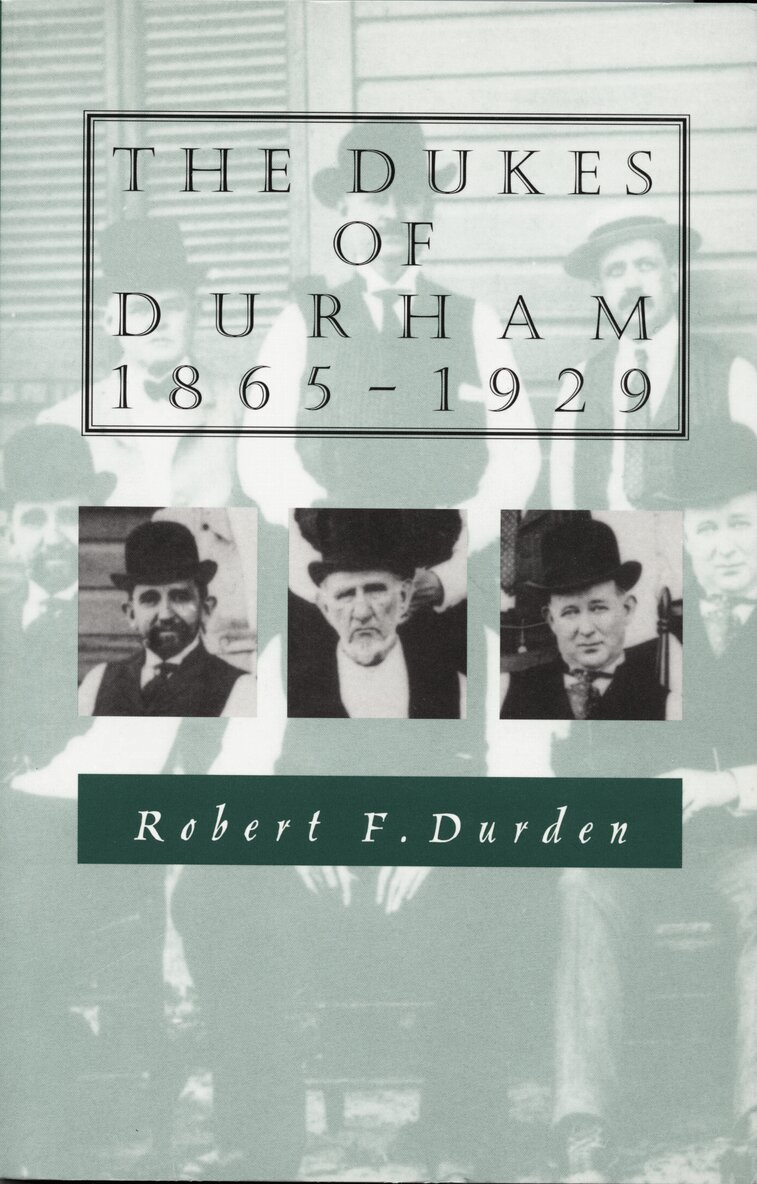
This is the history of Washington Duke and two of his sons, Benjamin Newton Duke and James Buchanan Duke. Although numerous other members of the family play their parts in the story it focuses primarily on the three men who were at the center of the economic and philanthropic activities which made the Dukes of Durham one of America's famous families. The Dukes operated closely and constantly as a family, and only in that context is their full story told.In the years after the Civil War, Washington Duke proved to be an unusually able industrialist and a conscientious, Methodist philanthropist. He was, in fact, a major Southern pioneer in both industry and philanthropy. His two sons by a second marriage were remarkably devoted to each other as well as to their father. Both sons also reflected traits of thier father. While Benjamin N. Duke and James B. Duke had life-long involvement with the business world-first in tobacco, then textiles, and finally electric power-as well as with philanthropy, they actually developed complementary specializations. Benjamin N. Duke, the older of the two, served as the family's primary agent for philanthropy from his early manhood in the late 1800's until he gradually became semi-invalid after 1915. James B. Duke, on the other hand, early displayed a marked talent, even a genius, for business. Toward the end of his life, with the establishment of The Duke Endowment late in 1924, he emerged as one of the nation's major philanthropists, ranking alongside Andrew Carnegie and John D. Rockefeller. A central theme of this book is, however, that the Endowment, despite its magnitude and far-reaching scope, was essentially the institutionalization and culmination of a pattern of family philanthropy that emerged in the 1890's and for which the older brother, Benjamin N. Duke, had always been the primary agent. Thus, the story of James B. Duke, who was and has remained much the more well-known of the two brothers, cannot properly be told out of the family context from which he emerged and in which occurred most of the important phases of his life.Washington Duke, as a small, land-owning yeoman farmer, was typical of the great majority class not only in antebellum North Carolina but in the South as a whole. Only after the war, when he and his sons emerged as large-scale industrialists and philanthropists, did the Dukes become atypical. Their story is, then, both agricultural and industrial, both Southern and national. Born North Carolinians, they moved onto a national, even global, stage. Yet all the while they kept deep roots, as well as vast investments of capital, in the Old North State, and they poured many millions into philanthropy, largely in the two Carolinas. Based largely on manuscript sources, many of them hitherto unused, this is the first study of the Duke family. The "New South," as recent historians have told us, may not have been so new-but it was certainly different in important ways, and the Dukes loomed large among those who helped to make it so.
1 090 kr
Skickas inom 7-10 vardagar
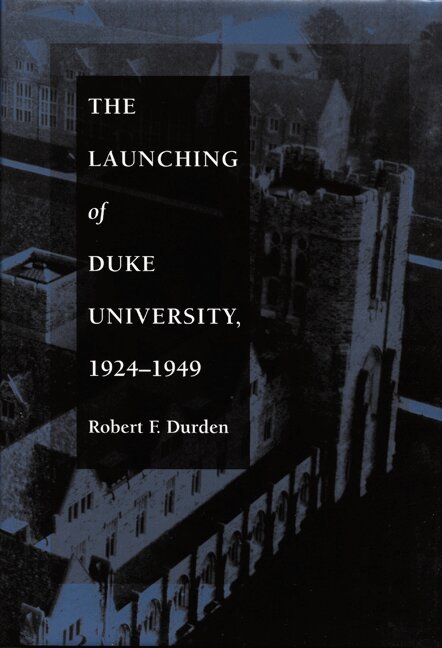
In this rich and authoritative history, distinguished historian Robert F. Durden tells the story of the formation of Duke University, beginning with its creation in 1924 as a new institution organized around Trinity College. As Durden reveals, this narrative belongs first and foremost to Duke University's original President, William Preston Few, whose visionary leadership successfully launched the building of the first voluntarily supported research university in the South. In focusing on Duke University's most formative and critical years-its first quarter century-Durden commemorates Few's remarkable successes while recognizing the painful realities and uncertainties of a young institution. Made possible by a gift from James B. Duke, the wealthiest member of the family that had underwritten Trinity College since 1890, Duke University was organized with Few as president. Few's goal was to turn Duke into a world-class institution of higher education and these early years saw the development of much of what we know as Duke University today. Drawing on extensive archival material culled over a ten-year period, Durden discusses the building of the Medical Center, the rebuilding of the School of Law, the acquisition of the Duke Forest and development of the School of Forestry, the nurturing of the Divinity School, and the enrichment of the Graduate School of Arts and Sciences.It was also during this period, as Durden details, that such treasures as the Sarah P. Duke Gardens were created, as well as some near treasures, as seen by the failed attempt to start an art museum. Although the story of the birth of this University belongs largely to William Preston Few, other people figure prominently and are discussed at length. Alice Baldwin, who led in the establishment of the Woman's College, emerges as a fascinating figure, as do William H. Wannamaker, James B. Duke, William Hanes Ackland, Robert L. Flowers, Justin Miller, and Wilburt Cornell Davision, among others.Although impressive growth occurred in Duke's formative years, tensions also arose. The need to strike an institutional balance between the twin demands of teaching and research, of regional versus national status, combined with continual shortages of funds, created occasional obstacles. The problem of two sets of trustees, one for the university and another for the Duke Endowment, loomed largest of all. As Few himself said, during these early years Duke successfully embarked on a long journey, for it was not until after World War II that Duke University consolidated the growth begun in the inter-war years. An important contribution to the history of Southern higher education as well as to Duke University, this book will be of great interest to historians, alumni, and friends of Duke University alike.