Robert F. Meier - Böcker
Visar alla böcker från författaren Robert F. Meier. Handla med fri frakt och snabb leverans.
5 produkter
5 produkter
235 kr
Skickas inom 5-8 vardagar
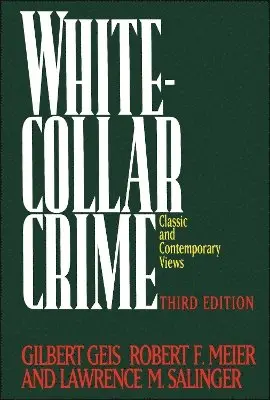
In the nearly twenty years since the first edition of White-Collar Crime, the fields of criminal justice and criminology have changed dramatically. Nonetheless, the revised edition, published in 1977, still holds a place on many bookshelves, a testament to the editors' ability to identify works of the highest quality. At long last, with the assistance of new co-editor Lawrence M. Salinger, White-Collar Crime has been fully revised, including the most extensive bibliography on white-collar crime that has ever been compiled.
911 kr
Skickas inom 5-8 vardagar
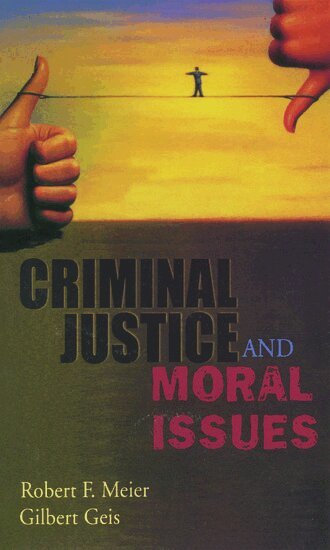
This text addresses the following two questions: "What kinds of problems can the law solve?" and "What kinds of problems does the law create?" Using these questions as starting points, Meier and Geis evenhandedly explore the role and function of law relating to six major issues that often divide Americans today: prostitution, drug use, homosexuality, abortion, pornography, and gambling. Statutes and public opinion have shifted dramatically over recent decades in regard to these behaviors. The book details these developments and offers explanations of why they have occurred. Some people view all or some of these behaviors as acts that ought to be permitted, as part of individual freedom. Others find one, some, or all of them to be genuine threats to the country's social and moral fiber and believe that they ought to be criminalized. Still others maintain that action ought to be taken to limit some of the behaviors, but that using the criminal justice system is not the best way to proceed. Meier and Geis' provocative book offers sophisticated, in-depth discussions of these issues, then reviews the conflicting opinions about the proper role of criminal law in dealing with them. It is written in straightforward, jargon-free language, providing an ideal background for exploring the facts and views regarding what are often contentious concerns. Criminal Justice and Moral Issues increases student understanding through the abundant use of relevant illustrations, examples, and case studies.
2 088 kr
Skickas inom 10-15 vardagar
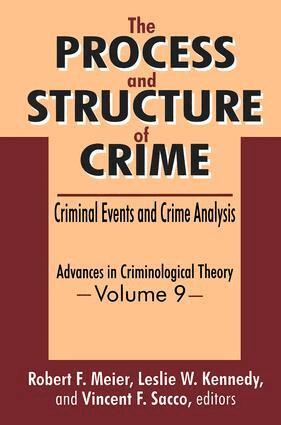
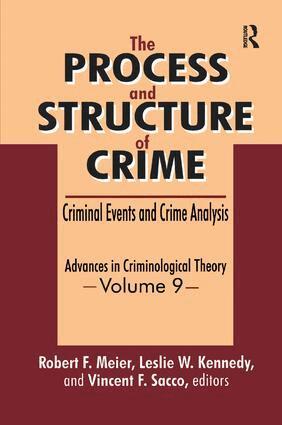
Criminology has developed strong methodological tools over the past decades, establishing itself as a competitive, sophisticated, and independent social science. Perhaps because of its emphasis on matters of design, methodology, and quantitative analysis, criminology has had few significant advances in theory. Advances in Criminological Theory is the first series exclusively dedicated to the dissemination of original work on criminological theory.The Process and Structure of Crime, the ninth volume in this landmark series, is a thorough overview of the conceptual and empirical issues raised by the adoption of a criminal event perspective, which takes into account the multifaceted character of human behavior. This book is divided into three sections: conceptual bases of criminal events, the criminal event perspective itself, and responses to criminal events. Contributors analyze and explore a wide range of topics, including: how interpersonal routines are structured through past experience; the influence of social context on interpersonal routines; criminal opportunity and its impact on criminal events; the significance of neighborhood context; the effect of victimization and fear; how problem-oriented policing efforts need to be informed by and reflect the problems of repeat offenders, repeat victims, and hot spots of crime; and finally, how changes in the physical environment constrain or limit criminal opportunities. This fascinating work will be beneficial to criminologists, sociologists, and scholars of legal studies.Contributors to this volume include: Leslie W. Kennedy, Erin Gibbs Van Brunschot, Robert F. Meier, Mark Warr, Christopher Birkbeck, Luis Gerardo Gabaldon, Kriss A. Drass, Terance D. Miethe, Julie Horney, Jeffrey Fagan, Deanna L. Wilkinson, Robert J. Buskirk, Jr., Vincent F. Sacco, Ross Macmillan, John E. Eck, Paul J. Brantingham, and Pat Brantingham.
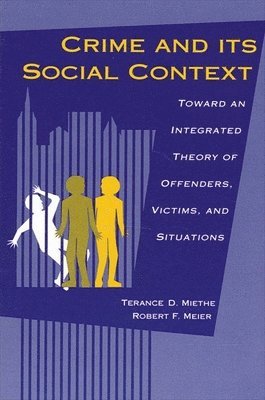
Crime and its Social Context
Toward an Integrated Theory of Offenders, Victims, and Situations
Häftad, Engelska, 1994
566 kr
Skickas inom 3-6 vardagar
Theories of criminality and theories of victimization have traditionally been discussed as though they bore no relationship to one another. Yet, a complete explanation for crime must examine both the decision to engage in crime by an offender and the everyday actions of ordinary citizens that increase vulnerability to criminals. The integration of these approaches yields testable models that have greater predictive power than could be obtained by looking only at models of offenders or models of victim behavior. A more general perspective that accounts for both the decision to engage in crime and the selection of particular crime targets is developed and tested.
671 kr
Skickas inom 10-15 vardagar
Criminology has developed strong methodological tools over the past decades, establishing itself as a competitive, sophisticated, and independent social science. Perhaps because of its emphasis on matters of design, methodology, and quantitative analysis, criminology has had few significant advances in theory. Advances in Criminological Theory is the first series exclusively dedicated to the dissemination of original work on criminological theory.The Process and Structure of Crime, the ninth volume in this landmark series, is a thorough overview of the conceptual and empirical issues raised by the adoption of a criminal event perspective, which takes into account the multifaceted character of human behavior. This book is divided into three sections: conceptual bases of criminal events, the criminal event perspective itself, and responses to criminal events. Contributors analyze and explore a wide range of topics, including: how interpersonal routines are structured through past experience; the influence of social context on interpersonal routines; criminal opportunity and its impact on criminal events; the significance of neighborhood context; the effect of victimization and fear; how problem-oriented policing efforts need to be informed by and reflect the problems of repeat offenders, repeat victims, and hot spots of crime; and finally, how changes in the physical environment constrain or limit criminal opportunities. This fascinating work will be beneficial to criminologists, sociologists, and scholars of legal studies.Contributors to this volume include: Leslie W. Kennedy, Erin Gibbs Van Brunschot, Robert F. Meier, Mark Warr, Christopher Birkbeck, Luis Gerardo Gabaldon, Kriss A. Drass, Terance D. Miethe, Julie Horney, Jeffrey Fagan, Deanna L. Wilkinson, Robert J. Buskirk, Jr., Vincent F. Sacco, Ross Macmillan, John E. Eck, Paul J. Brantingham, and Pat Brantingham.