Robert H. Rasche – Författare
Visar alla böcker från författaren Robert H. Rasche. Handla med fri frakt och snabb leverans.
4 produkter
4 produkter
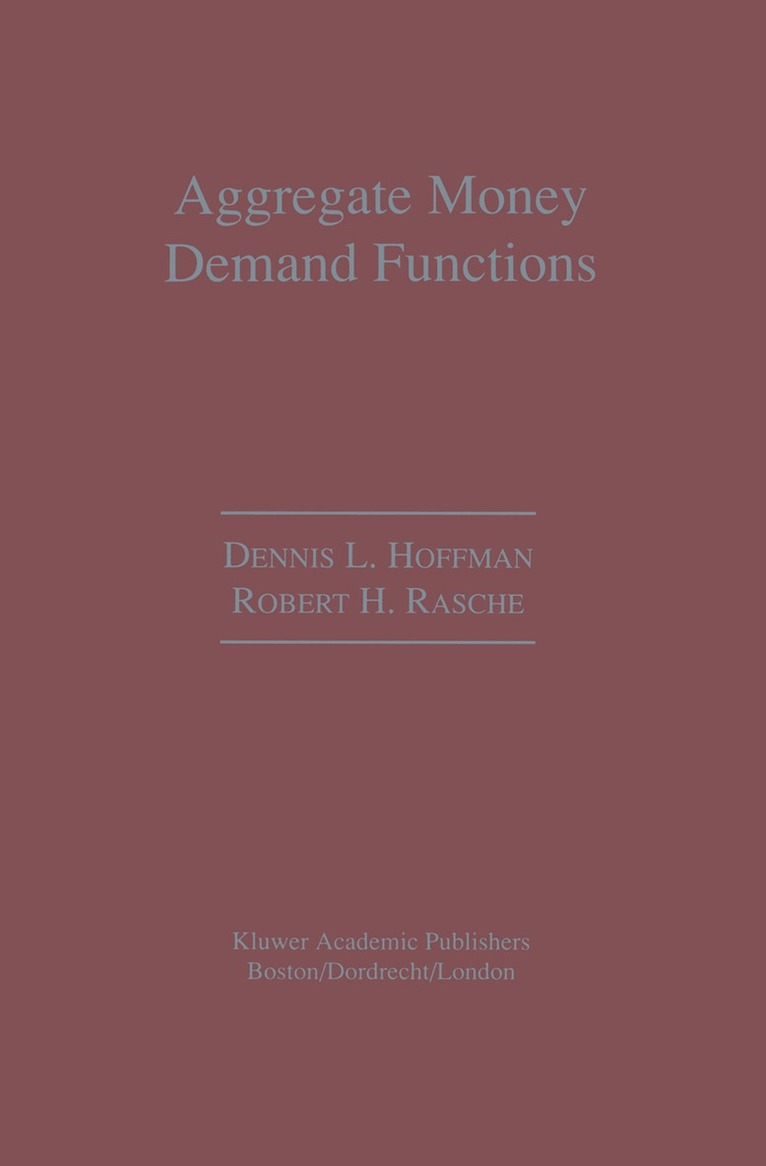
Aggregate Money Demand Functions
Empirical Applications in Cointegrated Systems
Inbunden, Engelska, 1996
1 094 kr
Skickas inom 10-15 vardagar
The econometric consequences of nonstationary data have wide-ranging implications for empirical research in economics. Specifically, these issues have implications for the study of empirical relations such as a money demand function that links macroeconomic aggregates: real money balances, real income and a nominal interest rate. Traditional monetary theory predicts that these nonstationary series form a co-integrating relation and, accordingly, that the dynamics of a vector process comprising these variables generates distinct patterns. Recent econometric developments designed to cope with nonstationarities have changed the course of empirical research in the area, but many fundamental challenges, for example the issue of identification, remain. This book is an effort to determine the consequences that nonstationarity has for the study of aggregate money demand relations. The object of this study is to utilize the tools of modern time series analysis to determine the role of an aggregate demand for real balances in the generation of macroeconomic time series.A significant characteristic of this research is the identification and estimation of this demand function in a multivariate framework, in contrast to most existing studies that concentrate on a single equation framework.
1 094 kr
Skickas inom 10-15 vardagar
Karl Brunner Monetary affairs have preoccupied observers over the ages. In the middle of the 14th century, the chaos in the French currency system after many rounds of currency debasement attracted comments expressing helpless confusion. Goethe's Mephistopheles convinced the imperial court to inflate with paper money "for the benefit of the public" and to satisfy all the demands on the government's largesse. Our century is no exception. The massive technological improvement in creating money has contributed to hyperinflationary experiences never before recorded in history. These events occurred, however, in the political disarray following major wars. More important are the persistent pe ace time failures of our monetary institutions. A massive worldwide deflation, centered in the United States and Germany, imposed a tragic social and political fate on Western societies. Similarly, the sequence of a worldwide inflation followed by deflation observed over the past 15 years has fostered disruptive economic and political conditions. The monetary disarray experienced throughout history was crucially influenced by the prevailing monetary arrangements. These arrangements determine the level and movement of the nation's money stock over time. Under the circumstances, the political issue confronting us bears on the useful choice of monetary arrangements. This choice should involve institutions that prohibit both massive deflation and persistent inflation.
Aggregate Money Demand Functions
Empirical Applications in Cointegrated Systems
Häftad, Engelska, 2011
1 094 kr
Skickas inom 10-15 vardagar
The econometric consequences of nonstationary data have wide ranging im plications for empirical research in economics. Specifically, these issues have implications for the study of empirical relations such as a money demand func tion that links macroeconomic aggregates: real money balances, real income and a nominal interest rate. Traditional monetary theory predicts that these nonsta tionary series form a cointegrating relation and accordingly, that the dynamics of a vector process comprised of these variables generates distinct patterns. Re cent econometric developments designed to cope with nonstationarities have changed the course of empirical research in the area, but many fundamental challenges, for example the issue of identification, remain. This book represents the efforts undertaken by the authors in recent years in an effort to determine the consequences that nonstationarity has for the study of aggregate money demand relations. We have brought together an empirical methodology that we find useful in conducting empirical research. Some of the work was undertaken during the authors' sabbatical periods and we wish to acknowledge the generous support of Arizona State University and Michigan State University respectively. Professor Hoffman wishes to acknowledge the support of the Fulbright-Hays Foundation that supported sabbattical research in Europe and separate support of the Council of 100 Summer Research Program at Arizona State University.
1 094 kr
Skickas inom 10-15 vardagar
Karl Brunner Monetary affairs have preoccupied observers over the ages. In the middle of the 14th century, the chaos in the French currency system after many rounds of currency debasement attracted comments expressing helpless confusion. Goethe's Mephistopheles convinced the imperial court to inflate with paper money "for the benefit of the public" and to satisfy all the demands on the government's largesse. Our century is no exception. The massive technological improvement in creating money has contributed to hyperinflationary experiences never before recorded in history. These events occurred, however, in the political disarray following major wars. More important are the persistent pe ace time failures of our monetary institutions. A massive worldwide deflation, centered in the United States and Germany, imposed a tragic social and political fate on Western societies. Similarly, the sequence of a worldwide inflation followed by deflation observed over the past 15 years has fostered disruptive economic and political conditions. The monetary disarray experienced throughout history was crucially influenced by the prevailing monetary arrangements. These arrangements determine the level and movement of the nation's money stock over time. Under the circumstances, the political issue confronting us bears on the useful choice of monetary arrangements. This choice should involve institutions that prohibit both massive deflation and persistent inflation.