Robert Henry Peters - Böcker
Visar alla böcker från författaren Robert Henry Peters. Handla med fri frakt och snabb leverans.
2 produkter
2 produkter
989 kr
Skickas inom 7-10 vardagar
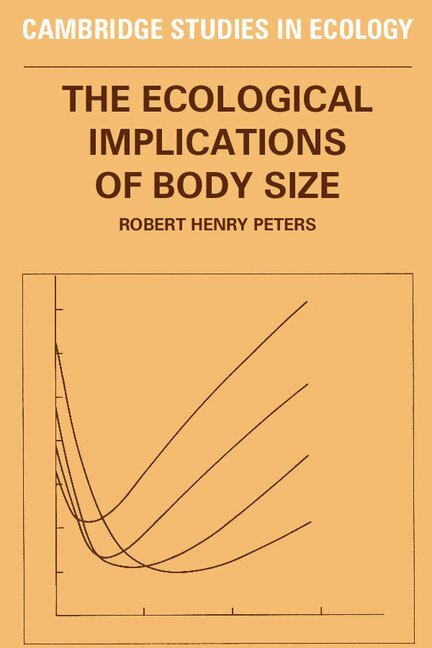
It is generally recognized that larger animals eat more, live longer, have larger offspring, and so on; but it is unusual to see these commonplace observations as a basis for scientific biology. A large number of empirically based relationships describe biological rates as simple functions of body size; and other such relations predict the intrinsic rate of population growth, animal speed, animal density, territory size, prey size, physiology, and morphology. Such equations almost always exist for mammals and birds, often for other vertebrates and invertebrates, sometimes for protozoa, algae, and bacteria, and occasionally even for plants. There are too many organisms to measure all aspects of the biology of every species of population, so scientists must depend on generalizations. Body size relations represent our most extensive and powerful assemblage of generalizations, but they have never been organized for use in ecology. This book represents the largest single compilation of interspecific size relations, and instructs the reader on the use of these relationships; their comparison, combination, and criticism. Both strengths and weaknesses of our current knowledge are discussed in order to indicate the many possible directions for further research. This important volume will therefore provide a point of departure toward a new applied ecology, giving quantitative solutions to real questions. It will interest advanced students of ecology and comparative physiology as well as professional biologists.
1 014 kr
Skickas inom 7-10 vardagar
This is a book of criticism. It is directed at contemporary ecology, but would apply to any science or indeed any statement that claims to contain information. Application of simple criteria to judge the information in ecological statements reveals deep inadequacies in the science. Furthermore, the complexity of the contemporary field of ecology and the mistraining of a generation of ecologists has obscured its weakness. As a result, many ecologists are unaware of the failings of the science although others are deeply concerned for the future of the field. The author, Professor Peters, argues that a return to simple question of fact, to observations, and to questions of general relevance to science and society can make ecology a useful, practical and informative science. Such science is desperately needed to meet the problems of the age. A thought-provoking book that will be of interest to all scientists, but in particular ecologists from undergraduates to senior academics and professionals.