Robert J. Whitley - Böcker
Visar alla böcker från författaren Robert J. Whitley. Handla med fri frakt och snabb leverans.
3 produkter
3 produkter
1 578 kr
Skickas inom 10-15 vardagar
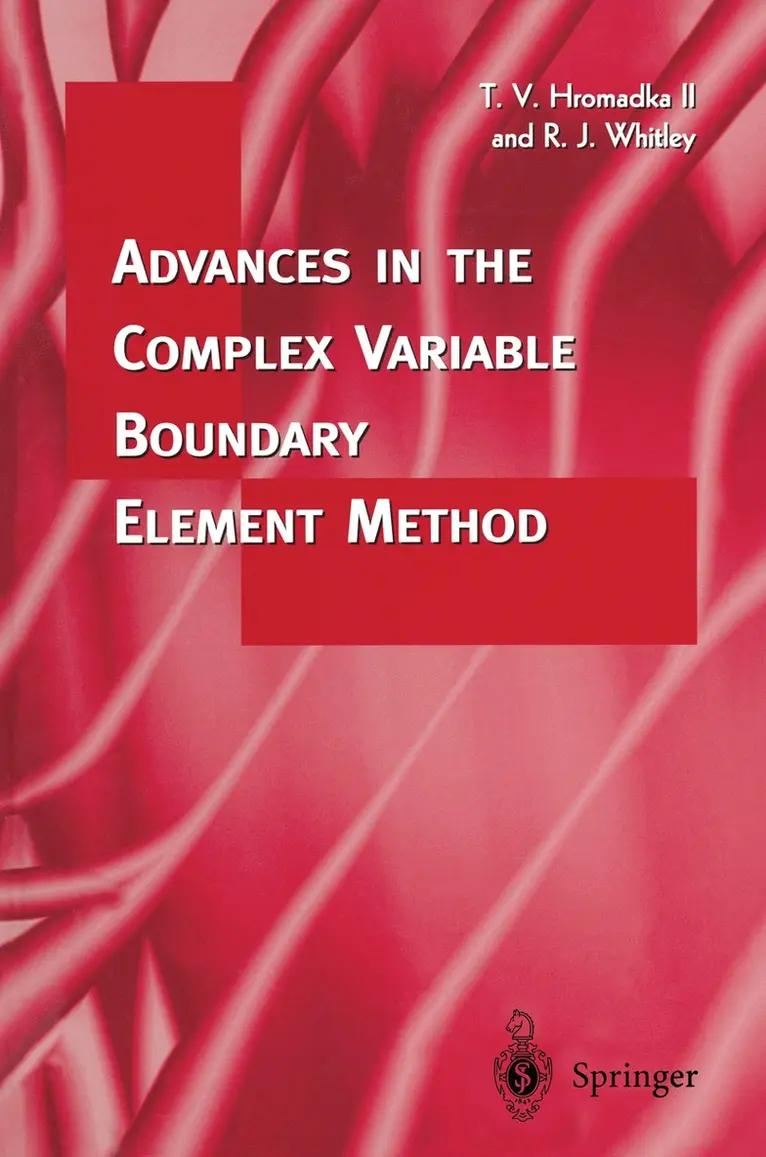
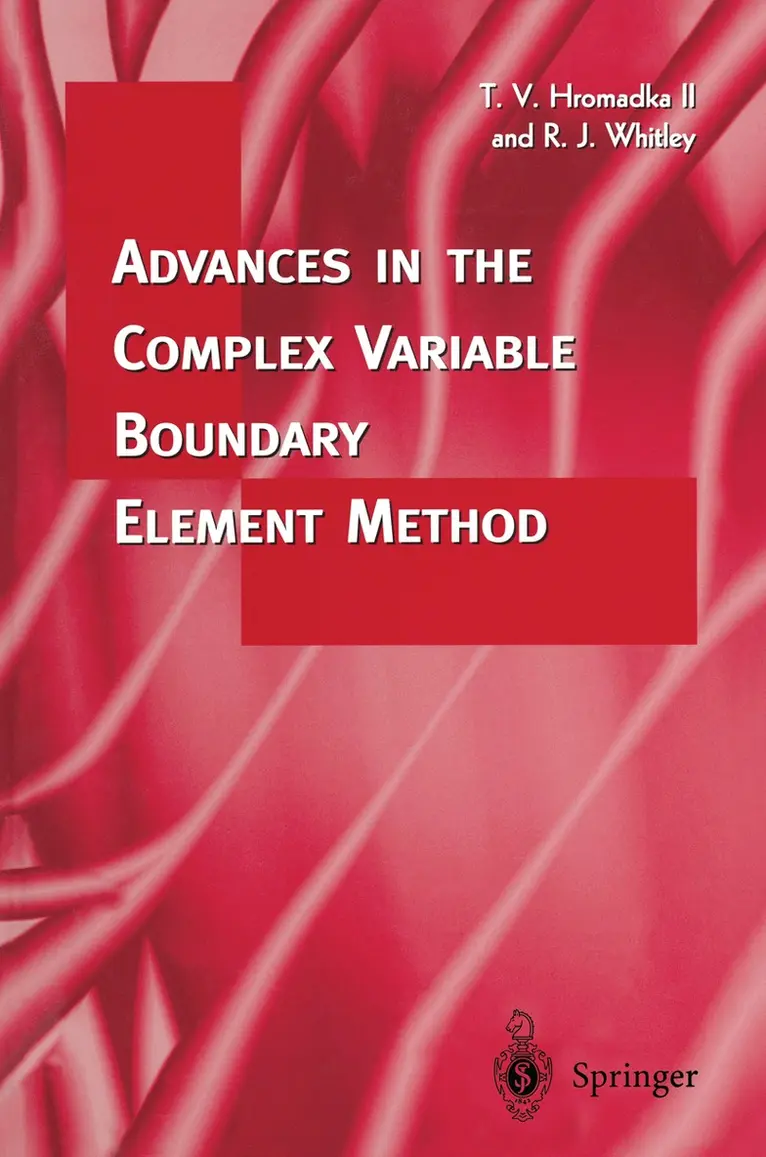
Since its inception by Hromadka and Guymon in 1983, the Complex Variable Boundary Element Method or CVBEM has been the subject of several theoretical adventures as well as numerous exciting applications. The CVBEM is a numerical application of the Cauchy Integral theorem (well-known to students of complex variables) to two-dimensional potential problems involving the Laplace or Poisson equations. Because the numerical application is analytic, the approximation exactly solves the Laplace equation. This attribute of the CVBEM is a distinct advantage over other numerical techniques that develop only an inexact approximation of the Laplace equation. In this book, several of the advances in CVBEM technology, that have evolved since 1983, are assembled according to primary topics including theoretical developments, applications, and CVBEM modeling error analysis. The book is self-contained on a chapter basis so that the reader can go to the chapter of interest rather than necessarily reading the entire prior material. Most of the applications presented in this book are based on the computer programs listed in the prior CVBEM book published by Springer-Verlag (Hromadka and Lai, 1987) and so are not republished here.
1 578 kr
Skickas inom 10-15 vardagar
As well as describing the applications of the CVBEM, the authors explain its mathematical background - vital to understanding the subject as a whole. This is a comprehensive book, bringing together ten years of work in CVBEM technology. It should be of particular interest to those concerned with solving technical engineering problems - while scientists, graduate students, computer programmers and those working in industry should find the book helpful.
1 064 kr
Skickas inom 10-15 vardagar
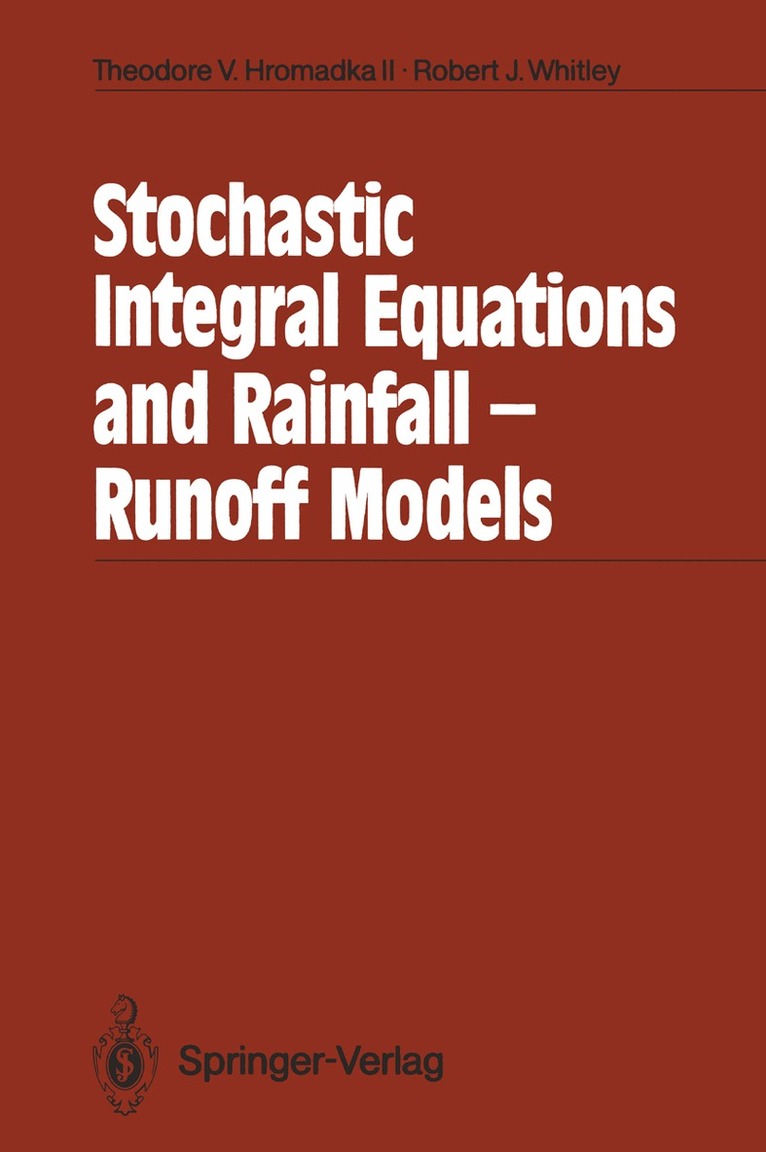
The subject of rainfall-runoff modeling involves a wide spectrum of topics. Fundamental to each topic is the problem of accurately computing runoff at a point given rainfall data at another point. The fact that there is currently no one universally accepted approach to computing runoff, given rainfall data, indicates that a purely deter ministic solution to the problem has not yet been found. The technology employed in the modern rainfall-runoff models has evolved substantially over the last two decades, with computer models becoming increasingly more complex in their detail of describing the hydrologic and hydraulic processes which occur in the catchment. But despite the advances in including this additional detail, the level of error in runoff estimates (given rainfall) does not seem to be significantly changed with increasing model complexity; in fact it is not uncommon for the model's level of accuracy to deteriorate with increasing complexity. In a latter section of this chapter, a literature review of the state-of-the-art in rainfall-runoff modeling is compiled which includes many of the concerns noted by rainfall-runoff modelers. The review indicates that there is still no deterministic solution to the rainfall-runoff modeling problem, and that the error in runoff estimates produced from rainfall-runoff models is of such magnitude that they should not be simply ignored.