Robert Jackall - Böcker
Visar alla böcker från författaren Robert Jackall. Handla med fri frakt och snabb leverans.
11 produkter
11 produkter
388 kr
Skickas
This classic study of ethics in business presents an eye-opening account of how corporate managers think the world works, and how big organizations shape moral consciousness. Robert Jackall takes the reader inside a topsy-turvy world where hard work does not necessarily lead to success, but sharp talk, self-promotion, powerful patrons, and sheer luck might. What sort of everyday rules-in-use do people play by when there are no fixed standards to explain why some succeed and others fail? In the words of one corporate manager, those rules boil down to this maxim: ¨What is right in the corporation is what the guy above you wants from you. That's what morality is in the corporation.¨ This brilliant, disturbing, funny look at the ethos of the corporate world presents compelling real life stories of the men and women charged with running the businesses of America. This anniversary edition includes an afterword by the author linking the themes of Moral Mazes to the financial tsunami that engulfed the world economy in 2008.
260 kr
Skickas inom 7-10 vardagar
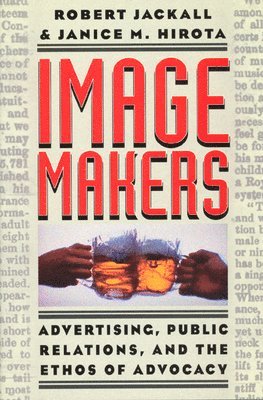
Talking dogs pitching ethnic food. Heart-tugging appeals for contributions. Recruitment calls for enlistment in the military. Tub-thumpers excoriating American society with over-the-top rhetoric. Everywhere we turn, we are exhorted to spend money, join organizations, rally to causes or express outrage. "Image Makers" is a comprehensive analysis of modern advocacy - from commercials to public service ads to government propaganda - and its roots in advertising and public relations. Robert Jackall and Janice M. Hirota explore the fashioning of the apparatus of advocacy through the stories of two organizations, the Committee on Public Information, which sold the Great War to the American public, and the Advertising Council, which since the Second World War has been the main coordinator of public service advertising. They then turn to the career of William Bernbach, the adman's adman, who reinvented advertising and grappled creatively with the profound skepticism of a propaganda-weary midcentury public. Jackall and Hirota argue that the tools-in-trade and habits of mind of "image makers" have now migrated into every corner of modern society.Advocacy is now a vocation for many, and American society abounds as well with "techncians in moral outrage", including street-smart impresarios, feminist preachers and bombastic talk-radio hosts. The apparatus and ethos of advocacy give rise to endlessly shifting patterns of conflicting representations and claims, and in their midst "Image Makers" offers a clear and spirited understanding of advocacy in contemporary society and the quandaries it generates.
414 kr
Skickas inom 7-10 vardagar
Worker Cooperatives in America maps the past, present, and possible futures of democratic enterprise in the United States, arguing—against the grain of corporate inevitability—that firms owned and governed by workers can address stubborn problems of unemployment, productivity, and workplace alienation. Edited by Robert Jackall and Henry M. Levin, the volume moves from vivid historical arcs—co-ops formed by striking nineteenth-century artisans, New Deal–era self-help ventures—to contemporary case studies of plywood mills, reforestation crews, and urban collectives. Across these sites, contributors probe the hard mechanics of democratic firms: capitalizing without ceding control, balancing egalitarian norms with market exigencies, rotating jobs to build skill and solidarity, and designing governance that is both participatory and effective. Empirical chapters engage Mondragón as a global benchmark, report comparative productivity advantages, and show how cooperatives preserve jobs when conventional owners shutter plants. The result is a rigorous, data-grounded challenge to managerial common sense.Equally attentive to limits, the book confronts the structural headwinds co-ops face in a legal and financial ecosystem optimized for hierarchical corporations. Essays on Employee Stock Ownership Plans, membership rights, and cooperative law demystify vehicles that can either enable or erode self-management. Analyses of culture, training, and decision rules illuminate why some democracies falter while others endure. Throughout, the editors press a central question: how can enterprises reconcile internal commitments to voice and equity with external demands of competitive markets? With clear-eyed assessments and practical design lessons—revolving credit funds, representative/assembly hybrids, counter-cyclical work-sharing—this collection offers scholars, organizers, and policy makers a usable blueprint. Worker cooperatives, the contributors show, are not a panacea; they are a durable, American repertoire for linking productivity to dignity, enterprise to citizenship, and work to democracy.This title is part of UC Press's Voices Revived program, which commemorates University of California Press’s mission to seek out and cultivate the brightest minds and give them voice, reach, and impact. Drawing on a backlist dating to 1893, Voices Revived makes high-quality, peer-reviewed scholarship accessible once again using print-on-demand technology. This title was originally published in 1984.
780 kr
Skickas inom 7-10 vardagar
Worker Cooperatives in America maps the past, present, and possible futures of democratic enterprise in the United States, arguing—against the grain of corporate inevitability—that firms owned and governed by workers can address stubborn problems of unemployment, productivity, and workplace alienation. Edited by Robert Jackall and Henry M. Levin, the volume moves from vivid historical arcs—co-ops formed by striking nineteenth-century artisans, New Deal–era self-help ventures—to contemporary case studies of plywood mills, reforestation crews, and urban collectives. Across these sites, contributors probe the hard mechanics of democratic firms: capitalizing without ceding control, balancing egalitarian norms with market exigencies, rotating jobs to build skill and solidarity, and designing governance that is both participatory and effective. Empirical chapters engage Mondragón as a global benchmark, report comparative productivity advantages, and show how cooperatives preserve jobs when conventional owners shutter plants. The result is a rigorous, data-grounded challenge to managerial common sense.Equally attentive to limits, the book confronts the structural headwinds co-ops face in a legal and financial ecosystem optimized for hierarchical corporations. Essays on Employee Stock Ownership Plans, membership rights, and cooperative law demystify vehicles that can either enable or erode self-management. Analyses of culture, training, and decision rules illuminate why some democracies falter while others endure. Throughout, the editors press a central question: how can enterprises reconcile internal commitments to voice and equity with external demands of competitive markets? With clear-eyed assessments and practical design lessons—revolving credit funds, representative/assembly hybrids, counter-cyclical work-sharing—this collection offers scholars, organizers, and policy makers a usable blueprint. Worker cooperatives, the contributors show, are not a panacea; they are a durable, American repertoire for linking productivity to dignity, enterprise to citizenship, and work to democracy.This title is part of UC Press's Voices Revived program, which commemorates University of California Press’s mission to seek out and cultivate the brightest minds and give them voice, reach, and impact. Drawing on a backlist dating to 1893, Voices Revived makes high-quality, peer-reviewed scholarship accessible once again using print-on-demand technology. This title was originally published in 1984.
299 kr
Skickas inom 10-15 vardagar
Four bullet-torn bodies in a drug-ridden South Bronx alley. A college boy shot in the head on the West Side Highway. A wild shootout on the streets of Washington Heights, home of New York City's immigrant Dominican community and hub of the eastern seaboard's drug trade. All seemingly separate acts of violence. But investigators discover a pattern to the mayhem, with links to scores of assaults and murders throughout the city.In this bloody urban saga, Robert Jackall recounts how street cops, detectives, and prosecutors pieced together a puzzle-like story of narcotics trafficking, money laundering, and murders for hire, all centered on a vicious gang of Dominican youths known as the Wild Cowboys. These boyhood friends, operators of a lucrative crack business in the Bronx, routinely pistol-whipped their workers, murdered rivals, shot or slashed witnesses to their crimes, and eventually turned on one another in a deadly civil war. Jackall chronicles the crime-scene investigations, frantic car chases, street arrests at gunpoint, interviews with informants, and knuckle-breaking plea bargaining that culminated in prison terms for more than forty gang members.But he also tells a cautionary tale--one of a society with irreconcilable differences, fraught with self-doubt and moral ambivalence, where the institutional logics of law and bureaucracy often have perverse outcomes. A society where the forces of order battle not just violent criminals but elites seemingly aligned with forces of disorder: community activists who grab any pretext to further narrow causes; intellectuals who romanticize criminals; judges who refuse to lock up dangerous men; federal prosecutors who relish nailing cops more than crooks; and politicians who pander to the worst of our society behind rhetorics of social justice and moral probity. In such an up-for-grabs world, whose order will prevail?
317 kr
Skickas inom 10-15 vardagar
Detectives work the streets--an arena of action, vice, lust, greed, aggression, and violence--to gather shards of information about who did what to whom. They also work the cumbersome machinery of the justice system--semi-military police hierarchies with their endless jockeying for prestige, procedure-driven district attorney offices, and backlogged courts--transforming hard-won street knowledge into public narratives of responsibility for crime. Street Stories, based on years of fieldwork with the New York City Police Department and the District Attorney of New York, examines the moral ambiguities of the detectives' world as they shuttle between the streets and a bureaucratic behemoth.In piecing together street stories to solve intriguing puzzles of agency and motive, detectives crisscross the checkerboard of urban life. Their interactions in social strata high and low foster cosmopolitan habits of mind and easy conversational skills. And they become incomparable storytellers. This book brims with the truth-is-stranger-than-fiction violence of the underworld and tells about a justice apparatus that splinters knowledge, reduces life-and-death issues to arcane hair-splitting, and makes rationality a bedfellow of absurdity. Detectives' stories lay bare their occupational consciousness--the cunning and trickery of their investigative craft, their self-images, moral rules-in-use, and judgments about the players in their world--as well as their personal ambitions, sensibilities, resentments, hopes, and fears. When detectives do make cases, they take satisfaction in removing predators from the streets and helping to ensure public safety. But their stories also illuminate dark corners of a troubled social order.
1 409 kr
Skickas inom 5-8 vardagar
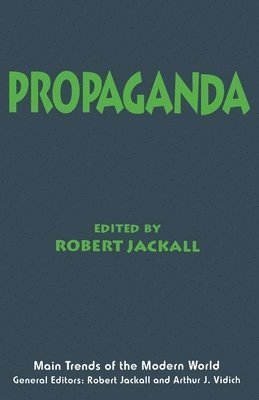
Traces the origins of modern propaganda and its influence in modern historyThis volume traces the origins, ethos, and workings of modern propaganda, which now permeates all institutions in our society. Scholars such as C. Wright Mills, Walter Lippmann, and Hans Speier here explore the social and institutional groundwork of modern propaganda. The book then examines the axial age of propaganda, from the Great War through the Cold War, focusing on key propaganda organizations, such as the Committee on Public Information, the Nazi propaganda machine, and the group of Hollywood directors that produced propaganda films for the armed services during the Second World War. This section also details the wizardry of the master Nazi propagandist, Joseph Goebbels. Finally, the volume examines the ubiquity of propaganda in contemporary society, focusing on bureaucratic propaganda, advertising, public relations, and politics and language.
468 kr
Skickas inom 5-8 vardagar
This volume traces the origins, ethos, and workings of modern propaganda, which now permeates all institutions in our society. Scholars such as C. Wright Mills, Walter Lippmann, and Hans Speier here explore the social and institutional groundwork of modern propaganda. The book then examines the axial age of propaganda, from the Great War through the Cold War, focusing on key propaganda organizations, such as the Committee on Public Information, the Nazi propaganda machine, and the group of Hollywood directors that produced propaganda films for the armed services during the Second World War. This section also details the wizardry of the master Nazi propagandist, Joseph Goebbels. Finally, the volume examines the ubiquity of propaganda in contemporary society, focusing on bureaucratic propaganda, advertising, public relations, and politics and language.
468 kr
Skickas inom 5-8 vardagar
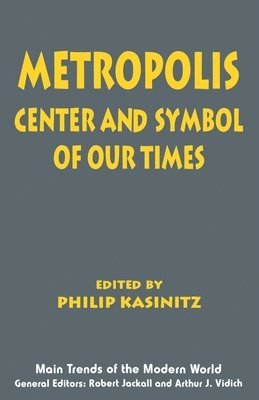
The modern city is the nexus of culture, politics, and art. Despite the manifold problems cities face, more and more Americans are abandoning rural areas and relocating to urban centers. By the year 2000, 4 out of 5 Americans will live within one hour of a major city. What has prompted this emphasis on the city? Chronicling the rise of the modern city, Metropolis draws from the work of such renowned social thinkers as Georg Simmel, Lewis Mumford, Walter Benjamin, Richard Sennett, and Herbert Gans, to illustrate how and why we have come to be an urban society and what the future holds for the American city. Each of the five sections (on modernity and the urban ethos; New York City; community and social bonds in the city; social relations and public places; and the role of space, race, class, and politics in the American city) is prefaced by an introduction by the editor, highlighting the issues under discussion.
391 kr
Skickas inom 10-15 vardagar
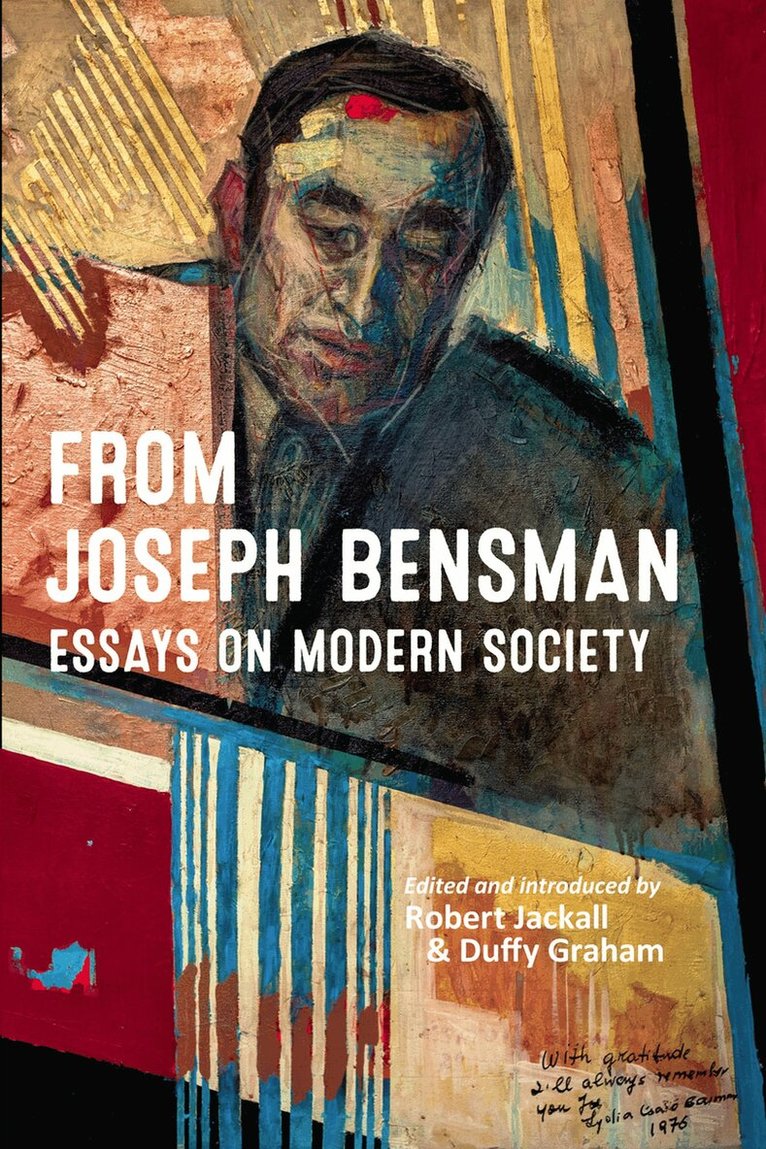
Joseph Bensman (1922- 1998), a renowned analyst of modern institutions, professions, and culture, was Distinguished Professor of Sociology at the Graduate Center, City University of New York, and at City College of New York. From Joseph Bensman: Essays on Modern Society brings together some of his finest work, often done in collaboration with colleagues such as Arthur J. Vidich, Robert Lilienfeld, Bernard Rosenberg, and Israel Gerver. In the introduction to this volume, editors Robert Jackall and Duffy Graham identify Bensman's trademark habits of mind: an analytical stance, fundamentally objective and dispassionate a vigilant awareness of the reach and vitality of bureaucracy an ability to discern intellectual problems in superficially unremarkable phenomena attention to empirical detail and suspicion of theoretical abstractions and appreciation of irony and unintended consequences.
594 kr
Skickas inom 10-15 vardagar
Albert Salomon (1891 - 1996) was an eminent German-Jewish sociologist. He studied art history, religious history, and philosophy at Humboldt University in Berlin philosophy at the University of Freiburg and sociology at the University of Heidelberg. At Heidelberg, he studied under Max Weber, Georg Luká cs, and Karl Mannheim. His fellow students included, among other great social thinkers, Hannah Arendt and Hans Speier. After obtaining his doctorate in sociology under Mannheim, he taught at the Deutsche Hochschule fü r Politik, but lost his job there when the Nazis came to power in January 1933. He received an offer from Alvin Johnson to teach at the University in Exile at the New School for Social Research and, with his family, migrated to New York City in early 1935. Over the years, Salomon taught many courses in the Graduate Faculty of Political and Social Science at the New School, including seminars on Weber, Durkheim, the history of social thought, and Balzac as a sociologist. His students revered him for his breadth and depth of learning and his exacting standards. Later scholars, including the editors of From Albert Salomon: Essays on Social Thinkers, regard him as one of the most important interpreters of Western thought and as an exemplar of the great Jewish intellectual tradition.