Robert Maynard Hutchins – författare
Visar alla böcker från författaren Robert Maynard Hutchins. Handla med fri frakt och snabb leverans.
8 produkter
8 produkter
700 kr
Skickas inom 10-15 vardagar
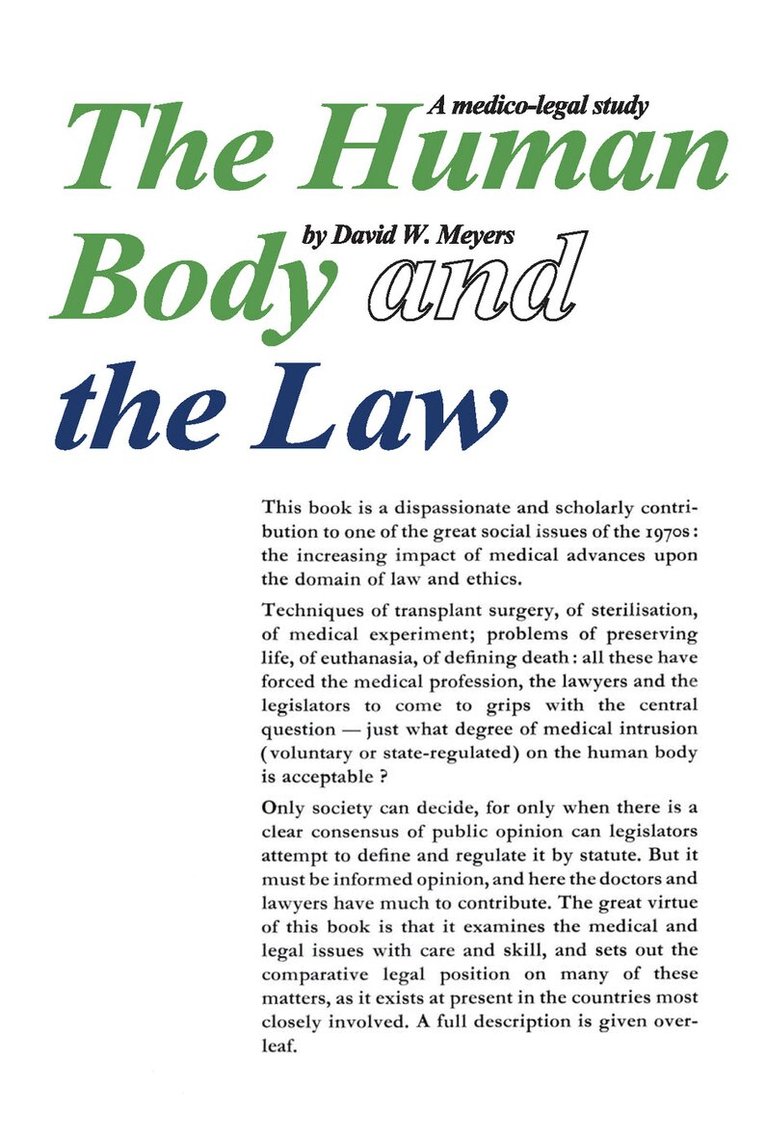
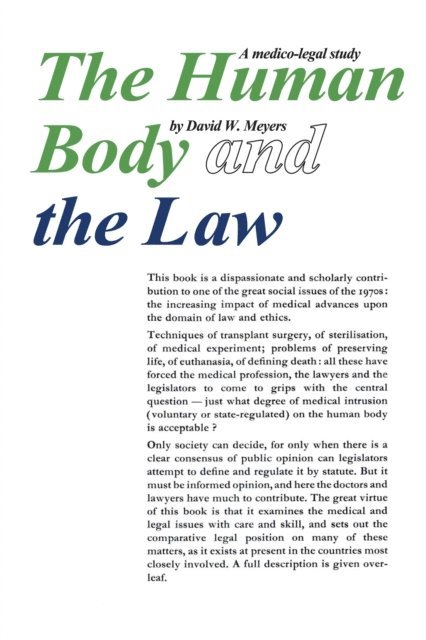
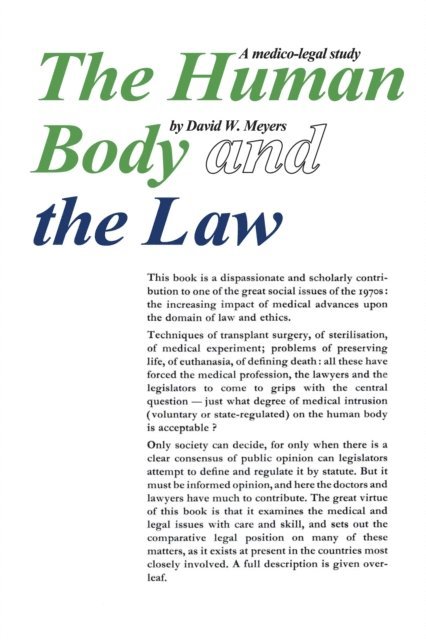
In this admirably objective and lucid exposition, the author examines from a medico-legal standpoint the comparative position in various countries, particularly in the UK and the USA, of currently controversial medical procedures: voluntary sterilisation, compulsory sterilisation and castration, trans-sexualism, experimentation, transplantation, and euthanasia - few of which, if any, enjoy a settled or clearly defined place in the eyes of the law. He considers the problems from two perspectives: first, that of the individual in society and how far he himself may determine the extent of physical intrusion on his body; secondly, that of the state or society and how far it may impose or limit medical intrusion on the human body. Thus, Mr. Meyers provides a valuable account, not only of current medical attitudes, but also of relevant case and statute law as it stands at present.It is inherent in the nature of this book that it should arouse controversy and argument. There are many important questions to be debated: Has the state the right to enforce its conception of morality without showing that the behaviour it proscribes has a harmful effect on other members of society? To what extent does consent by the individual concerned insulate a surgeon from criminal liability? In connection with compulsory sterilisation, who is to judge those unfit to procreate? What is a proper definition of medical experimentation? What constitutes death? If a man has a right to live has he not an equal right to die?These are a few of the issues raised. The author has not hesitated to express his own opinions but has clearly relegated them to the summary at the end of each chapter, thereby leaving the objectivity of his main text unimpaired.David W. Meyers is a practicing lawyer in California, with American and British legal qualifications at the firm of Dickenson, Peatman & Fogarty. He has taught at the University of Edinburgh Law School and the University of Tasmania Law School as well as being a guest lecturer at University of California, San Francisco Medical School and University of Aberdeen Law School located in Scotland. He wrote two books this book and Medico-Legal Implications of Death and Dying.
375 kr
Skickas inom 5-8 vardagar
237 kr
Skickas inom 5-8 vardagar
553 kr
Skickas inom 5-8 vardagar
434 kr
Skickas inom 5-8 vardagar
2 154 kr
Skickas inom 10-15 vardagar
In this admirably objective and lucid exposition, the author examines from a medico-legal standpoint the comparative position in various countries, particularly in the UK and the USA, of currently controversial medical procedures: voluntary sterilisation, compulsory sterilisation and castration, trans-sexualism, experimentation, transplantation, and euthanasia - few of which, if any, enjoy a settled or clearly defined place in the eyes of the law. He considers the problems from two perspectives: first, that of the individual in society and how far he himself may determine the extent of physical intrusion on his body; secondly, that of the state or society and how far it may impose or limit medical intrusion on the human body. Thus, Mr. Meyers provides a valuable account, not only of current medical attitudes, but also of relevant case and statute law as it stands at present.It is inherent in the nature of this book that it should arouse controversy and argument. There are many important questions to be debated: Has the state the right to enforce its conception of morality without showing that the behaviour it proscribes has a harmful effect on other members of society? To what extent does consent by the individual concerned insulate a surgeon from criminal liability? In connection with compulsory sterilisation, who is to judge those unfit to procreate? What is a proper definition of medical experimentation? What constitutes death? If a man has a right to live has he not an equal right to die?These are a few of the issues raised. The author has not hesitated to express his own opinions but has clearly relegated them to the summary at the end of each chapter, thereby leaving the objectivity of his main text unimpaired.David W. Meyers is a practicing lawyer in California, with American and British legal qualifications at the firm of Dickenson, Peatman & Fogarty. He has taught at the University of Edinburgh Law School and the University of Tasmania Law School as well as being a guest lecturer at University of California, San Francisco Medical School and University of Aberdeen Law School located in Scotland. He wrote two books this book and Medico-Legal Implications of Death and Dying.
Higher Learning in America
A Memorandum on the Conduct of Universities by Business Men
Inbunden, Engelska, 2017
2 276 kr
Skickas inom 10-15 vardagar
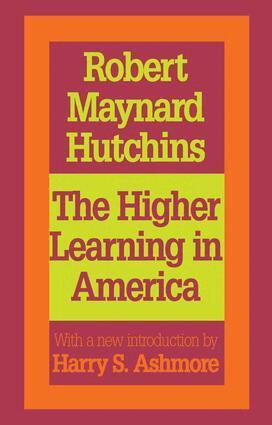
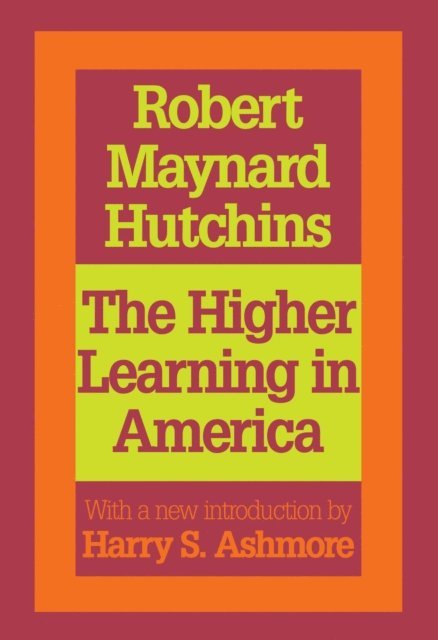
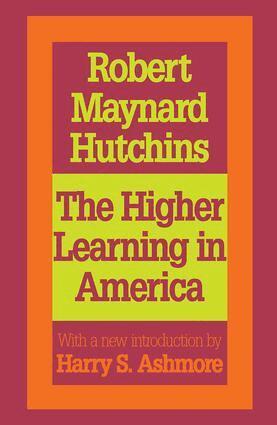
Perhaps the pivotal book in the reform of higher education in the United States, Robert M. Hutchins' classic is once again available, with a brilliant personal and professional appreciation by Harry S. Ashmore. When it was published in 1936The Higher Learning in Americabrought into focus the root causes of the controversies that still beset the nation's educational system. Taking office in 1929 as president of the University of Chicago, Hutchins began his tenure by declaring the learning available in even the most prestigious universities grossly deficient.He cited himself as case in point. At Yale he had graduated at the top of his college class and set a record in the law school that led to appointment as professor and, at 26, promotion to dean. But he had acquired only "some knowledge of the Bible, of Shakespeare, andFaust,of one dialogue of Plato, and of the opinions of many semi-literate and a few literate judges, and that was about all."The curricular reforms and administrative reorganization he undertook at Chicago are set forth in this volume, along with the philosophical arguments he worked out to explicate and defend his views. His goal was to reestablish the liberal arts and humanities as the basis for undergraduate education, consigning specialization and research to graduate and professional schools. Hutchins envisioned the university as a community of scholars who, in addition to teaching and research, provided independent thought and criticism of a society being rapidly transformed by science and technology. Challenging the educational establishment at every pertinent level, he became the most celebrated and most controversial intellectual of his era.After twenty-two years at Chicago, Hutchins became associate director of the newly enriched Ford Foundation, where he was primarily responsible for the bold reforms sponsored by its Fund for the Advancement of Education and Fund for Adult Education. In 1960 he established the Center for the Study of Democratic Institutions at Santa Barbara to maintain an ongoing dialogue between scholars and practitioners that would "identify and clarify the basic issues of our time, and widen the circles of discussion about them."
Higher Learning in America
A Memorandum on the Conduct of Universities by Business Men
Häftad, Engelska, 1995
647 kr
Skickas inom 10-15 vardagar
Perhaps the pivotal book in the reform of higher education in the United States, Robert M. Hutchins' classic is once again available, with a brilliant personal and professional appreciation by Harry S. Ashmore. When it was published in 1936The Higher Learning in Americabrought into focus the root causes of the controversies that still beset the nation's educational system. Taking office in 1929 as president of the University of Chicago, Hutchins began his tenure by declaring the learning available in even the most prestigious universities grossly deficient.He cited himself as case in point. At Yale he had graduated at the top of his college class and set a record in the law school that led to appointment as professor and, at 26, promotion to dean. But he had acquired only "some knowledge of the Bible, of Shakespeare, andFaust,of one dialogue of Plato, and of the opinions of many semi-literate and a few literate judges, and that was about all."The curricular reforms and administrative reorganization he undertook at Chicago are set forth in this volume, along with the philosophical arguments he worked out to explicate and defend his views. His goal was to reestablish the liberal arts and humanities as the basis for undergraduate education, consigning specialization and research to graduate and professional schools. Hutchins envisioned the university as a community of scholars who, in addition to teaching and research, provided independent thought and criticism of a society being rapidly transformed by science and technology. Challenging the educational establishment at every pertinent level, he became the most celebrated—and most controversial—intellectual of his era.After twenty-two years at Chicago, Hutchins became associate director of the newly enriched Ford Foundation, where he was primarily responsible for the bold reforms sponsored by its Fund for the Advancement of Education and Fund for Adult Education. In 1960 he established the Center for the Study of Democratic Institutions at Santa Barbara to maintain an ongoing dialogue between scholars and practitioners that would "identify and clarify the basic issues of our time, and widen the circles of discussion about them."