Robert R. Kaufman - Böcker
Visar alla böcker från författaren Robert R. Kaufman. Handla med fri frakt och snabb leverans.
8 produkter
8 produkter
863 kr
Skickas inom 7-10 vardagar
Countries of the former Soviet Union and Eastern Europe are entering the second decade of political transformation and economic reform. The first decade involved macroeconomic stabilization, privatization, and development of the basic institutional infrastructure of a market economy. The new policy challenges center on the nature of the social contract between citizens and their governments. These challenges include identifying the appropriate boundaries between the obligations of the public sector and the responsibilities of individual citizens, the range of public goods the government should supply, and who should pay for and benefit from their provision. The essays in this volume, first published in 2001, focus on two interrelated issues: the making of fiscal policy and the provision of citizens' welfare, particularly regarding pensions and health care. The essays emphasize that there is no single model of a market economy; rather, governments and publics face a range of options for restructuring the socialist welfare state.
435 kr
Skickas inom 7-10 vardagar
Countries of the former Soviet Union and Eastern Europe are entering the second decade of political transformation and economic reform. The first decade involved macroeconomic stabilization, privatization, and development of the basic institutional infrastructure of a market economy. The new policy challenges center on the nature of the social contract between citizens and their governments. These challenges include identifying the appropriate boundaries between the obligations of the public sector and the responsibilities of individual citizens, the range of public goods the government should supply, and who should pay for and benefit from their provision. The essays in this volume, first published in 2001, focus on two interrelated issues: the making of fiscal policy and the provision of citizens' welfare, particularly regarding pensions and health care. The essays emphasize that there is no single model of a market economy; rather, governments and publics face a range of options for restructuring the socialist welfare state.
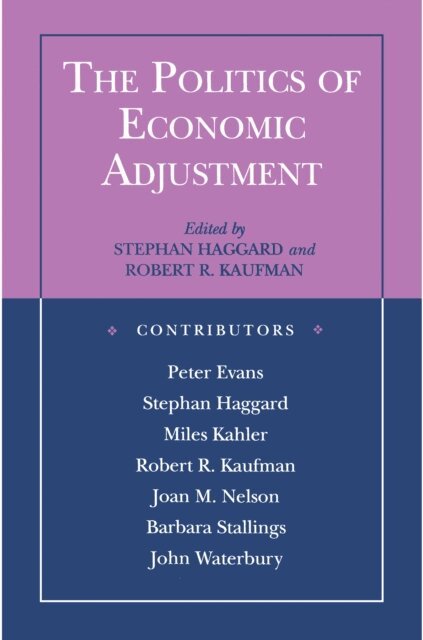
Politics of Economic Adjustment
International Constraints, Distributive Conflicts and the State
Häftad, Engelska, 1992
581 kr
Skickas inom 7-10 vardagar
In the 1980s some developing countries adopted orthodox market-oriented policies in response to international economic crises, others experimented with alternative programs, and still others failed to develop coherent adjustment strategies of any sort. Building on the case studies in Economic Crisis and Policy Choice, these essays offer comparative analysis of these divergent experiences with macroeconomic stabilization and structural adjustment. Barbara Stallings and Miles Kahler explore the external pressures on governments. Peter Evans and John Waterbury examine the role of the state in the adjustment process, Evans through the lens of earlier historical experience with economic restructuring, Waterbury by focusing on the politics of privatization. Joan Nelson analyzes the politics of income distribution in the adjustment process, and Haggard and Kaufman investigate the political correlates of inflation and stabilization. A final essay assesses the prospects for combining market-oriented reforms with political democratization.
503 kr
Skickas inom 7-10 vardagar
In the last two decades, there has been a widespread movement from authoritarian to democratic rule among developing countries, often occurring against a backdrop of severe economic crises and the adoption of market-oriented reforms. The coincidence of these events raises long-standing questions about the relationship between economic and political change. In this book, Stephan Haggard and Robert Kaufman explore this relationship, addressing a variety of questions: What role have economic crises played in the current wave of political liberalization and democratization? Can new democracies manage the daunting political challenges posed by economic reform? Under what economic and institutional conditions is democracy most likely to be consolidated? Drawing on contemporary political economy and the experiences of twelve Latin American and Asian countries, they develop a new approach to understanding democratic transitions.Haggard and Kaufman first analyze the relationship between economic crisis and authoritarian withdrawal and then examine how the economic and institutional legacies of authoritarian rule affect the capacity of new democratic governments to initiate and sustain economic policy reform. Finally, the authors analyze the consolidation of political and economic reform over the long run. Throughout, they emphasize the relationship between economic conditions, the interests and power of contending social groups, and the mediating role of representative institutions, particularly political parties.
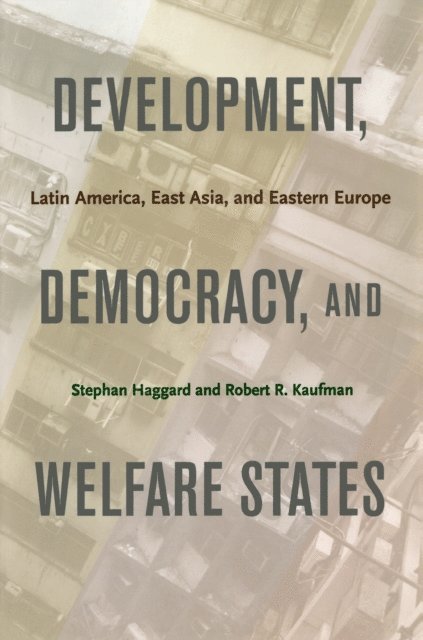
Development, Democracy, and Welfare States
Latin America, East Asia, and Eastern Europe
Häftad, Engelska, 2008
440 kr
Skickas inom 7-10 vardagar
This is the first book to compare the distinctive welfare states of Latin America, East Asia, and Eastern Europe. Stephan Haggard and Robert Kaufman trace the historical origins of social policy in these regions to crucial political changes in the mid-twentieth century, and show how the legacies of these early choices are influencing welfare reform following democratization and globalization. After World War II, communist regimes in Eastern Europe adopted wide-ranging socialist entitlements while conservative dictatorships in East Asia sharply limited social security but invested in education. In Latin America, where welfare systems were instituted earlier, unequal social-security systems favored formal sector workers and the middle class. Haggard and Kaufman compare the different welfare paths of the countries in these regions following democratization and the move toward more open economies. Although these transformations generated pressure to reform existing welfare systems, economic performance and welfare legacies exerted a more profound influence.The authors show how exclusionary welfare systems and economic crisis in Latin America created incentives to adopt liberal social-policy reforms, while social entitlements from the communist era limited the scope of liberal reforms in the new democracies of Eastern Europe. In East Asia, high growth and permissive fiscal conditions provided opportunities to broaden social entitlements in the new democracies. This book highlights the importance of placing the contemporary effects of democratization and globalization into a broader historical context.
951 kr
Skickas inom 7-10 vardagar
From the 1980s through the first decade of the twenty-first century, the spread of democracy across the developing and post-Communist worlds transformed the global political landscape. What drove these changes and what determined whether the emerging democracies would stabilize or revert to authoritarian rule? Dictators and Democrats takes a comprehensive look at the transitions to and from democracy in recent decades. Deploying both statistical and qualitative analysis, Stephen Haggard and Robert Kaufman engage with theories of democratic change and advocate approaches that emphasize political and institutional factors. While inequality has been a prominent explanation for democratic transitions, the authors argue that its role has been limited, and elites as well as masses can drive regime change. Examining seventy-eight cases of democratic transition and twenty-five reversions since 1980, Haggard and Kaufman show how differences in authoritarian regimes and organizational capabilities shape popular protest and elite initiatives in transitions to democracy, and how institutional weaknesses cause some democracies to fail.The determinants of democracy lie in the strength of existing institutions and the public's capacity to engage in collective action. There are multiple routes to democracy, but those growing out of mass mobilization may provide more checks on incumbents than those emerging from intra-elite bargains. Moving beyond well-known beliefs regarding regime changes, Dictators and Democrats explores the conditions under which transitions to democracy are likely to arise.
330 kr
Skickas inom 7-10 vardagar
From the 1980s through the first decade of the twenty-first century, the spread of democracy across the developing and post-Communist worlds transformed the global political landscape. What drove these changes and what determined whether the emerging democracies would stabilize or revert to authoritarian rule? Dictators and Democrats takes a comprehensive look at the transitions to and from democracy in recent decades. Deploying both statistical and qualitative analysis, Stephen Haggard and Robert Kaufman engage with theories of democratic change and advocate approaches that emphasize political and institutional factors. While inequality has been a prominent explanation for democratic transitions, the authors argue that its role has been limited, and elites as well as masses can drive regime change. Examining seventy-eight cases of democratic transition and twenty-five reversions since 1980, Haggard and Kaufman show how differences in authoritarian regimes and organizational capabilities shape popular protest and elite initiatives in transitions to democracy, and how institutional weaknesses cause some democracies to fail.The determinants of democracy lie in the strength of existing institutions and the public's capacity to engage in collective action. There are multiple routes to democracy, but those growing out of mass mobilization may provide more checks on incumbents than those emerging from intra-elite bargains. Moving beyond well-known beliefs regarding regime changes, Dictators and Democrats explores the conditions under which transitions to democracy are likely to arise.
Crucial Needs, Weak Incentives
Social Sector Reform, Democratization, and Globalization in Latin America
Inbunden, Engelska, 2005
520 kr
Tillfälligt slut
Crucial Needs, Weak Incentives studies the politics of efforts to reform education and health services in Latin America in the 1990s. Both sectors were common targets of reform-education because of its economic importance, health care because of needs to reduce great inequities of access and opportunities to increase domestic savings presented by reforms. Both sectors also have large numbers of unionized public employees, whose presence affects patronage as well as political power. The book presents case studies that offer a wealth of new information not previously accessible to the English-speaking academic and policy community. For health care, these cover Mexico, Argentina, Colombia, Brazil, Costa Rica, and Peru; for eductaion, Mexico, Argentina, Colombia, Brazil, Nicaragua, and Venezuela. Four chapters by the editors set out for each sector the goals, structure, and outcomes of reform efforts. Contributors are Marta Arretche, Josefina Bruni Celli, Mary A. Clark, Javier Corrales, Sonia M. Draibe, Christina Ewig, Alec Ian Gershberg, Alejandra Gonzalez Rossetti, Merilee S. Grindle, Peter Lloyd-Sherlock, Pamela S. Lowden, and Patricia Ramirez.