Robert Stilling – författare
Visar alla böcker från författaren Robert Stilling. Handla med fri frakt och snabb leverans.
2 produkter
2 produkter
Inbunden, Engelska, 2021
502 kr
Skickas inom 10-15 vardagar
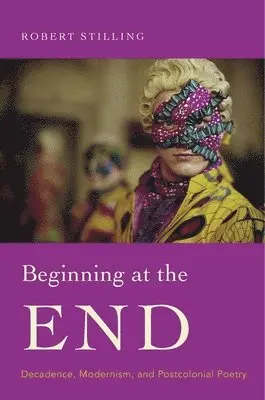
During the struggle for decolonization, Frantz Fanon argued that artists who mimicked European aestheticism were “beginning at the end,” skipping the inventive phase of youth for a decadence thought more typical of Europe’s declining empires. Robert Stilling takes up Fanon’s assertion to argue that decadence became a key idea in postcolonial thought, describing both the failures of revolutionary nationalism and the assertion of new cosmopolitan ideas about poetry and art.In Stilling’s account, anglophone postcolonial artists have reshaped modernist forms associated with the idea of art for art’s sake and often condemned as decadent. By reading decadent works by J. K. Huysmans, Walter Pater, Henry James, and Oscar Wilde alongside Chinua Achebe, Derek Walcott, Agha Shahid Ali, Derek Mahon, Yinka Shonibare, Wole Soyinka, and Bernardine Evaristo, Stilling shows how postcolonial artists reimagined the politics of aestheticism in the service of anticolonial critique. He also shows how fin de siècle figures such as Wilde questioned the imperial ideologies of their own era.Like their European counterparts, postcolonial artists have had to negotiate between the imaginative demands of art and the pressure to conform to a revolutionary politics seemingly inseparable from realism. Beginning at the End argues that both groups—European decadents and postcolonial artists—maintained commitments to artifice while fostering oppositional politics. It asks that we recognize what aestheticism has contributed to politically engaged postcolonial literature. At the same time, Stilling breaks down the boundaries around decadent literature, taking it outside of Europe and emphasizing the global reach of its imaginative transgressions.
Häftad, Engelska, 2008
285 kr
Skickas inom 10-15 vardagar
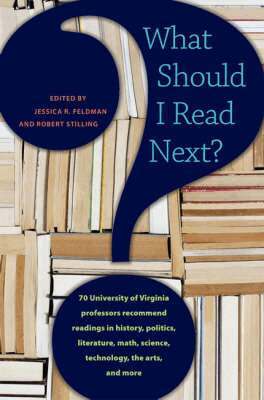
Even the most well-read among us feel gaps in our knowledge. Former English majors or art students want to understand the monetary system; mathematicians or doctors just want a great novel. Travel sections in bookstores are full of authors ready to tell you the hundred places to visit before you die, but what about the best book to read on global warming?""What Should I Read Next?"" taps seventy University of Virginia professors in an array of fields for suggestions on how to satisfy this nagging intellectual curiosity. Each contributor recommends five titles that speak to their area of inquiry, providing both a general introduction and commentary on each selection. The results read like a series of personal tutorials: Larry Sabato considers how political power is acquired, used, and held onto; climatologist Robert E. Davis provides a timely navigation of global-warming literature; and Michael Levenson offers five ways to approach James Joyce's Ulysses. Other topics include how computing changes thinking, the life and afterlife of slavery, understanding cities, and ecstatic poetry. The entries convey the contributors' expertise but also, more importantly, the enthusiasm, the original kernels of curiosity, that drew these scholars to their life's work.Designed for the lifelong learner who wants to branch out from his or her own profession or discipline, these explorations - of art, science, history, technology, politics, and much more - offer an inspiring place to start.