Robert Zemsky - Böcker
Visar alla böcker från författaren Robert Zemsky. Handla med fri frakt och snabb leverans.
8 produkter
8 produkter
338 kr
Skickas inom 5-8 vardagar
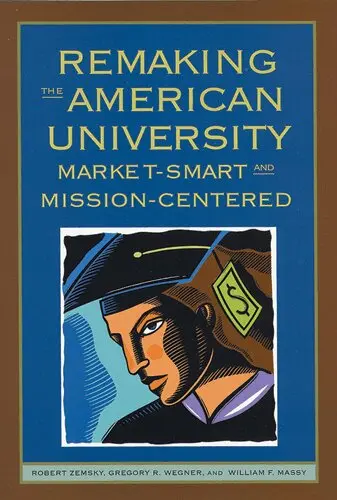
At one time, universities educated new generations and were a source of social change. Today colleges and universities are less places of public purpose, than agencies of personal advantage. Remaking the American University provides a penetrating analysis of the ways market forces have shaped and distorted the behaviors, purposes, and ultimately the missions of universities and colleges over the past half-century. The authors describe how a competitive preoccupation with rankings and markets published by the media spawned an admissions arms race that drains institutional resources and energies. Equally revealing are the depictions of the ways faculty distance themselves from their universities with the resulting increase in the number of administrators, which contributes substantially to institutional costs. Other chapters focus on the impact of intercollegiate athletics on educational mission, even among selective institutions; on the unforeseen result of higher education's "outsourcing" a substantial share of the scholarly publication function to for-profit interests; and on the potentially dire consequences of today's zealous investments in e-learning.A central question extends through this series of explorations: Can universities and colleges today still choose to be places of public purpose? In the answers they provide, both sobering and enlightening, the authors underscore a consistent and powerful lesson-academic institutions cannot ignore the workings of the markets. The challenge ahead is to learn how to better use those markets to achieve public purposes.
376 kr
Skickas inom 7-10 vardagar
Making Reform Work is a practical narrative of ideas that begins by describing who is saying what about American higher education, who's angry, who's disappointed, and why. Most of the pleas for changing American colleges and universities that originate outside the academy are lamentations on a small number of too often repeated themes. The critique from within the academy focuses on issues principally involving money and the power of the market to change colleges and universities. Sandwiched between these perspectives is a public that still has faith in an enterprise that it really doesn't understand. Robert Zemsky, one of a select group of scholars who participated in Secretary of Education Margaret Spellings' 2005 Commission on the Future of Higher Education, signed off on the commission's report with reluctance. In Making Reform Work he presents the ideas he believes should have come from that group to forge a practical agenda for change. Zemsky argues that improving higher education will require enlisting faculty leadership, on the one hand, and, on the other, a strategy for changing the higher education system writ large. Directing his attention from what can't be done to what can be done, Zemsky provides numerous suggestions. These include a renewed effort to help students' performance in high schools and a stronger focus on the science of active learning, not just teaching methods. He concludes by suggesting a series of dislodging events, for example, making a three-year baccalaureate the standard undergraduate degree, congressional rethinking of student aid in the wake of the loan scandal, and a change in the rules governing endowments that could break the gridlock that today holds higher education reform captive. Making Reform Work offers three rules for successful college and university transformation: don't vilify, don't play games, and come to the table with a well-thought-out strategy rather than a sharply worded lamentation.
Checklist for Change
Making American Higher Education a Sustainable Enterprise
Inbunden, Engelska, 2013
414 kr
Skickas inom 7-10 vardagar
Almost every day American higher education is making news with a list of problems that includes the incoherent nature of the curriculum, the resistance of the faculty to change, and the influential role of the federal government both through major investments in student aid and intrusive policies. Checklist for Change not only diagnoses these problems, but also provides constructive recommendations for practical change. Robert Zemsky details the complications that have impeded every credible reform intended to change American higher education. He demythologizes such initiatives as the Morrill Act, the GI Bill, and the Higher Education Act of 1972, shedding new light on their origins and the ways they have shaped higher education in unanticipated and not commonly understood ways. Next, he addresses overly simplistic arguments about the causes of the problems we face and builds a convincing argument that well-intentioned actions have combined to create the current mess for which everyone is to blame.Using provocative case studies, Zemsky describes the reforms being implemented at a few institutions with the hope that these might serve as harbingers of the kinds of change needed: the University of Minnesota at Rochester’s compact curriculum in the health sciences only, Whittier College’s emphasis on learning outcomes, and the University of Wisconsin Oshkosh’s coherent overall curriculum. In conclusion, Zemsky describes the principal changes that must occur not singly but in combination. These include a fundamental recasting of federal financial aid; new mechanisms for better channeling the competition among colleges and universities; recasting the undergraduate curriculum; and a stronger, more collective faculty voice in governance that defines not why, but how the enterprise must change.
Making Sense of the College Curriculum
Faculty Stories of Change, Conflict, and Accommodation
Inbunden, Engelska, 2018
350 kr
Skickas inom 7-10 vardagar
Readers of Making Sense of the College Curriculum expecting a traditional academic publication full of numeric and related data will likely be disappointed with this volume, which is based on stories rather than numbers. The contributors include over 185 faculty members from eleven colleges and universities, representing all sectors of higher education, who share personal, humorous, powerful, and poignant stories about their experiences in a life that is more a calling than a profession. Collectively, these accounts help to answer the question of why developing a coherent undergraduate curriculum is so vexing to colleges and universities. Their stories also belie the public’s and policymakers’ belief that faculty members care more about their scholarship and research than their students and work far less than most people.
Making Sense of the College Curriculum
Faculty Stories of Change, Conflict, and Accommodation
Häftad, Engelska, 2026
204 kr
Kommande
Readers of Making Sense of the College Curriculum expecting a traditional academic publication full of numeric and related data will likely be disappointed with this volume, which is based on stories rather than numbers. The contributors include over 185 faculty members from eleven colleges and universities, representing all sectors of higher education, who share personal, humorous, powerful, and poignant stories about their experiences in a life that is more a calling than a profession. Collectively, these accounts help to answer the question of why developing a coherent undergraduate curriculum is so vexing to colleges and universities. Their stories also belie the public’s and policymakers’ belief that faculty members care more about their scholarship and research than their students and work far less than most people.
342 kr
Skickas inom 7-10 vardagar
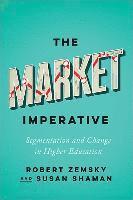
It is no surprise that college tuition and student debt are on the rise. Universities no longer charge tuition to simply cover costs. They are market enterprises that charge whatever the market will bear. Institutional ambition, along with increasing competition for students, now shapes the economics of higher education. In The Market Imperative, Robert Zemsky and Susan Shaman argue that too many institutional leaders and policymakers do not understand how deeply the consumer markets they promoted have changed American higher education. Instead of functioning as a single integrated industry, higher education is in fact a collection of segmented and more or less separate markets. These markets have their own distinctive operating constraints and logics, especially regarding price. But those most responsible for federal higher education policy have made a muck of the enterprise, while state policymaking has all but disappeared, the victim of weak imaginations, insufficient funding, and an aversion to targeted investment.Chapter by chapter, The Market Imperative draws on new data developed by the authors in a Gates Foundation-funded project to describe the landscape: how the market for higher education distributes students among competing institutions; what the job market is looking for; how markets differ across the fifty states; and how the higher education market determines the kinds of faculty at different kinds of institutions. The volume concludes with a three-pronged set of policies for making American higher education mission centered as well as market smart. Although there is no "one-size-fits-all" approach for reforming higher education, this clearly written book will productively advance understanding of the challenges colleges and universities face by providing a mapping of the configuration of the market for an undergraduate education.
444 kr
Skickas inom 7-10 vardagar
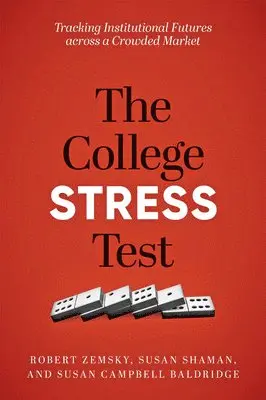
Provides an insightful analysis of the market stresses that threaten the viability of some of America's colleges and universities while delivering a powerful predictive tool to measure an institution's risk of closure.In The College Stress Test, Robert Zemsky, Susan Shaman, and Susan Campbell Baldridge present readers with a full, frank, and informed discussion about college and university closures. Drawing on the massive institutional data set available from IPEDS (the Integrated Postsecondary Education Data System), they build a stress test for estimating the market viability of more than 2,800 undergraduate institutions. They examine four key variables—new student enrollments, net cash price, student retention, and major external funding—to gauge whether an institution is potentially at risk of considering closure or merging with another school. They also assess student body demographics to see which students are commonly served by institutions experiencing market stress. The book's appendix includes a powerful do-it-yourself tool that institutions can apply, using their own IPEDS data, to understand their level of risk.The book's underlying statistical analysis makes clear that closings will not be nearly as prevalent as many prognosticators are predicting and will in fact impact relatively few students. The authors argue that just 10 percent or fewer of the nation's colleges and universities face substantial market risk, while 60 percent face little or no market risk. The remaining 30 percent of institutions, the authors find, are bound to struggle. To thrive, the book advises, these schools will need to reconsider the curricula they deliver, the prices they charge, and their willingness to experiment with new modes of instruction. The College Stress Test provides an urgently needed road map at a moment when the higher education terrain is shifting. Those interested in and responsible for the fate of these institutions will find in this book a clearly defined set of risk indicators, a methodology for monitoring progress over time, and an evidence-based understanding of where they reside in the landscape of institutional risk.
373 kr
Skickas inom 7-10 vardagar
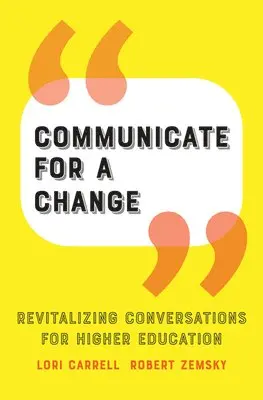
This is a different kind of book: a call for courageous conversations focusing on nine taboo subjects that bedevil higher education.For nearly a decade, distinguished scholars Lori Carrell and Robert Zemsky have been having frank conversations with each other—and with colleagues and friends—about the state of higher education. In Communicate for a Change, they bring together nine of their most insightful conversations to explore difficult questions that today's administrators, trustees, and faculty members too frequently avoid. Why, Carrell and Zemsky ask, is it so hard to talk about the mess that higher education is in? And how can we refocus the conversation on what really matters, grappling with taboo subjects in a way that helps to revitalize higher education from the inside out? Grounded in the real, as opposed to the rhetorical, importance of community in making change, these revealing conversations also explore• why the public no longer sees faculty as heroes and experts• how to overcome the academy's fondness for slogans• how money talks• why curricular change doesn't (usually) happen• the students we hardly know and how we might come to know them better• how to constructively approach differences of race and gender• and much moreA golden thread weaves its way through the book, revealing the premise that rich, honest talk can generate trust, connection, and fresh ideas for revolutionary change. Carrell, the chancellor of the University of Minnesota Rochester, is by both training and instinct a testifier. Learning for her is tangible, a product of truly getting dirty, sorting through the muck of conflict as well as connection. Zemsky, on the other hand, is a provocateur who pushes an argument as a means to explore differences and conflicts. Both are natural storytellers. Their conversations are enriched by the contributions of a host of higher education experts and leaders. Breaking new ground in terms of both its subject matter and its format, Communicate for a Change is an accessible and engaging catalyst that will kick-start subsequent deliberations.