Roberto Alejandro - Böcker
Visar alla böcker från författaren . Handla med fri frakt och snabb leverans.
5 produkter
5 produkter
422 kr
Skickas inom 10-15 vardagar
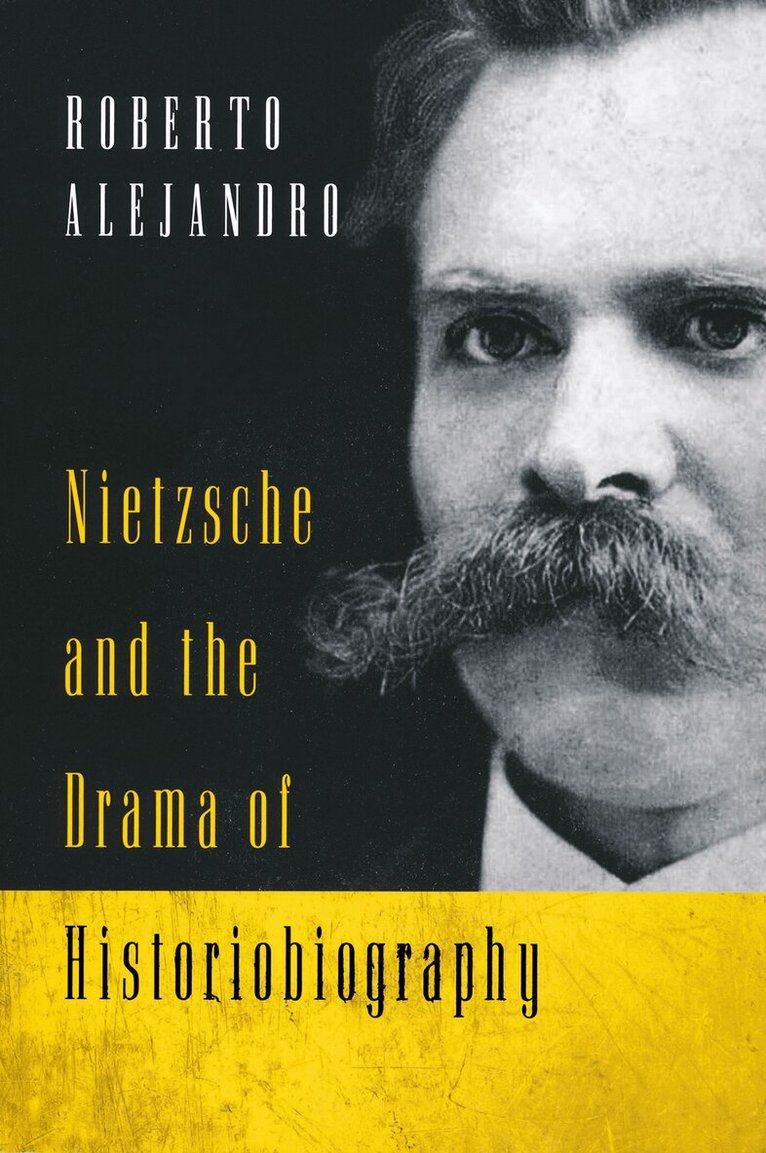
In this extraordinary contribution to Nietzsche studies, Robert Alejandro offers an original interpretation of Friedrich Nietzsche's philosophy viewed as a complete whole. Alejandro painstakingly traces the different ways in which Nietzsche reconfigured and shifted his analyses of morality and of the human condition, until he was content with the final result: nothing was dispensable; everything was necessary. This is a philosophy of reconciliation—hardly nihilism—and it is a perspective that is not adequately addressed elsewhere in the literature on Nietzsche. Alejandro traces the evolution of Nietzsche's thought by identifying the different layers of his philosophy, expressed in a complex array of stories and historical narratives. Alejandro analyzes the different stories of Nietzsche, places those stories within a tradition of genealogical theorizing, and interprets both the stories and the genealogy in terms of one of Nietzsche's unique features, his use of "historiobiography." According to Alejandro, historiobiography blends the idea of an attunement with all history and one's awareness of this attunement. As a mode of philosophizing, historiobiography allows Nietzsche to view all human history as if it runs through his own life and thoughts. Alejandro argues that Nietzsche deployed three strategies to find relief from his sense of the meaninglessness of life: his magnified concept of what he himself represented in human history, his doctrine of the eternal recurrence, and his philosophy of reconciliation.
1 344 kr
Skickas inom 10-15 vardagar
In this extraordinary contribution to Nietzsche studies, Robert Alejandro offers an original interpretation of Friedrich Nietzsche's philosophy viewed as a complete whole. Alejandro painstakingly traces the different ways in which Nietzsche reconfigured and shifted his analyses of morality and of the human condition, until he was content with the final result: nothing was dispensable; everything was necessary. This is a philosophy of reconciliation—hardly nihilism—and it is a perspective that is not adequately addressed elsewhere in the literature on Nietzsche. Alejandro traces the evolution of Nietzsche's thought by identifying the different layers of his philosophy, expressed in a complex array of stories and historical narratives. Alejandro analyzes the different stories of Nietzsche, places those stories within a tradition of genealogical theorizing, and interprets both the stories and the genealogy in terms of one of Nietzsche's unique features, his use of "historiobiography." According to Alejandro, historiobiography blends the idea of an attunement with all history and one's awareness of this attunement. As a mode of philosophizing, historiobiography allows Nietzsche to view all human history as if it runs through his own life and thoughts. Alejandro argues that Nietzsche deployed three strategies to find relief from his sense of the meaninglessness of life: his magnified concept of what he himself represented in human history, his doctrine of the eternal recurrence, and his philosophy of reconciliation.
1 057 kr
Tillfälligt slut
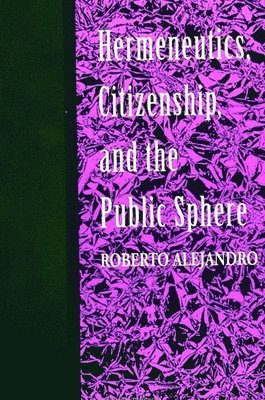
This book sheds new light on the question of democratic politics by proposing a hermeneutic conception of citizenship and the public sphere. At the same time, it presents a critique of the postmodern arguments advanced by Richard Rorty, Jean-Francois Lyotard, and Jean Baudrillard. Questioning a dominant interpretation that sees Gadamer's hermeneutics as the expression of a conservative project, Alejandro argues that it includes an important element of critique that could challenge dominant structures and practices.
566 kr
Skickas inom 3-6 vardagar
This book sheds new light on the question of democratic politics by proposing a hermeneutic conception of citizenship and the public sphere. At the same time, it presents a critique of the postmodern arguments advanced by Richard Rorty, Jean-Francois Lyotard, and Jean Baudrillard. Questioning a dominant interpretation that sees Gadamer's hermeneutics as the expression of a conservative project, Alejandro argues that it includes an important element of critique that could challenge dominant structures and practices.
387 kr
Skickas inom 5-8 vardagar
The idea of fairness lies at the heart of the concept of justice proposed by political philosopher John Rawls, a concept that liberals have often invoked to defend the welfare state. In The Limits of Rawlsian Justice political theorist Roberto Alejandro challenges the assumptions that Rawls set out to defend his position. While other opponents of Rawls have attempted to offer an alternative to his concept of justice as fairness, Alejandro instead examines Rawls from within his own writings, testing Rawls's assumptions on the basis of those assumptions themselves. As a result, Alejandro shows that Rawls's idea of justice as fairness is fraught with inner tensions, exposed to utilitarian dangers, and far from being the coherent model Rawls promised. Alejandro concludes that Rawls's notion of justice-as-fairness preserves the status quo, overlooks the realities of inequalities in today's society, and is inherently conservative. As a theoretical paradigm, it is exhausted. He urges that we acknowledge the limits of Rawlsian justice both as a defense of the welfare state and as the basis of a just society.