Robin Milner - Böcker
Visar alla böcker från författaren Robin Milner. Handla med fri frakt och snabb leverans.
7 produkter
7 produkter
535 kr
Skickas inom 3-6 vardagar
746 kr
Skickas inom 7-10 vardagar
First published in 1996, this collection of essays by distinguished computer scientists celebrates the achievements of research and speculates about the unsolved problems in computer science that require future investigation. Since the subject stretches from technology in the field, through engineering design to foundations in mathematics, there is a wide variety of concerns and approaches among the authors. The book's purpose is to show that long-term research in computer science is crucial and that it must not be driven solely by commercial considerations. The authors do not shirk the difficult aspects of their topics, but try to expose them in the simplest terms possible without diluting them, in order that the reader can understand the issues involved. Thus the book also represents a broad overview of much of the state of knowledge and future expectations of computer science, illustrating that it is much more than a technology and it is a fully fledged and growing intellectual discipline with its own engineering principles and its own scientific concepts and models. It will be stimulating reading because it represents the views of prominent authorities who have had a significant impact on the direction of innovation, research and development in computer science.
1 349 kr
Skickas inom 7-10 vardagar
First published in 1996, this collection of essays by distinguished computer scientists celebrates the achievements of research and speculates about the unsolved problems in computer science that require future investigation. Since the subject stretches from technology in the field, through engineering design to foundations in mathematics, there is a wide variety of concerns and approaches among the authors. The book's purpose is to show that long-term research in computer science is crucial and that it must not be driven solely by commercial considerations. The authors do not shirk the difficult aspects of their topics, but try to expose them in the simplest terms possible without diluting them, in order that the reader can understand the issues involved. Thus the book also represents a broad overview of much of the state of knowledge and future expectations of computer science, illustrating that it is much more than a technology and it is a fully fledged and growing intellectual discipline with its own engineering principles and its own scientific concepts and models. It will be stimulating reading because it represents the views of prominent authorities who have had a significant impact on the direction of innovation, research and development in computer science.
955 kr
Skickas inom 7-10 vardagar
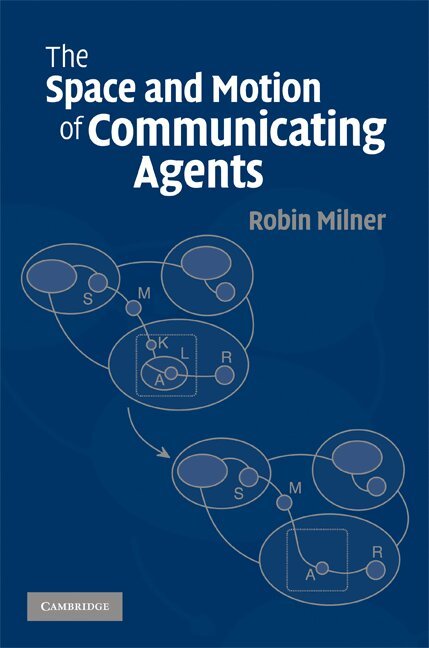
The world is increasingly populated with interactive agents distributed in space, real or abstract. These agents can be artificial, as in computing systems that manage and monitor traffic or health; or they can be natural, e.g. communicating humans, or biological cells. It is important to be able to model networks of agents in order to understand and optimise their behaviour. Robin Milner describes in this book just such a model, by presenting a unified and rigorous structural theory, based on bigraphs, for systems of interacting agents. This theory is a bridge between the existing theories of concurrent processes and the aspirations for ubiquitous systems, whose enormous size challenges our understanding. The book is reasonably self-contained mathematically, and is designed to be learned from: examples and exercises abound, solutions for the latter are provided. Like Milner's other work, this is destined to have far-reaching and profound significance.
1 241 kr
Skickas inom 7-10 vardagar
The pi-calculus differs from other models of communicating behaviour mainly in its treatment of mobility. The movement of a piece of data inside a computer program is treated exactly the same as the transfer of a message - or indeed an entire computer program - across the internet. One can also describe networks which reconfigure themselves. The calculus is very simple but powerful; its most prominent ingredient is the notion of a name. Its theory has two important ingredients: the concept of behavioural (or observational) equivalence, and the use of a new theory of types to classify patterns of interactive behaviour. The internet, and its communication protocols, fall within the scope of the theory just as much as computer programs, data structures, algorithms and programming languages. This book is the first textbook on the subject; it has been long-awaited by professionals and will be welcomed by them, and their students.
733 kr
Skickas inom 7-10 vardagar
The pi-calculus differs from other models of communicating behaviour mainly in its treatment of mobility. The movement of a piece of data inside a computer program is treated exactly the same as the transfer of a message - or indeed an entire computer program - across the internet. One can also describe networks which reconfigure themselves. The calculus is very simple but powerful; its most prominent ingredient is the notion of a name. Its theory has two important ingredients: the concept of behavioural (or observational) equivalence, and the use of a new theory of types to classify patterns of interactive behaviour. The internet, and its communication protocols, fall within the scope of the theory just as much as computer programs, data structures, algorithms and programming languages. This book is the first textbook on the subject; it has been long-awaited by professionals and will be welcomed by them, and their students.
636 kr
Skickas inom 7-10 vardagar
The world is increasingly populated with interactive agents distributed in space, real or abstract. These agents can be artificial, as in computing systems that manage and monitor traffic or health; or they can be natural, e.g. communicating humans, or biological cells. It is important to be able to model networks of agents in order to understand and optimise their behaviour. Robin Milner describes in this book just such a model, by presenting a unified and rigorous structural theory, based on bigraphs, for systems of interacting agents. This theory is a bridge between the existing theories of concurrent processes and the aspirations for ubiquitous systems, whose enormous size challenges our understanding. The book is reasonably self-contained mathematically, and is designed to be learned from: examples and exercises abound, solutions for the latter are provided. Like Milner's other work, this is destined to have far-reaching and profound significance.