Robert Harper – författare
Visar alla böcker från författaren Robert Harper. Handla med fri frakt och snabb leverans.
7 produkter
7 produkter
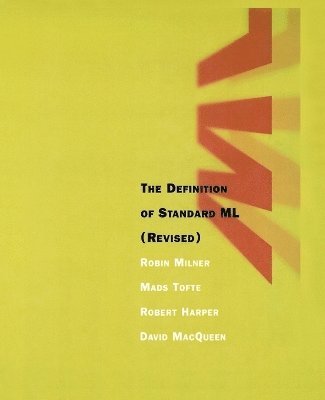
Häftad, Engelska, 1997
522 kr
Skickas inom 3-6 vardagar
Häftad, Engelska, 1990
392 kr
Skickas inom 5-8 vardagar
In 1961 Jean Gottmann published his pioneering study of urban sprawl along the Boston-Washington corridor. The book's title soon became a household word, and its author gained worldwide acclaim for his insights into the dimensions of urbanism. Since writing "Megalopolis," Gottmann has published more than eighty articles on the urban scene. Now, for the first time, the best of that work is available in a single volume. "Since Megalopolis" treats urban questions from the ancient and modern worlds alike. What can today's planners learn from the ancient Greek city of Miletus? What do the shape and placement of the world's capitals tell us about their function? How large can our cities grow before suffocating in slums, pollution, and crime? Gottmann offers a hard-headed argument on the economic value of city parks--and a utopian vision of Manhattan auto traffic speeding through subway tunnels. He examines Tanaka's Tokyo and Solomon's Jerusalem--and tells why the king's wisdom did not extend to urban planning. In an introductory essay new to this volume, Gottmann draws a lesson from an earlier megalopolis."In antiquity," he writes, "a great city flourished for 600 years on the small and craggy island of Delos in the Aegean sea. When circumstances excluded it from the predominant networks, it fell into ruins. Now an archaeological museum, Delos reminds us that cities are human artifacts and exist by participating in systems of relationships, not just as eagle nests."
Inbunden, Engelska, 2016
929 kr
Skickas inom 7-10 vardagar
This text develops a comprehensive theory of programming languages based on type systems and structural operational semantics. Language concepts are precisely defined by their static and dynamic semantics, presenting the essential tools both intuitively and rigorously while relying on only elementary mathematics. These tools are used to analyze and prove properties of languages and provide the framework for combining and comparing language features. The broad range of concepts includes fundamental data types such as sums and products, polymorphic and abstract types, dynamic typing, dynamic dispatch, subtyping and refinement types, symbols and dynamic classification, parallelism and cost semantics, and concurrency and distribution. The methods are directly applicable to language implementation, to the development of logics for reasoning about programs, and to the formal verification language properties such as type safety. This thoroughly revised second edition includes exercises at the end of nearly every chapter and a new chapter on type refinements.
E-bok
PDF, Engelska, 20161 085 kr
Läs direkt efter köp
This text develops a comprehensive theory of programming languages based on type systems and structural operational semantics. Language concepts are precisely defined by their static and dynamic semantics, presenting the essential tools both intuitively and rigorously while relying on only elementary mathematics. These tools are used to analyze and prove properties of languages and provide the framework for combining and comparing language features. The broad range of concepts includes fundamental data types such as sums and products, polymorphic and abstract types, dynamic typing, dynamic dispatch, subtyping and refinement types, symbols and dynamic classification, parallelism and cost semantics, and concurrency and distribution. The methods are directly applicable to language implementation, to the development of logics for reasoning about programs, and to the formal verification language properties such as type safety. This thoroughly revised second edition includes exercises at the end of nearly every chapter and a new chapter on type refinements.
E-bok
Engelska102 kr
Läs direkt efter köp
Häftad, Engelska, 2001
565 kr
Skickas inom 10-15 vardagar
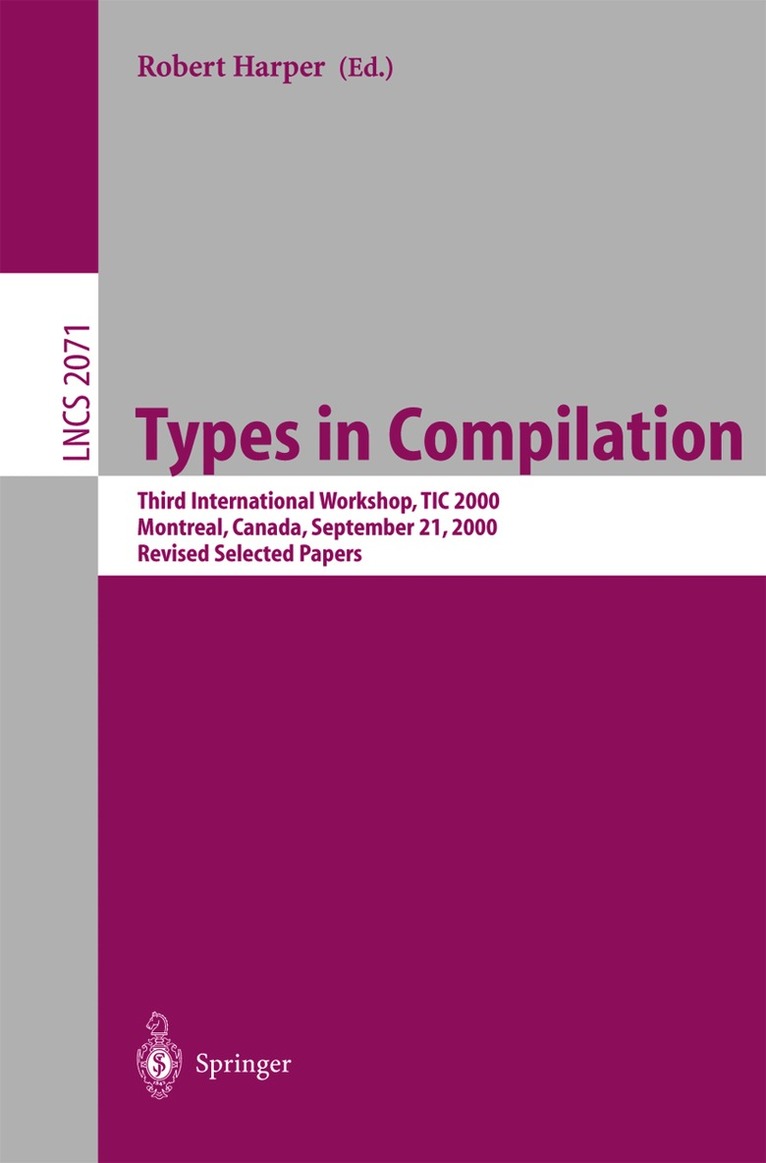
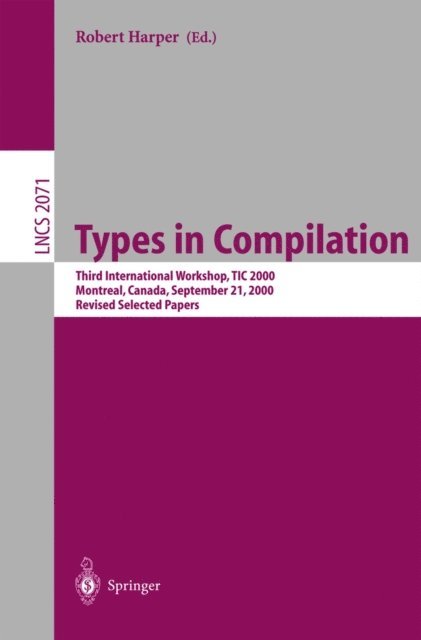
The importance of typed languages for building robust software systems is, by now, an undisputed fact. Years of research have led to languages with richly expressive, yet easy to use, type systems for high-level programming languages. Types provide not only a conceptual framework for language designers, but also a ord positive bene ts to the programmer, principally the ability to express and enforce levels of abstraction within a program. Early compilers for typed languages followed closely the methods used for their untyped counterparts. The role of types was limited to the earliest s- ges of compilation, and they were thereafter ignored during the remainder of the translation process. More recently, however, implementors have come to - cognize the importance of types during compilation and even for object code. Several advantages of types in compilation have been noted to date: { They support self-checking by the compiler. By tracking types during c- pilation it is possible for an internal type checker to detect translation errors at an early stage, greatly facilitating compiler development. { They support certi cation of object code. By extending types to the ge- rated object code, it becomes possible for a code user to ensure the basic integrity of that code by checking its type consistency before execution. { They support optimized data representations and calling conventions, even in the presence of modularity. By passing types at compile-, link-, and even run-time, it is possible to avoid compromises of data representation imposed by untyped compilation techniques.
E-bok
PDF, Engelska, 2003708 kr
Läs direkt efter köp
The importance of typed languages for building robust software systems is, by now, an undisputed fact. Years of research have led to languages with richly expressive, yet easy to use, type systems for high-level programming languages. Types provide not only a conceptual framework for language designers, but also a ord positive bene ts to the programmer, principally the ability to express and enforce levels of abstraction within a program. Early compilers for typed languages followed closely the methods used for their untyped counterparts. The role of types was limited to the earliest s- ges of compilation, and they were thereafter ignored during the remainder of the translation process. More recently, however, implementors have come to - cognize the importance of types during compilation and even for object code. Several advantages of types in compilation have been noted to date: { They support self-checking by the compiler. By tracking types during c- pilation it is possible for an internal type checker to detect translation errors at an early stage, greatly facilitating compiler development. { They support certi cation of object code. By extending types to the ge- rated object code, it becomes possible for a code user to ensure the basic integrity of that code by checking its type consistency before execution. { They support optimized data representations and calling conventions, even in the presence of modularity. By passing types at compile-, link-, and even run-time, it is possible to avoid compromises of data representation imposed by untyped compilation techniques.