• Fri frakt över 249 kr
  • •
  • Snabba leveranser
  • •
  • Billiga böcker
Kundservice

Du är på sajten för privatpersoner.

Företag, bibliotek eller offentlig verksamhet?

Du handlar på classic.bokus.com, där alla dina funktioner finns intakta.
Till classic.bokus.com
Bokus logotyp. Gå till startsidan.
  • Erbjudanden
  • Nyheter
  • Student
  • Topplistor
  • Barn & ungdom
  • Bokus Play
  • E-böcker
  • Pocketböcker
  • Spel & pussel

10% studentrabatt med kod TERM26

Sidfot

Mina sidor

    Hjälp

    • Kundservice
    • Vanliga frågor och svar
    • Frakt och leverans
    • Retur vid ångerrätt
    • Reklamera vara
    • Betalning
    • Köpvillkor
    • Allmänna villkor
    • Information om webbplatsens tillgänglighet

    Om Bokus

    • Om oss
    • Pressrum
    • För studenter
    • För företag
    • För bibliotek och offentlig verksamhet
    • För leverantörer
    • Hållbarhet

    Populärt

    • Aktuella erbjudanden
    • Presentkort
    • Studentlitteratur
    • Nya böcker
    • Topplistor
    • Signerade böcker
    • Engelska böcker

    Inspiration

    • Boktips
    • BookTok
    • Populära bokserier
    • Barnbokskaraktärer
    • Populära författare
    Logotyp för Bokus
    Följ oss på Facebook (extern länk)Följ oss på Instagram (extern länk)Följ oss på YouTube (extern länk)Följ oss på TikTok (extern länk)
    bokus @ CookiesAnpassa cookiesIntegritetspolicyKöpvillkor
    Till Citymail hemsida (extern länk)Till Budbee hemsida (extern länk)Till Postnord hemsida (extern länk)Till Schenker hemsida (extern länk)Till Early Bird hemsida (extern länk)Till Walleys hemsida (extern länk)
    1. Data och IT
    2. Operativsystem

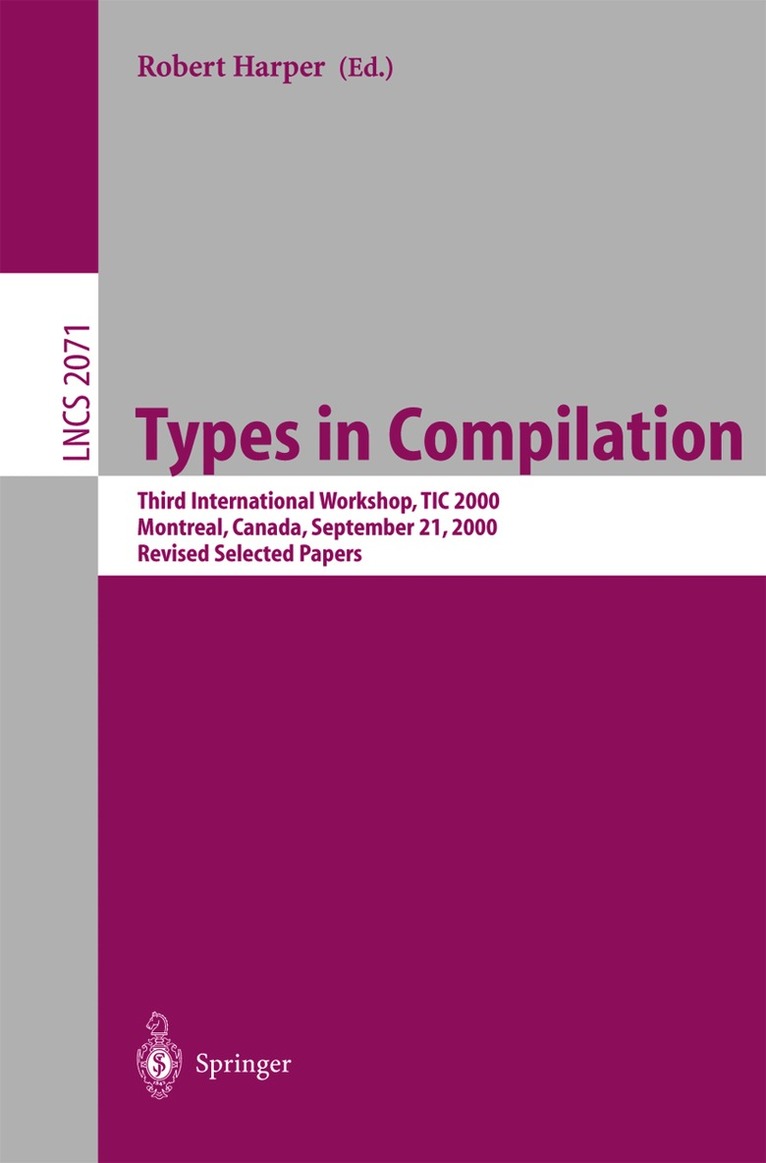
    Types in Compilation

    Third International Workshop, TIC 2000, Montreal, Canada, September 21, 2000. Revised Selected Papers

    AvRobert Harper

    Häftad, Engelska, 2001

    Del i serien Lecture Notes in Computer Science

    566 kr

    Beställningsvara. Skickas inom 10-15 vardagar. Fri frakt över 249 kr.

    Beskrivning

    The importance of typed languages for building robust software systems is, by now, an undisputed fact. Years of research have led to languages with richly expressive, yet easy to use, type systems for high-level programming languages. Types provide not only a conceptual framework for language designers, but also a ord positive bene ts to the programmer, principally the ability to express and enforce levels of abstraction within a program. Early compilers for typed languages followed closely the methods used for their untyped counterparts. The role of types was limited to the earliest s- ges of compilation, and they were thereafter ignored during the remainder of the translation process. More recently, however, implementors have come to - cognize the importance of types during compilation and even for object code. Several advantages of types in compilation have been noted to date: { They support self-checking by the compiler. By tracking types during c- pilation it is possible for an internal type checker to detect translation errors at an early stage, greatly facilitating compiler development. { They support certi cation of object code. By extending types to the ge- rated object code, it becomes possible for a code user to ensure the basic integrity of that code by checking its type consistency before execution. { They support optimized data representations and calling conventions, even in the presence of modularity. By passing types at compile-, link-, and even run-time, it is possible to avoid compromises of data representation imposed by untyped compilation techniques.

    Produktinformation

    • Utgivningsdatum:2001-06-20
    • Mått:155 x 235 x 13 mm
    • Vikt:347 g
    • Format:Häftad
    • Språk:Engelska
    • Serie:Lecture Notes in Computer Science
    • Antal sidor:214
    • Upplaga:2001
    • Förlag:Springer-Verlag Berlin and Heidelberg GmbH & Co. KG
    • ISBN:9783540421962

    Utforska kategorier

    • Operativsystem inom Data och IT

    Innehållsförteckning

    • Types in Compilation.- Sound and Complete Elimination of Singleton Kinds.- Program Representation Size in an Intermediate Language with Intersection and Union Types.- An Abstract Model of Java Dynamic Linking and Loading.- Sharing in Typed Module Assembly Language.- Scalable Certification for Typed Assembly Language.- Safe and Flexible Dynamic Linking of Native Code.- Alias Types for Recursive Data Structures.