Roger H. White - Böcker
Visar alla böcker från författaren Roger H. White. Handla med fri frakt och snabb leverans.
6 produkter
6 produkter
Roman and Celtic Objects from Anglo-Saxon Graves
A catalogue and an interpretation of their use
Häftad, Engelska, 1988
1 243 kr
Skickas inom 5-8 vardagar
World Heritage: Global Challenges Local Solutions
Proceedings of a conference at Coalbrookdale, 4-7th May 2006 hosted by the Ironbridge Institute
Häftad, Engelska, 2007
637 kr
Skickas inom 5-8 vardagar
Footprints of Industry
Papers from the 300th anniversary conference at Coalbrookdale, 3-7 June 2009
Häftad, Engelska, 2010
1 212 kr
Skickas inom 5-8 vardagar
442 kr
Skickas
Wroxeter: Ashes under Uricon offers a perspective on how people over time have viewed the abandoned Roman city of Wroxeter in Shropshire. It responds to three main artistic outputs relating to the site: poetry, images and texts. The poets include Wilfred Owen, A.E. Housman and Mary Webb. The writers cover a range of interests relating to the site but include Darwin, Dickens, Rosemary Sutcliff and John Buchan. The artists are perhaps less well-known but include watercolours by Thomas Girtin, archaeological reconstructions by Alan Sorrell and Amedée Forrestier, and paintings by Wroxeter’s own resident artist, Thomas Prytherch. Photographs are represented by the work of Francis Bedford and others more closely associated with aerial archaeology such as J.K. St Joseph and Arnold Baker.While the famous names have their value, The book also investigates what locals and visitors thought of the site over time – how they perceived it and have responded to it. It reflects in particular upon how the public and locals responded to the archaeological discoveries on the site and perceived the narratives that were created by the archaeologists working on it. It contends that archaeologists are just as much story-tellers as the writers, poets or artists, although their work is more filtered or controlled, and through these narratives, they inspire others.A further strand to the book is to explore the increasing focus over the past century on the democratisation of access to and understanding of the site, alongside increasing state intervention in its running. This too has had its impact on who visits and what is understood about the site. A short concluding section offers a vision of how the site might develop in the near-future, and how its cultural side might flourish once again.
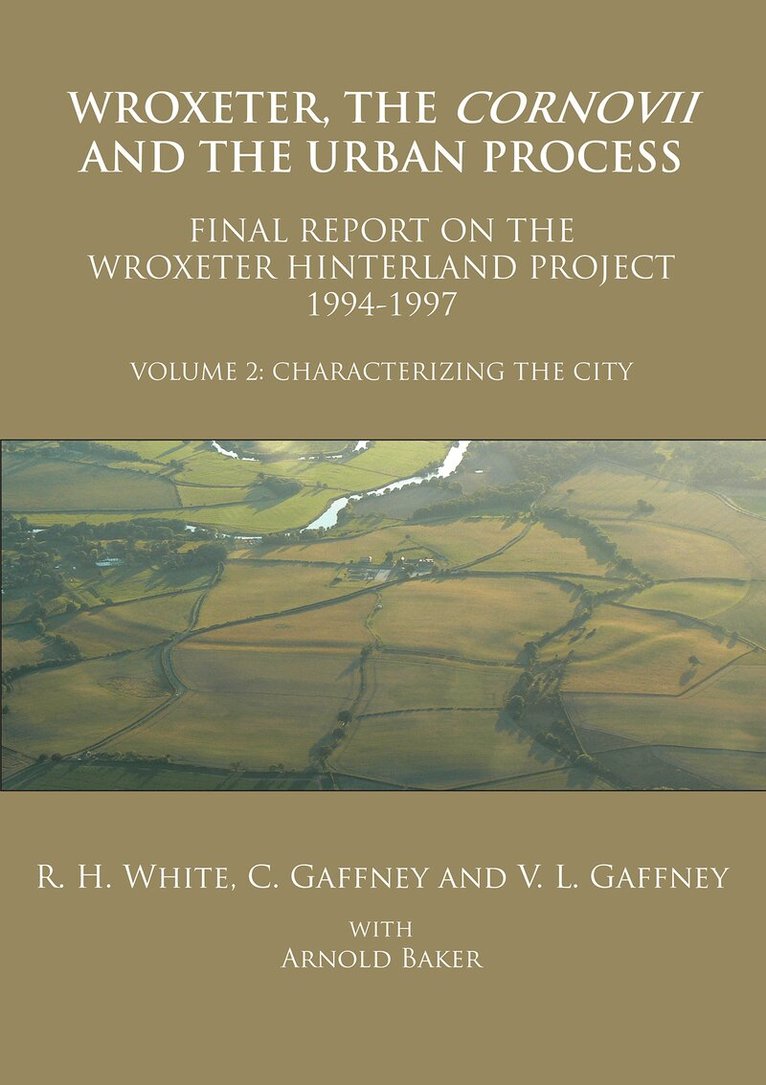
Wroxeter, the Cornovii and the Urban Process. Volume 2: Characterizing the City. Final Report of the Wroxeter Hinterland Project, 1994-1997
Häftad, Engelska, 2013
729 kr
Skickas
In the mid 1990s, the site of the Roman city of Viroconium Cornoviorum at Wroxeter, Shropshire, was subjected to one of the most intensive campaigns of geophysical survey ever carried out on a Roman town. The result was a complete plan of the city using magnetometry but also significant deployment of other technologies including resistance, GPR and more experimental technologies. Since that time, geophysical survey has continued intermittently, using the site as a geophysical laboratory. This volume reports on the archaeological interpretation of this work, marrying the extensive and nuanced geophysical data with a detailed analysis of the existing aerial photographic record created by Arnold Baker during the 1950s to 1980s. The resulting work is the first insula by insula description of all the visible buildings in the town, the first time that this has been attempted for a Romano-British town, and one of the few attempted anywhere in the Empire. The analysis has enabled a complete reinterpretation of the historical development of the town that links it to its surrounding hinterland and to wider concerns about Roman Urban development. The volume also contains detail of small-scale excavations that have been carried out since 1999 on the site, many in previously unexplored areas, and completes the publication of all outstanding archaeological work on the monument
618 kr
Skickas
Shropshire, as one of the contributors to this volume notes, is simultaneously remote and well-connected … which also means it is often (but wrongly) overlooked and underestimated. This volume of collected papers – newly commissioned and bringing entirely new research into play – was brought together to commemorate the issuing of the 100th volume of the Shropshire Archaeological and Historical Society’s Transactions. It offers snapshots of Shropshire’s past, from the earliest prehistory to the end of the twentieth century. As befits the Society, it offers both archaeological and historic perspectives and demonstrates the importance of the county in the wider context of the United Kingdom. While not attempting to be comprehensive in its contents, it nonetheless offers insights into how the county came into being, and the forces that shaped it, not the least of which is its extraordinarily diverse geology. The volume offers too a perspective of those historically researching Shropshire’s past, often women who gained their foothold either through teaching on or participating in adult education.This is certainly the first attempt to offer a comprehensive overview of Shropshire in over 50 years, and what it seeks to achieve in its scope has not been attempted before. The Society’s aim is both to showcase the research going on in the county, but also to parade its riches: there is much more to learn about Shropshire, and it is hoped this book will encourage others to take up its challenges and continue to allow the understanding of the county to flourish.The contributors to this volume almost all have long-standing connections to Shropshire, and some are also proud Salopians. Most are based in the county, and continue their long-term research there, while one holds a significant role in the protection of Shropshire’s heritage.