Romain Cansière - Böcker
Visar alla böcker från författaren Romain Cansière. Handla med fri frakt och snabb leverans.
5 produkter
5 produkter
198 kr
Skickas inom 10-15 vardagar
A highly illustrated account of the battle for Blanc Mont Ridge in 1918, where the US attackers broke the German line and sent them into headlong retreat in one of the major US victories of World War I.The dominating Blanc Mont Ridge complex in the Champagne region of France was home to some of the most complex German defences on the Western Front. Its heights offered artillery observation that made even approaching the ridge virtually suicidal.Pessimistic about the ability of depleted and demoralized French units to capture the position, Général Henri Gouraud was granted the use of two American divisions: the veteran 2nd “Indianhead” Division, including the 4th (Marine) Brigade, and the untested 36th “Arrowhead” Division of the Texas and Oklahoma National Guard.This fully illustrated book describes this Allied offensive with American troops in the vanguard, and shows how despite the heavy losses it sustained to both manpower and supporting armour, they eventually forced the Germans to abandon most of the region in one of the largest withdrawals of the war.
Del 108 - Duel
USMC M4A2 Sherman vs Japanese Type 95 Ha-Go
The Central Pacific 1943–44
Häftad, Engelska, 2021
163 kr
Skickas inom 7-10 vardagar
The different national tank doctrines of the United States and Imperial Japan resulted in a terrible mismatch of the predominant tank types in the crucial Central Pacific campaign.A flawed Japanese doctrine emphasized light infantry support tanks, often used in small numbers. Tactically, tanks were often frittered away in armored versions of the familiar banzai attacks. Meanwhile, the Americans saw the tank as an infantry support weapon, but developed a more systematic tactical doctrine. They settled upon a larger medium tank – in the case of most Marine Corps tank battalions, the diesel-powered M4A2 (unwanted by the US Army). This superbly detailed title reveals how both the two sides’ tactical and technical differences in the approach to armored warfare soon became apparent over a series of deadly engagements, from the first tank fight at the battle of Tarawa in November 1943, through to engagements on Parry Island, Saipan, and Guam, before ending with Peleliu in September 1944.
152 kr
Skickas inom 7-10 vardagar
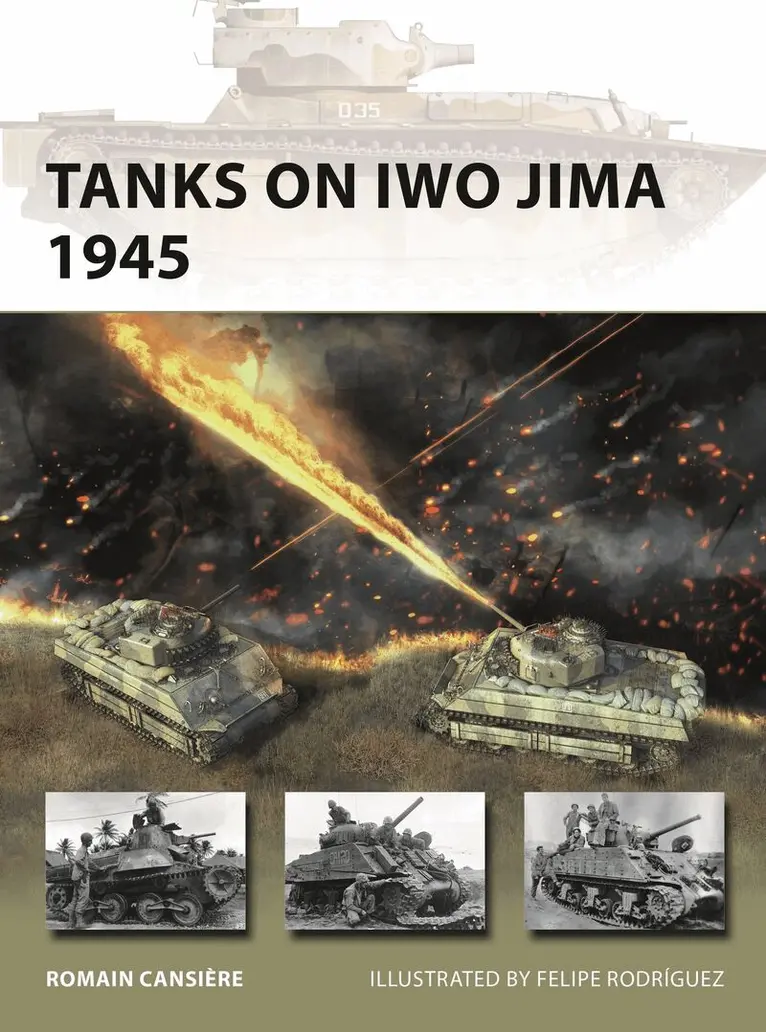
An award-winning US Marine Corps armor historian's account of the role of US and Japanese tanks on Iwo Jima. The battle of Iwo Jima is iconic and known for its brutality: this was the only battle in which the number of US casualties outnumbered those of the Japanese. But as is often the case with the Pacific campaigns, the tank action on the island has generally been overshadowed by that of infantry. The tank, however, played an important role as a support weapon – especially on the US side – despite the rough terrain and unconventional enemy tactics. Using unpublished official records and veterans' accounts, award-winning USMC armor specialist Romain Cansière sheds new light on Japanese and USMC armored operations on the island. This book offers new information on the battle in a complete, concise, and accessible format, and its illustrations include unpublished photographs from private collections and meticulously researched new color profiles, highlighting the tanks' modifications and their diverse camouflage and markings.
Del 353 - New Vanguard
Tanks in the Gilbert Islands 1943
Armor in the battles for Tarawa and Makin
Häftad, Engelska, 2026
152 kr
Kommande
Fully illustrated, this examines how the Gilberts invasion proved the importance and difficulty of using armor in the Pacific, and laid the groundwork for America's island campaign.The capture of the heavily fortified Gilbert Islands was intended to secure air bases for the Marshall Islands campaign. The garrison commander General Keiji Shibazaki claimed that “a thousand men in a hundred years couldn’t take Tarawa”. Simultaneously, the Marine Corps landed on Tarawa and the Army on Makin, in the first opposed landings of the Pacific War, with armor supporting the assault waves. But as is often the case with pioneering operations, things didn't go according to plan. Reefs, low tides, strong Japanese opposition, lack of communication, and absence of suitable doctrine lead to a near-disaster on Tarawa.In this book, illustrated with superb new tank profiles and previously unpublished photos, armor historian Romain Cansière examines how the battles for Tarawa and Makin highlighted the difficulties of providing armored support in the Pacific landings. Studying the roles of tanks in both operations, how inexperienced armor crews overcame the difficulties of combat, and the role of Japanese tanks in both battles, this book offers the first account of how armor performed in this ‘proving ground’ operation, and what lessons were learned for future landings in the Pacific.
432 kr
Skickas inom 3-6 vardagar
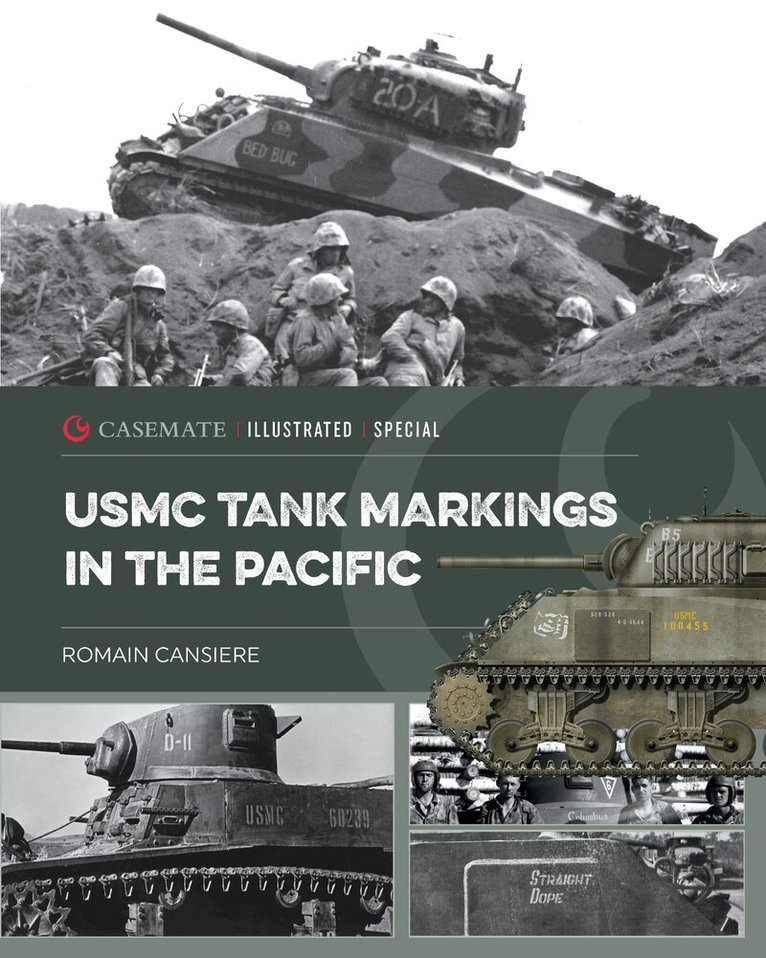
The markings on tanks of the United States Marine Corps during World War II are so varied that some have concluded they were meaningless, even anarchic. Official documents offer little insight, but a careful study of period photographs and film, crossreferenced with combat reports and veteran accounts, reveals the different systems of markings that combat units used to identify their vehicles. These markings varied between units, and from one campaign to the next, but were well thought out and designed to be practical and easy for tankers to interpret. In addition to tactical markings, most tankers were given names by their crews, and these were added to the tank’s marking. Personifying the tank often boosted crew morale and led to even more careful maintenance of the tank. Names were approved by tank commanders, and also followed systems that aided quick identification in combat.Illustrated with numerous period photographs and detailed color profiles, this book explains the markings used by USMC tank combat units during the Pacific War, from 1942 to 1945., each chapter details one unit, covering markings down to section level and showing how the markings and names changes through that unit’s campaigns.