Ronald Berman – författare
Visar alla böcker från författaren Ronald Berman. Handla med fri frakt och snabb leverans.
5 produkter
5 produkter
282 kr
Skickas inom 5-8 vardagar
"A stunning piece ofwork. If Fitzgerald could have wished for one reader of The Great Gatsby,it would have been Ronald Berman. Berman's criticism creates an idealcompanion piece to the novel--as brilliantly illuminating about Americaas it is about fiction, and composed with as much thought and style." -- Roger Rosenblatt"An impressive studythat brilliantly highlights the oneness of Fitzgerald's art with the overallcontext of modernism." -- Milton R. Stern, author of The Golden Moment: The Novels of F. Scott Fitzgerald"Citing films, dates,places, schedules, Broadway newsstands, and the spoils of manufacture,the author, never lapsing into critical jargon, locates the charactersin 'the moving present.' Gatsby, the first of the great novelsto emerge from B movies, uses the language of commodities, advertisements,photography, cinematography, and Horatio Alger to present models of identityfor characters absorbed in and by what is communicated. . . . Berman concludesthat Gatsby 'reassembled' rather than 'invented' himself."-- A. Hirsh, Choice
237 kr
Skickas inom 5-8 vardagar
Explores philosophical and aesthetic issues germane to the writings of three major modern literary figures.
298 kr
Skickas inom 5-8 vardagar
298 kr
Skickas inom 5-8 vardagar
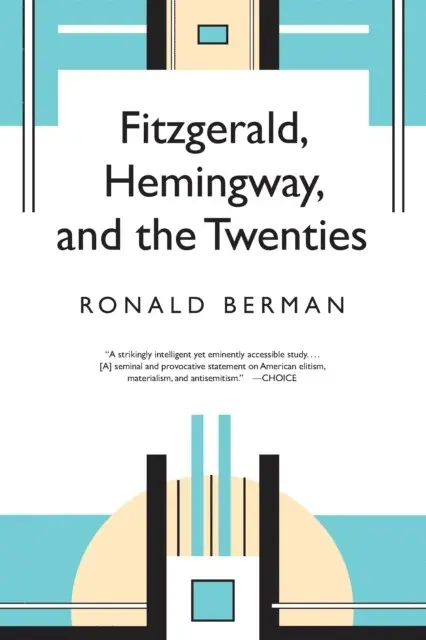
In this study, Ronald Berman examines the work of the critic/novelist Edmund Wilson and the art of F. Scott Fitzgerald and Ernest Hemingway as they wrestled with the problems of language, experience, perception and reality in the ""age of jazz."" By focusing specifically on aesthetics—the ways these writers translated everyday reality into language—Berman challenges and redefines many routinely accepted ideas concerning the legacy of these authors.Fitzgerald is generally thought of as a romantic, but Berman shows that we need to expand the idea of Romanticism to include its philosophy. Hemingway, widely viewed as a stylist who captured experience by simplifying language, is revealed as consciously demonstrating reality's resistance to language. Between these two renowned writers stands Wilson, who is critically influenced by Alfred North Whitehead, as well as Dewey, James, Santayana, and Freud.By patiently mapping the correctness of these philosophers, historians, literary critics and writers, Berman aims to open a gateway into the era. This work should be of interest to scholars of American literature, philosophy and aesthetics; to academic libraries; to students of intellectual history; and to general readers interested in Fitzgerald, Hemingway and Wilson.
328 kr
Skickas inom 5-8 vardagar
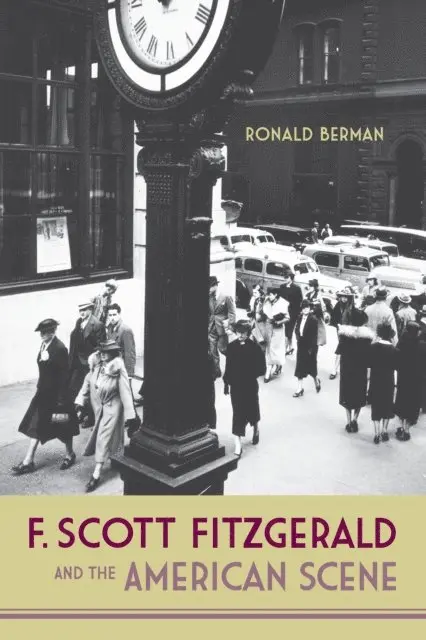
A study of the philosophical, intellectual, and political influences on the artistic creations of Fitzgerald and key early American modernist writers.F. Scott Fitzgerald and the American Scene continues Ronald Berman’s lifelong study of the philosophical, intellectual, and political influences on the artistic creations of key early American modernist writers. Each chapter in this volume elaborates on a crucial aspect of F. Scott Fitzgerald’s depiction of American society, specifically through the lens of the social sciences that most influenced his writing and thinking.Berman addresses, among other subjects, Fitzgerald’s use of philosophy, cultural analyses, and sociology—all enriched by the insights of his own experience living an American life. He was especially interested in how life had changed from 1910 to 1920. Many Americans were unable to navigate between the 1920s and their own memories of a very different world before the Great War; especially Daisy Buchanan who evolves from girlhood (as typified in sentimental novels of the time) to wifehood (as actually experienced in the new decade). There is a profound similarity between what happens to Fitzgerald’s characters and what happened to the nation.Berman revisits classics like The Great Gatsby but also looks carefully at Fitzgerald’s shorter fictions, analyzing a stimulating spectrum of scholars from more contemporary critics like Thomas Piketty to George Santayana, John Maynard Keynes, John Dewey, and Walter Lippmann. This fascinating addition to F. Scott Fitzgerald scholarship, although broad in its content, is accessible to a wide audience. Scholars and students of Fitzgerald and twentieth-century American literature, as well as dedicated Fitzgerald readers, will enjoy Berman’s take on a long-debated and celebrated author.