Ronald K. Pearson - Böcker
Visar alla böcker från författaren Ronald K. Pearson. Handla med fri frakt och snabb leverans.
8 produkter
8 produkter
2 672 kr
Skickas inom 5-8 vardagar
Fuelled by advances in computer technology, model-based approaches to the control of industrial processes are now widespread. While there is an enormous literature on modelling, the difficult first step of selecting an appropriate model structure has received almost no attention. This book fills the gap, providing practical insight into model selection for chemical processes and emphasizing structures suitable for control system design.
703 kr
Skickas inom 10-15 vardagar
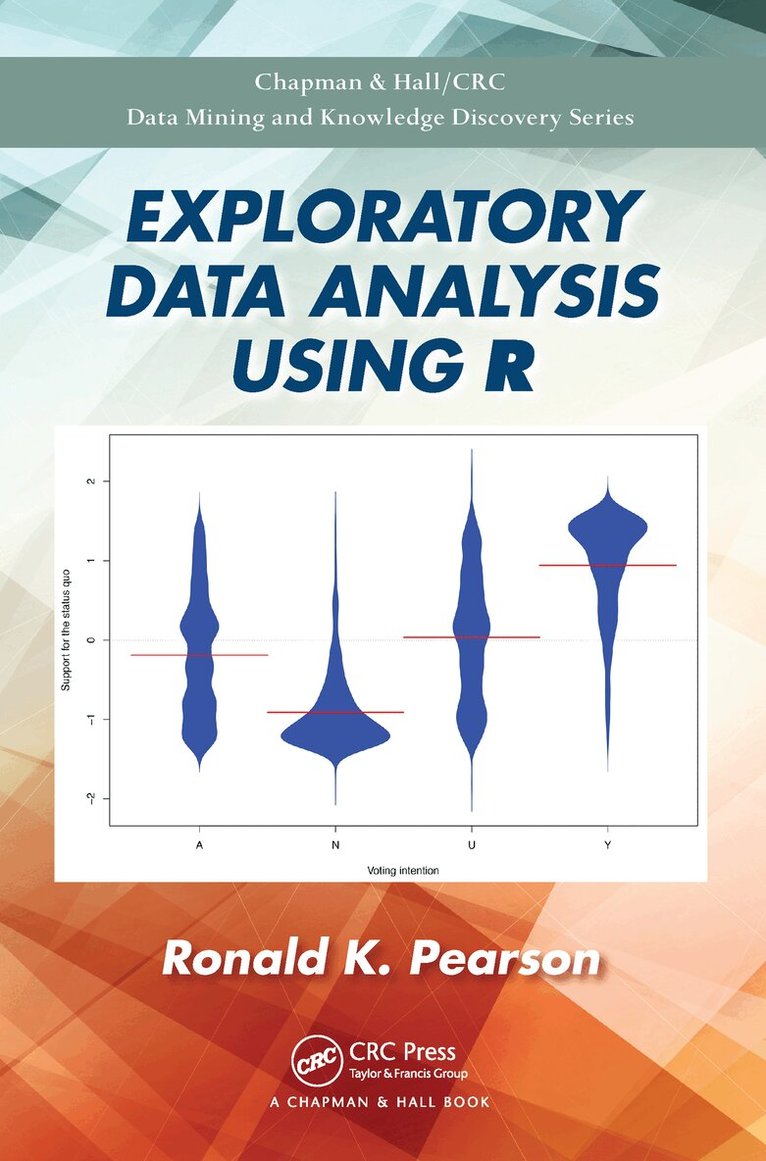
Exploratory Data Analysis Using R provides a classroom-tested introduction to exploratory data analysis (EDA) and introduces the range of "interesting" – good, bad, and ugly – features that can be found in data, and why it is important to find them. It also introduces the mechanics of using R to explore and explain data.The book begins with a detailed overview of data, exploratory analysis, and R, as well as graphics in R. It then explores working with external data, linear regression models, and crafting data stories. The second part of the book focuses on developing R programs, including good programming practices and examples, working with text data, and general predictive models. The book ends with a chapter on "keeping it all together" that includes managing the R installation, managing files, documenting, and an introduction to reproducible computing.The book is designed for both advanced undergraduate, entry-level graduate students, and working professionals with little to no prior exposure to data analysis, modeling, statistics, or programming. it keeps the treatment relatively non-mathematical, even though data analysis is an inherently mathematical subject. Exercises are included at the end of most chapters, and an instructor's solution manual is available.About the Author:Ronald K. Pearson holds the position of Senior Data Scientist with GeoVera, a property insurance company in Fairfield, California, and he has previously held similar positions in a variety of application areas, including software development, drug safety data analysis, and the analysis of industrial process data. He holds a PhD in Electrical Engineering and Computer Science from the Massachusetts Institute of Technology and has published conference and journal papers on topics ranging from nonlinear dynamic model structure selection to the problems of disguised missing data in predictive modeling. Dr. Pearson has authored or co-authored books including Exploring Data in Engineering, the Sciences, and Medicine (Oxford University Press, 2011) and Nonlinear Digital Filtering with Python. He is also the developer of the DataCamp course on base R graphics and is an author of the datarobot and GoodmanKruskal R packages available from CRAN (the Comprehensive R Archive Network).
785 kr
Kommande
Exploratory Data Analysis Using R provides a classroom-tested introduction to exploratory data analysis (EDA), and this revised edition is accompanied by the R package ExploreTheData that implements many of the approaches described. As before, the primary focus of the book is on identifying "interesting" features - good, bad, and ugly - in a dataset, why it is important to find them, how to treat them, and more generally, the use of R to explore and explain datasets and the analysis results derived from them.The book begins with a brief overview of exploratory data analysis using R, followed by a detailed discussion of creating various graphical data summaries in R. Then comes a thorough introduction to exploratory data analysis, and a detailed treatment of 13 data anomalies, why they are important, how to find them, and some options for addressing them. Subsequent chapters introduce the mechanics of working with external data, structured query language (SQL) for interacting with relational databases, linear regression analysis (the simplest and historically most important class of predictive models), and crafting data stories to explain our results to others. These chapters use R as an interactive data analysis platform, while Chapter 9 turns to writing programs in R, focusing on creating custom functions that can greatly simplify repetitive analysis tasks. Further chapters expand the scope to more advanced topics and techniques: special considerations for working with text data, a second look at exploratory data analysis, and more general predictive models. The book is designed for both advanced undergraduate, entry-level graduate students, and working professionals with little to no prior exposure to data analysis, modeling, statistics, or programming. It keeps the treatment relatively non-mathematical, even though data analysis is an inherently mathematical subject. Exercises are included at the end of most chapters, and an instructor's solution manual is available.
1 428 kr
Kommande
Exploratory Data Analysis Using R provides a classroom-tested introduction to exploratory data analysis (EDA), and this revised edition is accompanied by the R package ExploreTheData that implements many of the approaches described. As before, the primary focus of the book is on identifying "interesting" features - good, bad, and ugly - in a dataset, why it is important to find them, how to treat them, and more generally, the use of R to explore and explain datasets and the analysis results derived from them.The book begins with a brief overview of exploratory data analysis using R, followed by a detailed discussion of creating various graphical data summaries in R. Then comes a thorough introduction to exploratory data analysis, and a detailed treatment of 13 data anomalies, why they are important, how to find them, and some options for addressing them. Subsequent chapters introduce the mechanics of working with external data, structured query language (SQL) for interacting with relational databases, linear regression analysis (the simplest and historically most important class of predictive models), and crafting data stories to explain our results to others. These chapters use R as an interactive data analysis platform, while Chapter 9 turns to writing programs in R, focusing on creating custom functions that can greatly simplify repetitive analysis tasks. Further chapters expand the scope to more advanced topics and techniques: special considerations for working with text data, a second look at exploratory data analysis, and more general predictive models. The book is designed for both advanced undergraduate, entry-level graduate students, and working professionals with little to no prior exposure to data analysis, modeling, statistics, or programming. It keeps the treatment relatively non-mathematical, even though data analysis is an inherently mathematical subject. Exercises are included at the end of most chapters, and an instructor's solution manual is available.
2 306 kr
Skickas inom 10-15 vardagar
Exploratory Data Analysis Using R provides a classroom-tested introduction to exploratory data analysis (EDA) and introduces the range of "interesting" – good, bad, and ugly – features that can be found in data, and why it is important to find them. It also introduces the mechanics of using R to explore and explain data.The book begins with a detailed overview of data, exploratory analysis, and R, as well as graphics in R. It then explores working with external data, linear regression models, and crafting data stories. The second part of the book focuses on developing R programs, including good programming practices and examples, working with text data, and general predictive models. The book ends with a chapter on "keeping it all together" that includes managing the R installation, managing files, documenting, and an introduction to reproducible computing.The book is designed for both advanced undergraduate, entry-level graduate students, and working professionals with little to no prior exposure to data analysis, modeling, statistics, or programming. it keeps the treatment relatively non-mathematical, even though data analysis is an inherently mathematical subject. Exercises are included at the end of most chapters, and an instructor's solution manual is available.About the Author:Ronald K. Pearson holds the position of Senior Data Scientist with GeoVera, a property insurance company in Fairfield, California, and he has previously held similar positions in a variety of application areas, including software development, drug safety data analysis, and the analysis of industrial process data. He holds a PhD in Electrical Engineering and Computer Science from the Massachusetts Institute of Technology and has published conference and journal papers on topics ranging from nonlinear dynamic model structure selection to the problems of disguised missing data in predictive modeling. Dr. Pearson has authored or co-authored books including Exploring Data in Engineering, the Sciences, and Medicine (Oxford University Press, 2011) and Nonlinear Digital Filtering with Python. He is also the developer of the DataCamp course on base R graphics and is an author of the datarobot and GoodmanKruskal R packages available from CRAN (the Comprehensive R Archive Network).
1 697 kr
Skickas inom 7-10 vardagar
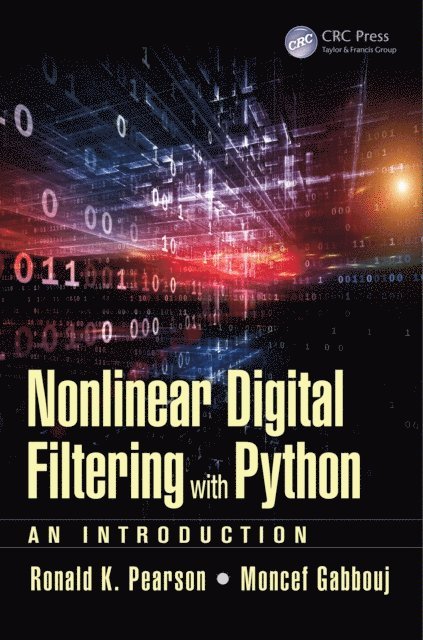
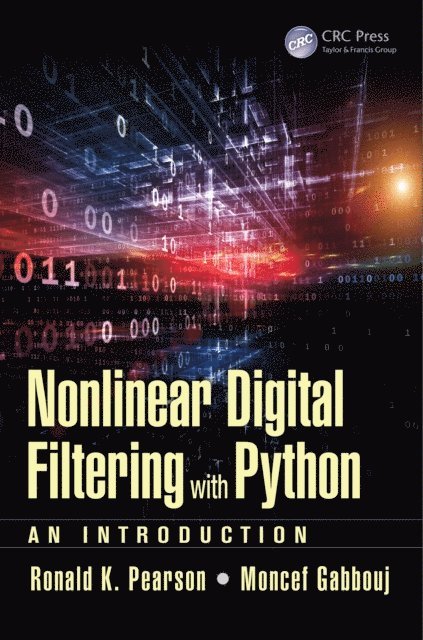
Nonlinear Digital Filtering with Python: An Introduction discusses important structural filter classes including the median filter and a number of its extensions (e.g., weighted and recursive median filters), and Volterra filters based on polynomial nonlinearities. Adopting both structural and behavioral approaches in characterizing and designing nonlinear digital filters, this book:Begins with an expedient introduction to programming in the free, open-source computing environment of PythonUses results from algebra and the theory of functional equations to construct and characterize behaviorally defined nonlinear filter classesAnalyzes the impact of a range of useful interconnection strategies on filter behavior, providing Python implementations of the presented filters and interconnection strategiesProposes practical, bottom-up strategies for designing more complex and capable filters from simpler components in a way that preserves the key properties of these componentsIllustrates the behavioral consequences of allowing recursive (i.e., feedback) interconnections in nonlinear digital filters while highlighting a challenging but promising research frontierNonlinear Digital Filtering with Python: An Introduction supplies essential knowledge useful for developing and implementing data cleaning filters for dynamic data analysis and time-series modeling.
921 kr
Skickas inom 7-10 vardagar
Exploratory Data Analysis Using R provides a classroom-tested introduction to exploratory data analysis (EDA) and introduces the range of "interesting" – good, bad, and ugly – features that can be found in data, and why it is important to find them. It also introduces the mechanics of using R to explore and explain data.The book begins with a detailed overview of data, exploratory analysis, and R, as well as graphics in R. It then explores working with external data, linear regression models, and crafting data stories. The second part of the book focuses on developing R programs, including good programming practices and examples, working with text data, and general predictive models. The book ends with a chapter on "keeping it all together" that includes managing the R installation, managing files, documenting, and an introduction to reproducible computing.The book is designed for both advanced undergraduate, entry-level graduate students, and working professionals with little to no prior exposure to data analysis, modeling, statistics, or programming. it keeps the treatment relatively non-mathematical, even though data analysis is an inherently mathematical subject. Exercises are included at the end of most chapters, and an instructor's solution manual is available.About the Author:Ronald K. Pearson holds the position of Senior Data Scientist with GeoVera, a property insurance company in Fairfield, California, and he has previously held similar positions in a variety of application areas, including software development, drug safety data analysis, and the analysis of industrial process data. He holds a PhD in Electrical Engineering and Computer Science from the Massachusetts Institute of Technology and has published conference and journal papers on topics ranging from nonlinear dynamic model structure selection to the problems of disguised missing data in predictive modeling. Dr. Pearson has authored or co-authored books including Exploring Data in Engineering, the Sciences, and Medicine (Oxford University Press, 2011) and Nonlinear Digital Filtering with Python. He is also the developer of the DataCamp course on base R graphics and is an author of the datarobot and GoodmanKruskal R packages available from CRAN (the Comprehensive R Archive Network).
1 139 kr
Skickas inom 7-10 vardagar
It has been estimated that as much as 80% of the total effort in a typical data analysis project is taken up with data preparation, including reconciling and merging data from different sources, identifying and interpreting various data anomalies, and selecting and implementing appropriate treatment strategies for the anomalies that are found. This book focuses on the identification and treatment of data anomalies, including examples that highlight different types of anomalies, their potential consequences if left undetected and untreated, and options for dealing with them.As both data sources and free, open-source data analysis software environments proliferate, more people and organizations are motivated to extract useful insights and information from data of many different kinds (e.g., numerical, categorical, and text). The book emphasizes the range of open-source tools available for identifying and treating data anomalies, mostly in R but also with several examples in Python.Mining Imperfect Data: With Examples in R and Python, Second Editionpresents a unified coverage of 10 different types of data anomalies (outliers, missing data, inliers, metadata errors, misalignment errors, thin levels in categorical variables, noninformative variables, duplicated records, coarsening of numerical data, and target leakage);includes an in-depth treatment of time-series outliers and simple nonlinear digital filtering strategies for dealing with them; andprovides a detailed introduction to several useful mathematical characteristics of important data characterizations that do not appear to be widely known among practitioners, such as functional equations and key inequalities.