Rosalind Love - Böcker
Visar alla böcker från författaren Rosalind Love. Handla med fri frakt och snabb leverans.
8 produkter
8 produkter
1 989 kr
Skickas inom 5-8 vardagar
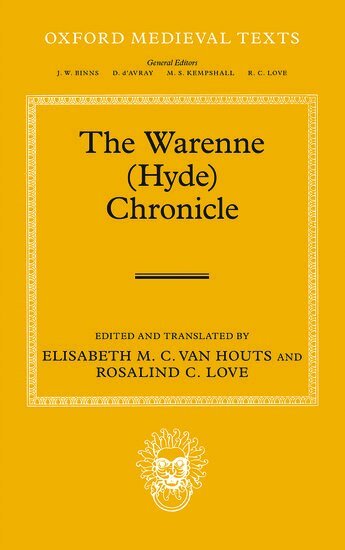
The Warenne Chronicle is the more appropriate name for the Latin text known as the Hyde Chronicle. It covers the period from 1035 - the year in which Robert the Magnificent, duke of Normandy, died - up to the account of the White ship disaster in November 1120 when William Adelin, eldest son and heir of King Henry I, lost his life at the age of eighteen. The chronicle therefore covers the history of Normandy and England around the Norman Conquest of England with special reference to the earls of Warenne in Normandy. It is not a full blown dynastic history of this aristocratic family, but rather a historical narrative that emphasises the loyal support of the earls to the Norman rulers. The crucial question as to how far the Warenne chronicler may have covered the years beyond 1120 is impossible to settle definitively. The new argument put forward here is that the Warenne Chronicle was written early in the reign of King Henry II, probably shortly after 1157, for King Stephen's son William and his wife Isabel, heiress of Warenne, to provide an account of the invaluable help her ancestors had given to the Anglo-Norman rulers. Although the chronicle has survived anonymously, the suggestion is made that the author may have been Master Eustace of Boulogne, clerk and chancellor of William of Blois as fourth earl of Warenne. Unique information, other than that pertaining to the Warennes, concerns the commemoration of Queen Edith/Matilda, Henry I's rule in western Normandy, and the use of the word 'normananglus' (Norman-English) for the inhabitants of England of Norman origin.
1 282 kr
Skickas inom 7-10 vardagar
Contributions to the forty-eighth volume of Anglo-Saxon England focus on aspects of Anglo-Saxon culture and history across a period from the sixth to the twelfth century. This volume begins with an examination of Beowulf fitt II and the Andreas-poet, and ends with a study of St Dunstan and the heavenly choirs of St Augustine's Abbey, Canterbury, as related in Goscelin's Historia translationis S. Augustini. Also included are articles on Leofric of Exeter and liturgical performance as pastoral care, legal culture under Dena lage with reference to III 'thelred, an Agnus Dei penny of King 'thelred the Unready and self-seeking in The Metres of Boethius. Latin verse in an Old English medical codex is examined with reference to Bald's Colophon, the figure of Beow is explored in a Scandinavian context and a new solution is provided for Exeter Riddle 55. Each article is preceded by a short abstract.
1 192 kr
Skickas inom 7-10 vardagar
Contributions to the forty-ninth volume of Anglo-Saxon England focus on aspects of Anglo-Saxon culture and history across a period from the sixth to the thirteenth century. This volume begins with a Record of the nineteenth conference of the International Society of Anglo-Saxonists, and ends with examination of Slave resistance in early Medieval England. Be wifmannes beweddunge is used to discuss the Anglo-Saxon betrothal and wedding process, and the gradual Christianisation of wedding rites throughout the period. Two companion articles re-evaluate commonly held beliefs about elite diets, using isotopic evidence to counter previous assumptions about the feorm or 'food rent' sent by free peasants to royal households. Also included are an examination of a recently discovered fragment of the abridged version of Cassiodorus's Expositio psalmorum, a reassessment of the importance of bookland in understanding the period, and an investigation into conflicting East Anglican episcopal chronology, with regard to Bede's Historia Ecclesiastica.
1 228 kr
Skickas inom 7-10 vardagar
The fiftieth volume of Anglo-Saxon England ranges from the seventh century - with studies of Archbishop Theodore's computus, the creation of English law-writing, and Aldhelm's Irish influences - into modernity, with new accounts of John Leland's De uiris illustribus and of iron as a metaphor for Old English verse in the eighteenth and nineteenth centuries. Several new discoveries also feature, including fragments of an Old English-glossed psalter, three Agnus Dei pennies, a proposed 'solution' to the Wife's Lament, and the likely site of the urbs Giudi described by Bede. Readers will encounter Eadgifu, a woman who governed Kent; the names of English clerics; the waning land of the kingdom of the Hwicce; the many uses and meanings of bells; and runes in the Vineyard of the Lord. Also included is an account of the International Society for the Study of Early Medieval England's 2021 virtual conference, and an essay surveying current scholarship on Archbishop Wulfstan II of York, commissioned to mark the millennium of his death. An index of the contents of volumes 1–50 marks the reaching of a different milestone. An abstract precedes each article. The fiftieth volume of Anglo-Saxon England ranges from the seventh century - with studies of Archbishop Theodore's computus, the creation of English law-writing, and Aldhelm's Irish influences - into modernity, with new accounts of John Leland's De uiris illustribus and of iron as a metaphor for Old English verse in the eighteenth and nineteenth centuries. Several new discoveries also feature, including fragments of an Old English-glossed psalter, three Agnus Dei pennies, a proposed 'solution' to the Wife's Lament, and the likely site of the urbs Giudi described by Bede. Readers will encounter Eadgifu, a woman who governed Kent; the names of English clerics; the waning land of the kingdom of the Hwicce; the many uses and meanings of bells; and runes in the Vineyard of the Lord. Also included is an account of the International Society for the Study of Early Medieval England's 2021 virtual conference, and an essay surveying current scholarship on Archbishop Wulfstan II of York, commissioned to mark the millennium of his death. An index of the contents of volumes 1–50 marks the reaching of a different milestone. An abstract precedes each article.
1 350 kr
Skickas inom 7-10 vardagar
The forty-second volume of Anglo-Saxon England begins with an article which introduces a 'new' Anglo-Latin poet to a modern audience, and ends with an article exploring the activities of a Norman archbishop of Canterbury when exiled from England in the early 1050s. Other disciplines well represented here are palaeography, philology, Old English language and literature, tenth-century diplomacy, and numismatics. Extended treatment is given to the reception in Anglo-Saxon England of a Latin life of St 'gidius, which lies behind the Old English Life of St Giles in Cambridge, Corpus Christi College MS 303. It is also a privilege for the journal to include the first scholarly publication of the recently discovered seal-matrix of a certain 'lfric, presumed to have been a layman who flourished in the late tenth century; the object itself has been acquired by the Fitzwilliam Museum, Cambridge. Each article is preceded by a short abstract.
1 485 kr
Skickas inom 7-10 vardagar
The forty-third volume of Anglo-Saxon England contains three contributions on Latin learning in the early part of the period, two focusing on texts being studied at Canterbury, and a third discussing the recording of Cuthbert's cult at Lindisfarne. Old English poetry is well represented by three contributions which exemplify new approaches towards poetic diction and its sources, and reinterpret Cynewulf's use of runes. Old English prose meanwhile receives further attention through a reassessment of its intended audience, and in an analysis of Andreas. There is also a discussion of an unusual prayer first attested in the Leofric Missal. The theme of kingship is addressed in an article on different representations of King Cnut in Old English, Latin and Old Norse texts, and in an extended review of demonstrably or arguably 'royal' books in the Anglo-Saxon period. Each article is preceded by a short abstract.
1 350 kr
Tillfälligt slut
The forty-fifth volume of Anglo-Saxon England focusses on various aspects of Anglo-Saxon culture and history from the seventh to the seventeenth century. In the field of Old English literature, contributions examine a ninth-century homily fragment, The Dream of the Rood, The Seafarer, and the Old English translation of Boethius' De Consolatione Philosophiae. A contribution which explores references to the senses in a wide range of vernacular texts is complemented by another which reconsiders the iconography of the Fuller Brooch. The network of fortifications recorded in the Burghal Hidage is re-interpreted here as a product of political developments in the later 870s; and a new edition of the 'Ely memoranda' reminds us that the religious houses of the tenth and eleventh centuries functioned also as major agricultural estates. Finally, the contribution of seventeenth-century antiquaries to the development of Anglo-Saxon studies is remembered in a study of an early Anglo-Saxon Grammar.
1 282 kr
Skickas inom 7-10 vardagar
The forty-seventh volume of Anglo-Saxon England begins with a record of the eighteenth conference of the International Society of Anglo-Saxonists, and ends with a fourth supplement to the Hand-list of Anglo-Saxon Non-Runic Inscriptions. Other articles in this volume cover a diverse range of subjects, including Skaldic art in Cnut's court, alliteration in Old English poetry, the northern world of an Anglo-Saxon mappa mundi and the Germanic context of Beowulf. Religious matters are given particular consideration in this volume: new light is shed on the lost St Margaret's crux nigra, and on Anglo-Breton contact between the tenth and twelfth centuries through an examination of St Kenelm and St Melor. Also included are an account of Archbishop Wulfstan's forgery of the 'laws of Edward and Guthrum', and an edition of the four sermons attributed to Candidus Witto. Each article is preceded by a short abstract.