Rosanna Warren - Böcker
Visar alla böcker från författaren Rosanna Warren. Handla med fri frakt och snabb leverans.
11 produkter
11 produkter
275 kr
Tillfälligt slut
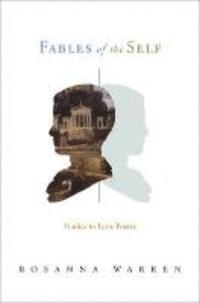
Fables of the Self traces ideas of imagined selfhood through the lyric poetry of classical Greece and Rome, the modernist poetry of France, and modern and contemporary English and American lyrics. Rosanna Warren's work emerges from the tradition of British and American poet-critics such as William Empson, Donald Davie, and Randall Jarrell. Her readings of Sappho, Virgil, Baudelaire, Melville, Rimbaud, Mark Strand, and Louise Glück, among others, combine Helen Vendler's passionate attention to detail and something of Harold Bloom's panoramic view. Warren opposes both the literalizing, autobiographical approach to self in so-called confessional poetry and the other extreme of avant-garde erasures of self. Framing her critical studies between a memoir of childhood and a concluding journal entry, Warren has composed an occult autobiography, showing the imagination as a transfiguring and potentially moral force.
423 kr
Skickas inom 7-10 vardagar
227 kr
Skickas inom 5-8 vardagar
In elegies of love and death, we learn the legacy of poet Max Jacob, and “the clarity of being alone,” but also that we still have to touch to believe, and that love, to believe in itself, must dress up in death. Yet sources of the future are also brought tenderly to us through the image of an unborn daughter, a child’s room in autumn, and the knowledge that “gene by gene, the tiny transcriptions continue.”
227 kr
Skickas inom 5-8 vardagar
Rosanna Warren's first collection of poetry, Each Leaf Shines Separate, announced the emergence of a fresh voice in contemporary American poetry and earned praise from John Hollander, Richard Eberhart, and Mark Strand. Now, in her second book, Rosanna Warren has fulfilled her promise. In Stained Glass she continues to examine, as John Hollander said of her first book, "the relation of art to nature, exploring the ultimate naturalness of the world of picture, and reading tenderly and shrewdly the forms of fable in which reality presents itself to the passionate gaze." Yet in this volume the poems are more personal and intimate—they possess an emotional depth that extends the earlier work. Stained Glass is a book of mourning. It begins with an echo of Milton's Lycidas and concludes with an evocation of Iliad XXIV; in its course it touches on many scenes of loss, personal and impersonal. In the voice of an Eskimo mother, in a Parisian market scene, in brilliant translations of poems by Max Jacob and Pierre Reverdy, to the more intimate elegies, the human drama unfolds within the larger rhythms of the natural landscape. In poems that are classical and eloquent, ranging from sonnets and rhymed quatrains to highly flexible free verse, Warren vividly probes the savagery of aging, the corruption of the human body and human estrangement from the divine, evoking as well scenes of simple tenderness and beauty. This year's recipient of an Ingram Merrill grant and the Lavan Award from the Academy of American Poets that honors a poet of exceptional merit under the age of forty, Rosanna Warren is clearly one of the most gifted poets of her generation.
141 kr
Tillfälligt slut
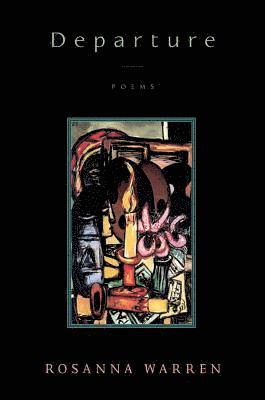
Ancient and modern eras, sacred and earthly forces, personal and communal mourning are all held in the arc of this exquisite new collection. Named an Honor Book in the 2004 Massachusetts Book Awards, Departure celebrates the marriage of contraries in private poems of difficult love as Rosanna Warren explores intimacy and separation between mother and daughter, husband and wife, artist and muse, woman and demon lover.
251 kr
Skickas inom 5-8 vardagar
In her fifth collection, Rosanna Warren draws inspiration not only from her own life but also from the works of other artists, both classical and contemporary, real and imagined. Warren explores the political and the personal through myth, history, elegy, and erotic lyric. She eulogizes her mother in poems such as “Mediterranean,” where she writes, “the mystery was / not that she walked there, ten years after her death, / / but that she vanished, and let twilight take her place—.” In other poems, Warren contemplates wreckage and sorrow in family life, in Hurricane Katrina, and in the Trojan War, but also moments of eerie blessing. In her most forceful collection to date, she obsessively traces themes, both ancient and modern, in a voice compelling and deeply persuasive.from "Mediterranean"There was something I wanted to say, at the age of twelve,some question she hadn't answered,and yesterday, so clearly seeing her pace before meit rose again to the tip of my tongue, and the mystery wasnot that she walked there, ten years after her death,but that she vanished, and let twilight take her place—

153 kr
Kommande
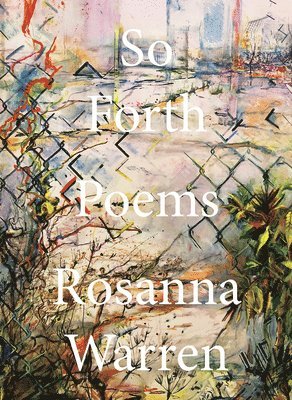
With irony, in mourning tinged with eros, one of our most extraordinary poets blends the personal and the political to meditate on damage, aging, and injustice. The poems in So Forth surge back in memory, pondering guilt and forgiveness. Consciousness flows from singular to plural; identity in these poems does a round dance with other personae, with formidable women artists of the past in the powerful sequence “Legende of Good Women,” with pre-Socratic philosophers, and with lovers, children, and strangers—the strangest of whom is the face in the mirror. In response to griefs both historical and contemporary, So Forth contemplates the quest for the holy and traditions of the sacred.
306 kr
Skickas
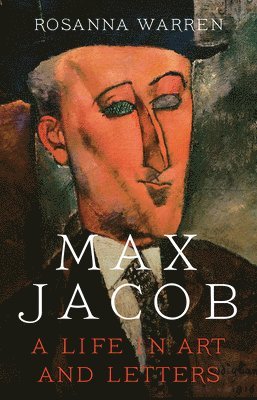
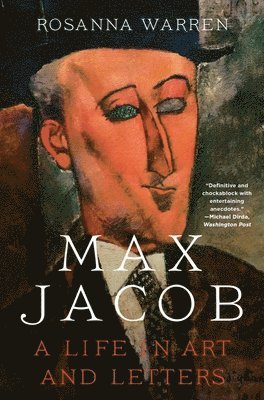
Though less of a household name than his contemporaries in early twentieth century Paris, Jewish homosexual poet Max Jacob was Pablo Picasso’s initiator into French culture, Guillaume Apollinaire’s guide out of the haze of symbolism, and Jean Cocteau’s loyal friend. As Picasso reinvented painting, Jacob helped to reinvent poetry with compressed, hard-edged prose poems and synapse-skipping verse lyrics, the product of a complex amalgamation of Jewish, Breton, Parisian, and Roman Catholic influences.In Max Jacob, the poet’s life plays out against the vivid backdrop of bohemian Paris from the turn of the twentieth century through the divisions of World War II. Acclaimed poet Rosanna Warren transports us to Picasso’s ramshackle studio in Montmartre, where Cubism was born; introduces the artists gathered at a seedy bar on the left bank, where Max would often hold court; and offers a front-row seat to the artistic squabbles that shaped the Modernist movement.Jacob’s complex understanding of faith, art, and sexuality animates this sweeping work. In 1909, he saw a vision of Christ in his shabby room in Montmartre, and in 1915 he converted formally from Judaism to Catholicism—with Picasso as his godfather. In his later years, Jacob split his time between Paris and the monastery of Benoît-sur-Loire. In February 1944, he was arrested by the Gestapo and sent to Drancy, where he would die a few days later.More than thirty years in the making, this landmark biography offers a compelling, tragic portrait of Jacob as a man and as an artist alongside a rich study of his groundbreaking poetry—in Warren’s own stunning translations. Max Jacob is a nuanced, deeply researched, and essential contribution to Modernist scholarship.
312 kr
Skickas
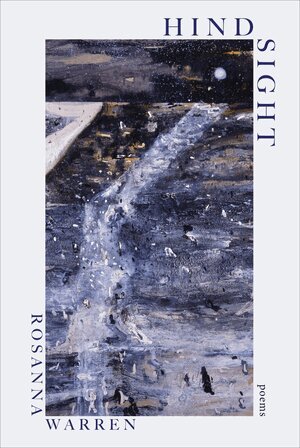
Hindsight arises from a tormented time in our country’s history. Some poems contemplate the shocks of the COVID-19 assault. Others consider our nation, which is torn to pieces politically. The poems in this collection attempt to find a language to describe the breakage.But political fracture occurs because of more fundamental dislocations: for this book, most crucially, spiritual. A search for forms of the sacred drives the whole collection. It’s a book of questions, not answers. In places, it struggles with the Christian story of sacrifice and crucifixion: a heretical attempt to make sense of suffering and of aggression. “Offices” and “Concerning ceremonies” borrow Christian liturgy to chart an experience of learning compassion. Each poem asks some version of the driving question from “Dead Flowers”: “What can be made of all this / grief.” Other poems turn to Judaism and Buddhism to see what wisdom they offer.Beneath theology pulses the private life. These poems look into a personal past and try to weigh the moral meaning of experience. In “Hindsight,” the speaker discovers, “I could have / seen you better, I / know that now.” Who have we been as we struggled to grow up? Whom have we hurt? What does it mean to be conscious?Hindsight elegantly embraces life writ large—larger than we are, sometimes violent, sometimes harshly beautiful—as ongoing instruction, in turn leaving the reader with a lyrical compass for orientation in our troubled moment.
248 kr
Kommande
More than a consecutive memoir, The Fair Fields presents a set of linked vignettes about what it was like to grow up in a white, liberal, literary household in Connecticut in the 1950s and early 1960s. Readers will meet characters they probably recognize, including Rosanna Warren’s parents—writers Robert Penn Warren and Eleanor Clark—and their friends: authors, visual artists, musicians, editors, and publishers.The narrative tracks Rosanna’s early childhood to young womanhood, taking in along the way visions of neolithic Brittany, Roman ruins in southern France, the French Revolution, the Algerian War, and the throes of the American civil rights movement in the 1960s. As much as a personal story, it’s a set of portraits from a certain gallery of post–World War II American intellectual life. It also tells the tale of a young artist finding her way from painting, her first vocation, to a life in writing.
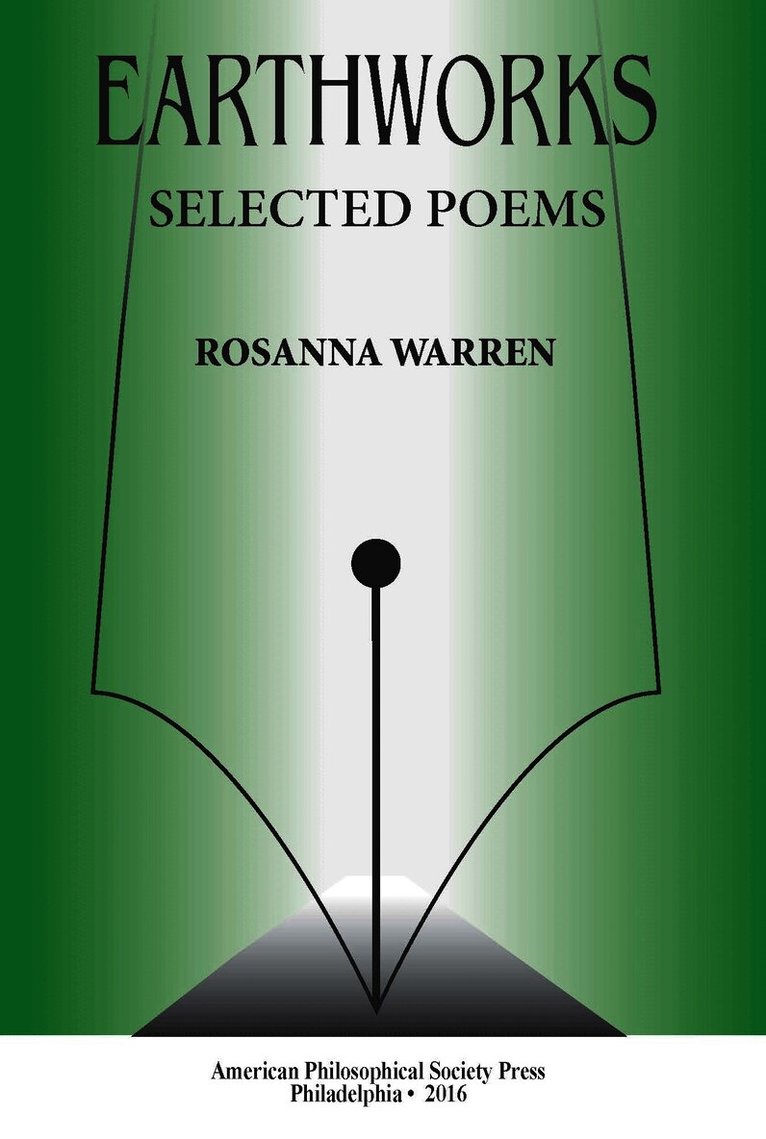
Earthworks
Selected Poems, Transactions, American Philosophical Society (Vol. 106, Part 1)
Häftad, Engelska, 2016
483 kr
Skickas inom 10-15 vardagar