Rosemary Batt - Böcker
Visar alla böcker från författaren Rosemary Batt. Handla med fri frakt och snabb leverans.
5 produkter
5 produkter
2 867 kr
Skickas inom 7-10 vardagar
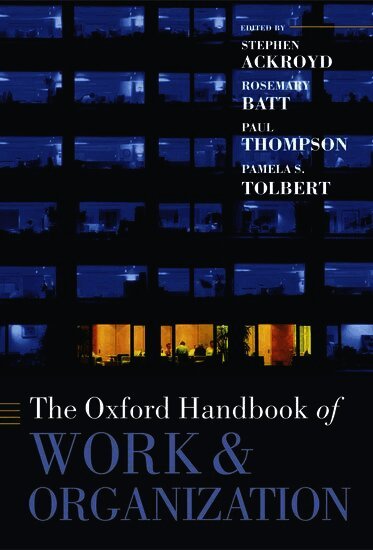
The last twenty-five years of the twentieth century was a period of extraordinary change in organizations and the economies of the developed world. This continues today. Such has been the scale and momentum of events that, for some analysts, the only comparable periods are the early part of the twentieth century in which the shift to mass production and large-scale organization was accomplished, or the industrial revolution itself a hundred years earlier. Researchers in Europe and the USA in particular have been studying change in work and organizations, but there has been little attempt to systematize and draw together the results of their work. So far, the emphasis amongst writers on organizations considering the problem of contemporary change has been on ways of conceptualizing events, rather than also considering evidence. But what has actually happened? How much of the flux of events is real change, and how much mere change in emphasis in which apparent change is overlaying organizational continuity? How far are changes in particular events and sectors connected, and is an overall understanding of complex processes possible?The Oxford Handbook of Work and Organization aims to bring together, present and discuss what is currently known about work and organizations and their connection to broader economic change in Europe and America. Issues of conceptualization are not neglected but, in contrast to other comparable volumes, the emphasis is firmly on what is known what and has been observed by researchers. The volume contains a range of theoretically informed essays, written by leading authorities in their respective fields, giving comprehensive coverage of changes in work, occupations, and organizations. It constitutes an invaluable overview of the accumulated understanding of research into work, occupations and organizations in recent decades. It shows that in almost every aspect of economic institutions, change has been considerable. The subject area of work, occupations and organizations is considered in four major sections of the volume: I, Work, Technology, and the Division of Labor; II, Managerial Regimes and Employee Actions; III, Occupations and Organizations; and IV, Organizing and Organizations. In this way the contemporary situation in work and organizations is considered extensively in its different dimensions and interconnections. The contributors have been selected for their expertise and include many leading authors in organizational analysis and substantive research. The handbook is thus an authoritative statement, and offers a valuable account of organizations at this time.
742 kr
Skickas inom 5-8 vardagar
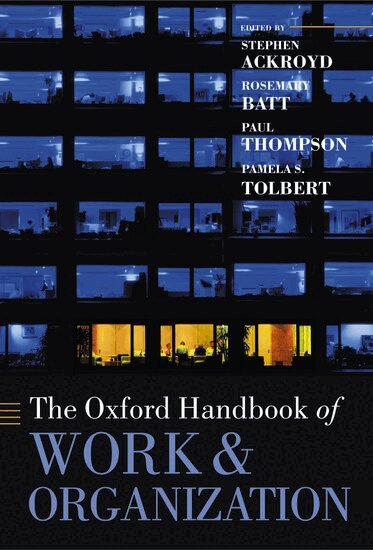
The last twenty-five years of the twentieth century was a period of extraordinary change in organizations and the economies of the developed world. This continues today. Such has been the scale and momentum of events that, for some analysts, the only comparable periods are the early part of the twentieth century in which the shift to mass production and large-scale organization was accomplished, or the industrial revolution itself a hundred years earlier. Researchers in Europe and the USA in particular have been studying change in work and organizations, but there has been little attempt to systematize and draw together the results of their work. So far, the emphasis amongst writers on organizations considering the problem of contemporary change has been on ways of conceptualizing events, rather than also considering evidence. But what has actually happened? How much of the flux of events is real change, and how much mere change in emphasis in which apparent change is overlaying organizational continuity? How far are changes in particular events and sectors connected, and is an overall understanding of complex processes possible? The Oxford Handbook of Work and Organization aims to bring together, present and discuss what is currently known about work and organizations and their connection to broader economic change in Europe and America. Issues of conceptualization are not neglected but, in contrast to other comparable volumes, the emphasis is firmly on what is known what and has been observed by researchers. The volume contains a range of theoretically informed essays, written by leading authorities in their respective fields, giving comprehensive coverage of changes in work, occupations, and organizations. It constitutes an invaluable overview of the accumulated understanding of research into work, occupations and organizations in recent decades. It shows that in almost every aspect of economic institutions, change has been considerable. The subject area of work, occupations and organizations is considered in four major sections of the volume: I, Work, Technology, and the Division of Labour; II, Managerial Regimes and Employee Responses; III, Occupations and Organizations; and IV, Organizations and Organized Systems. In this way the contemporary situation in work and organizations is considered extensively in its different dimensions and interconnections. The contributors have been selected for their expertise and include many leading authors in organizational analysis and substantive research. The handbook is thus an authoritative statement, and offers a valuable account of organizations at this time.
485 kr
Kommande
How the financialization of healthcare has eroded the quality of care, driven up prices, and worsened health inequalitiesFinancial actors and healthcare leaders increasingly view healthcare organizations as financial assets to be bought, sold, and managed for maximum profit, regardless of the effects on patient care. Healthcare in the Age of Finance Capital reveals how the federal government enables financial opportunism in healthcare and offers bold ideas for overhauling a failed system.Rosemary Batt and Eileen Appelbaum provide a unique analysis of the financialization of healthcare, a process in which a growing proportion of the healthcare economy is owned and controlled by the financial sector. Healthcare organizations increasingly depend on financial machinations and the earnings derived from them rather than revenue generated from patient care.The extent to which financial calculations overshadow the healthcare mission depends importantly on institutional legacies, reimbursement rules, and the failure of regulatory oversight. Batt and Appelbaum show how differences in regulations and financing rules shape whether financial actors can penetrate distinct healthcare segments—from hospitals, nursing homes, and ambulatory care to physician specialties, home health, hospice, and autism services. Nonprofit healthcare is not immune from this financial logic.Evidence based, accessible, and informed by real-world examples, Healthcare in the Age of Finance Capital sheds critical light on how financial deregulation coupled with the relaxation of health, tax, anti-trust, and labor laws have allowed financially driven actors to exploit public funds for private gain at the expense of healthcare organizations, patients, communities, labor, and taxpayers.
1 574 kr
Skickas inom 10-15 vardagar
Despite formidable obstacles, a small but growing number of U.S. companies rccognize that today's domestic and international markets require them to transform their production process. On the basis of more than ten years of survey data and the evidence of case studies, Eileen Appelbaum and Rosemary Batt analyze the experiences of these companies. Their findings reveal two distinct and coherent models of the new American workplace. One is an American version of team production, which combines the principles of sociotechnical systems with those of quality engineering and which decentralizes the management of work flow and decision making. The other is an American version of lean production, which relies more heavily on managerial and technical expertise, and on centralized coordination and decision making. The authors explain the organizational models from which high-performance firms in the United States have borrowed and outline the policies required to promote more widespread workplace change. They contend that U.S. firms can, in fact, compete successfully, while providing their workers with increased job security, livable wages, and enhanced job satisfaction. Certain to appeal to both union and business leaders, this volume also offers crucial insights to policy makers and to scholars of the new American workplace.
518 kr
Skickas inom 10-15 vardagar
Despite formidable obstacles, a small but growing number of U.S. companies rccognize that today's domestic and international markets require them to transform their production process. On the basis of more than ten years of survey data and the evidence of case studies, Eileen Appelbaum and Rosemary Batt analyze the experiences of these companies. Their findings reveal two distinct and coherent models of the new American workplace. One is an American version of team production, which combines the principles of sociotechnical systems with those of quality engineering and which decentralizes the management of work flow and decision making. The other is an American version of lean production, which relies more heavily on managerial and technical expertise, and on centralized coordination and decision making. The authors explain the organizational models from which high-performance firms in the United States have borrowed and outline the policies required to promote more widespread workplace change. They contend that U.S. firms can, in fact, compete successfully, while providing their workers with increased job security, livable wages, and enhanced job satisfaction. Certain to appeal to both union and business leaders, this volume also offers crucial insights to policy makers and to scholars of the new American workplace.