
Ross Thomson – författare
Visar alla böcker från författaren Ross Thomson. Handla med fri frakt och snabb leverans.
6 produkter
6 produkter
Inbunden, Engelska, 1993
1 602 kr
Skickas inom 10-15 vardagar
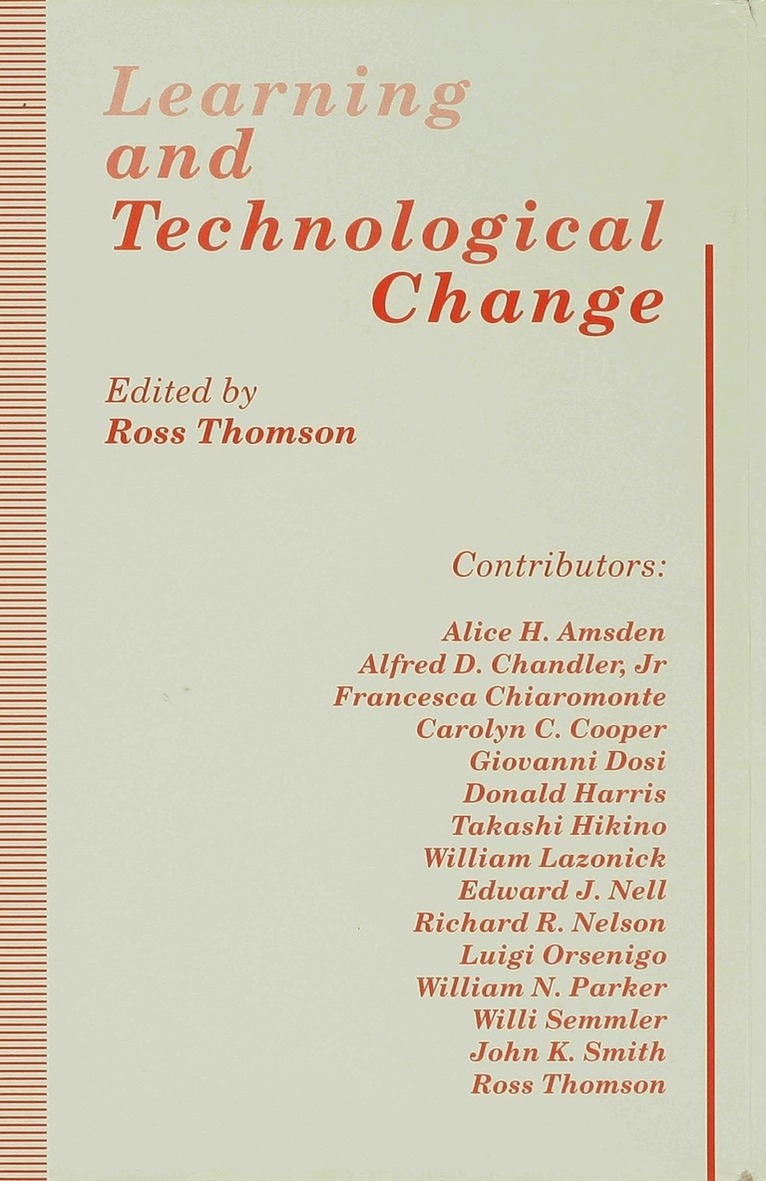
This volume features 15 contributors who argue that technical change can fruitfully be interpreted as an institutionally-structured learning process. These essays show that the analysis of knowledge-generating institutions - including firms, industries, patenting systems and occupations - provides insights into the pace, direction and persistence of technological change. The authors use these insights to both reshape economic theory, and reinterpret the economic development of Britain, the United States, Germany and Japan. Other titles by Ross Thomson includes "The Path to Mechanized Shoe Production in the United States", "Business and Economic History", " The Journal of Economic History", "The New Palgrave", "Social Concept" and "Technology and Culture".

Häftad, Engelska, 2012
537 kr
Skickas inom 10-15 vardagar
In 1800, shoes in the United States were made by craftsmen, each trained to create an entire shoe. A century later, shoes were mass-produced in factories employing dozens of machines and specialized workers. Ross Tomson describes this transition from craft to mechanized production in one of the largest American industries of the nineteenth century.Early shoe machinery originated through innovations made by shoemakers, tailors, and especially machinists. It contined to evolve through a process of ""learning by selling,"" in which sales of one generation of machines led to technological learning and ongoing invention by those who used, serviced, and sold them. As a result of this process, the mechanization of the shoe industry and the manufacturers of the machinery it used -- including such firms as Singer and United Shoe Machinery -- evolved together.In researching the process of industrialization, Thomson examined nearly 8,000 patents. Comparing the patent information with directories for more than eighty American cities, he was able to find out who the inventors were, who employed them, how many patents they held, and the extend to which their inventions were used.A UNC Press Enduring Edition -- UNC Press Enduring Editions use the latest in digital technology to make available again books from our distinguished backlist that were previously out of print. These editions are published unaltered from the original, and are presented in affordable paperback formats, bringing readers both historical and cultural value.

Häftad, Engelska, 2012
278 kr
Skickas inom 5-8 vardagar

Inbunden, Engelska, 2012
496 kr
Skickas inom 5-8 vardagar

Häftad, Engelska, 1993
1 602 kr
Skickas inom 10-15 vardagar
In this book, fifteen prominent scholars of the economy, business, and technology argue that technical change can fruitfully be interpreted as an institutionally structured learning process.
Inbunden, Engelska, 2009
711 kr
Tillfälligt slut
The United States registered phenomenal economic growth between the establishment of the new republic and the end of the Civil War. Ross Thomson's fresh study accounts for the unprecedented technological innovations that helped propel antebellum growth. Thomson argues that the transition of the United States from an agrarian economy in 1790 to an industrial leader in 1865 relied fundamentally on the spread of technological knowledge within and across industries. Essential to this spread was a dense web of knowledge-diffusing institutions-new occupations and industries, the patent office, machine shops, mechanics' associations, scientific societies, public colleges, and the civil engineering profession. Together they composed an integrated innovation system that generated, disseminated, and employed new technical knowledge across ever-widening ranges of the economy. To trace technological change in fourteen major industries and the economy as a whole, Thomson analyzes 14,000 patents, the records of two dozen machinery firms, census data for 1,800 companies, and hundreds of business directories.This exhaustive research leads to his interesting interpretation of technological diffusion and development. Thomson's impressive study of the infrastructure that fueled and supported the young country's economic and industrial successes will interest students of economic, technological, and business history.