Rüdiger Hell - Böcker
Visar alla böcker från författaren Rüdiger Hell. Handla med fri frakt och snabb leverans.
4 produkter
4 produkter
3 149 kr
Skickas inom 10-15 vardagar
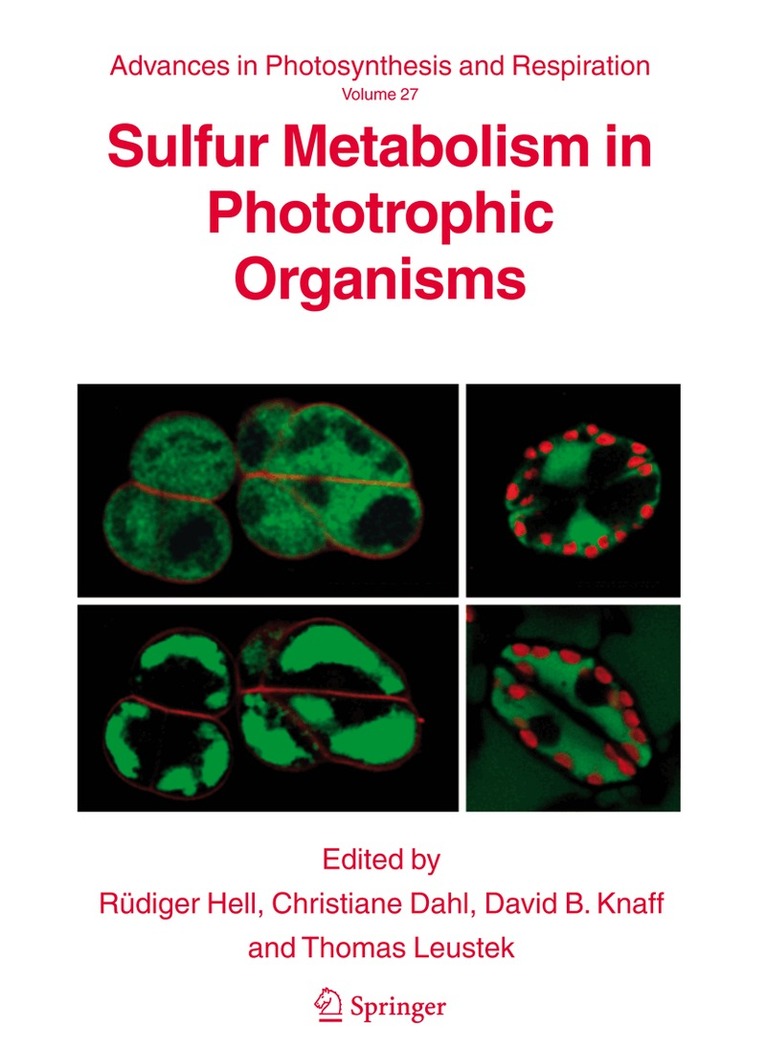
Sulfur is one of the most versatile elements in life due to its reactivity in different oxidation and reduction states. In phototrophic organisms, the redox properties of sulfur in proteins, and of sulfur-containing metabolites, are particularly important in the interaction between the reductive assimilation processes of photosynthesis and reactive oxygen species that arise as by-products of electron transport chains. Thiol groups in proteins and metabolites are targets of reactive oxygen species, resulting in potential damage and at the same time giving rise to redox signal cascades that trigger repair reactions and adaptation to environmental stress. Further, reduced sulfur compounds play a prominent role as electron donors for photosynthetic carbon dioxide fixation in anoxygenic phototrophic sulfur bacteria. Interest in the investigation of the multiple functions of sulfur-related processes has increased exponentially in recent years, especially in molecular and cellular biology, biochemistry, agrobiotechnology and ecology. This book provides, for the first time, in-depth and integrated coverage of the functions of sulfur in phototrophic organisms including bacteria, plants and algae; it bridges gaps between biochemistry and cellular biology of sulfur in these organisms, and of biology and environments dominated by them. This book is designed to be a comprehensive resource on sulfur in phototrophic organisms for advanced undergraduate and graduate students, beginning researchers and teachers in the area of photosynthesis, bacterial energy metabolism, biotechnology, plant nutrition, plant production and plant molecular physiology.
2 426 kr
Skickas inom 10-15 vardagar
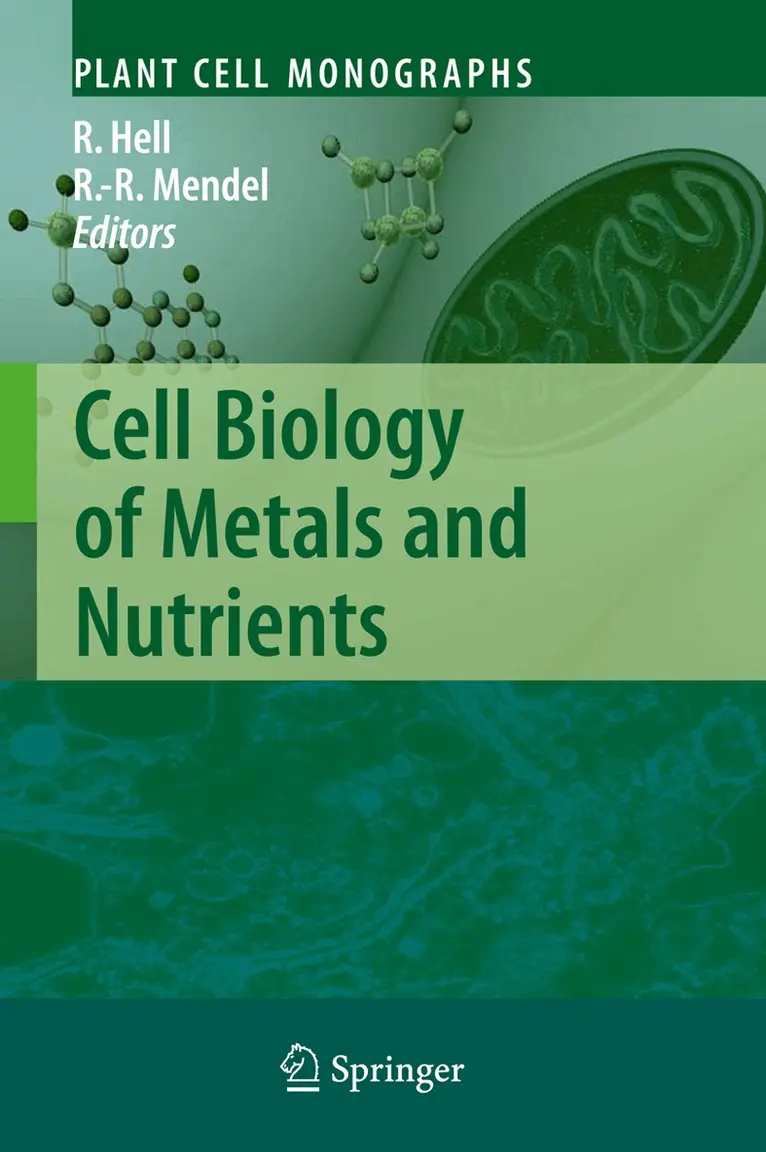
Plants are composed of 17 essential and at least 5 beneficial elements, and these must be taken up as metal or nutrient ions to allow for growth and cell division. Much effort has been devoted to studying the physiology and biochemistry of metals and nutrients in plants. The aspect of cell biology, however, is an emerging new field and much needs to be learned about sensing, long-distance communication within plants, and cellular signal transduction chains in response to environmental stress. Cellular malfunction and consequently disease result when any of the key steps in metal and nutrient homeostasis are disrupted.Working together, leading experts in their respective fields provide a new concept that reaches beyond plant nutrition and plasmalemma transport into cellular physiology. Each chapter contains basic information on uptake, physiological function, deficiency and toxicity syndromes, long-distance and intracellular transport. The discussion is devoted to metals and nutrients where recent progress has been made and highlights the aspects of homeostasis and sensing, signaling and regulation, drawing parallels to other organisms including humans. Finally, the book identifies gaps in our current knowledge and lays out future research directions.
2 426 kr
Skickas inom 10-15 vardagar
Plants are composed of 17 essential and at least 5 beneficial elements, and these must be taken up as metal or nutrient ions to allow for growth and cell division. Much effort has been devoted to studying the physiology and biochemistry of metals and nutrients in plants. The aspect of cell biology, however, is an emerging new field and much needs to be learned about sensing, long-distance communication within plants, and cellular signal transduction chains in response to environmental stress. Cellular malfunction and consequently disease result when any of the key steps in metal and nutrient homeostasis are disrupted.Working together, leading experts in their respective fields provide a new concept that reaches beyond plant nutrition and plasmalemma transport into cellular physiology. Each chapter contains basic information on uptake, physiological function, deficiency and toxicity syndromes, long-distance and intracellular transport. The discussion is devoted to metals and nutrients where recent progress has been made and highlights the aspects of homeostasis and sensing, signaling and regulation, drawing parallels to other organisms including humans. Finally, the book identifies gaps in our current knowledge and lays out future research directions.
3 162 kr
Skickas inom 10-15 vardagar
Sulfur is one of the most versatile elements in life due to its reactivity in different oxidation and reduction states. In phototrophic organisms, the redox properties of sulfur in proteins, and of sulfur-containing metabolites, are particularly important in the interaction between the reductive assimilation processes of photosynthesis and reactive oxygen species that arise as by-products of electron transport chains. Thiol groups in proteins and metabolites are targets of reactive oxygen species, resulting in potential damage and at the same time giving rise to redox signal cascades that trigger repair reactions and adaptation to environmental stress. Further, reduced sulfur compounds play a prominent role as electron donors for photosynthetic carbon dioxide fixation in anoxygenic phototrophic sulfur bacteria. Interest in the investigation of the multiple functions of sulfur-related processes has increased exponentially in recent years, especially in molecular and cellular biology, biochemistry, agrobiotechnology and ecology. This book provides, for the first time, in-depth and integrated coverage of the functions of sulfur in phototrophic organisms including bacteria, plants and algae; it bridges gaps between biochemistry and cellular biology of sulfur in these organisms, and of biology and environments dominated by them. This book is designed to be a comprehensive resource on sulfur in phototrophic organisms for advanced undergraduate and graduate students, beginning researchers and teachers in the area of photosynthesis, bacterial energy metabolism, biotechnology, plant nutrition, plant production and plant molecular physiology.