Rui Baptista - Böcker
Visar alla böcker från författaren Rui Baptista. Handla med fri frakt och snabb leverans.
4 produkter
4 produkter
1 593 kr
Skickas inom 10-15 vardagar
39 One of the main challenges facing the member states of the European Union (EU) is 40 the fundamental need to accept the strategic importance of entrepreneurship as a force 41 for regional development and economic growth. Definition of this urgent objective 42 is set in the context of the European Council in Lisbon in March 2000, where there 43 was focus on other operational goals directed to improving performance in European 44 regions in terms of different variables indicating the level of economic activity, 45 particularly employment, real convergence, economic reform, and social cohesion. 46 In 2003, the European Commission (EC) initiated the public debate around the 47 need to strengthen entrepreneurship in the European Union, through publication of 48 the “Green Paper on Entrepreneurship” in Europe which raised two fundamental 49 questions for reflection by policymakers, entrepreneurs, and individuals: (a) why 50 do so few Europeans set up their own business? and (b) why are so few European 51 businesses growing? 52 Later, in the context of the 2004 Spring European Council, the European 53 Commission launched the “Entrepreneurship Action Plan” which aimed fundamen- 54 tally to: (1) change the way society views entrepreneurs, (2) create conditions to 55 encourage more individuals to become entrepreneurs, (3) allow SMEs and entre- 56 preneurs to be more competitive and assume a more important role in determining 57 growth, (4) improve conditions for access to finance by SMEs and entrepreneurs, 58
1 593 kr
Skickas inom 10-15 vardagar
39 One of the main challenges facing the member states of the European Union (EU) is 40 the fundamental need to accept the strategic importance of entrepreneurship as a force 41 for regional development and economic growth. Definition of this urgent objective 42 is set in the context of the European Council in Lisbon in March 2000, where there 43 was focus on other operational goals directed to improving performance in European 44 regions in terms of different variables indicating the level of economic activity, 45 particularly employment, real convergence, economic reform, and social cohesion. 46 In 2003, the European Commission (EC) initiated the public debate around the 47 need to strengthen entrepreneurship in the European Union, through publication of 48 the “Green Paper on Entrepreneurship” in Europe which raised two fundamental 49 questions for reflection by policymakers, entrepreneurs, and individuals: (a) why 50 do so few Europeans set up their own business? and (b) why are so few European 51 businesses growing? 52 Later, in the context of the 2004 Spring European Council, the European 53 Commission launched the “Entrepreneurship Action Plan” which aimed fundamen- 54 tally to: (1) change the way society views entrepreneurs, (2) create conditions to 55 encourage more individuals to become entrepreneurs, (3) allow SMEs and entre- 56 preneurs to be more competitive and assume a more important role in determining 57 growth, (4) improve conditions for access to finance by SMEs and entrepreneurs, 58
Del 31 - International Studies in Entrepreneurship
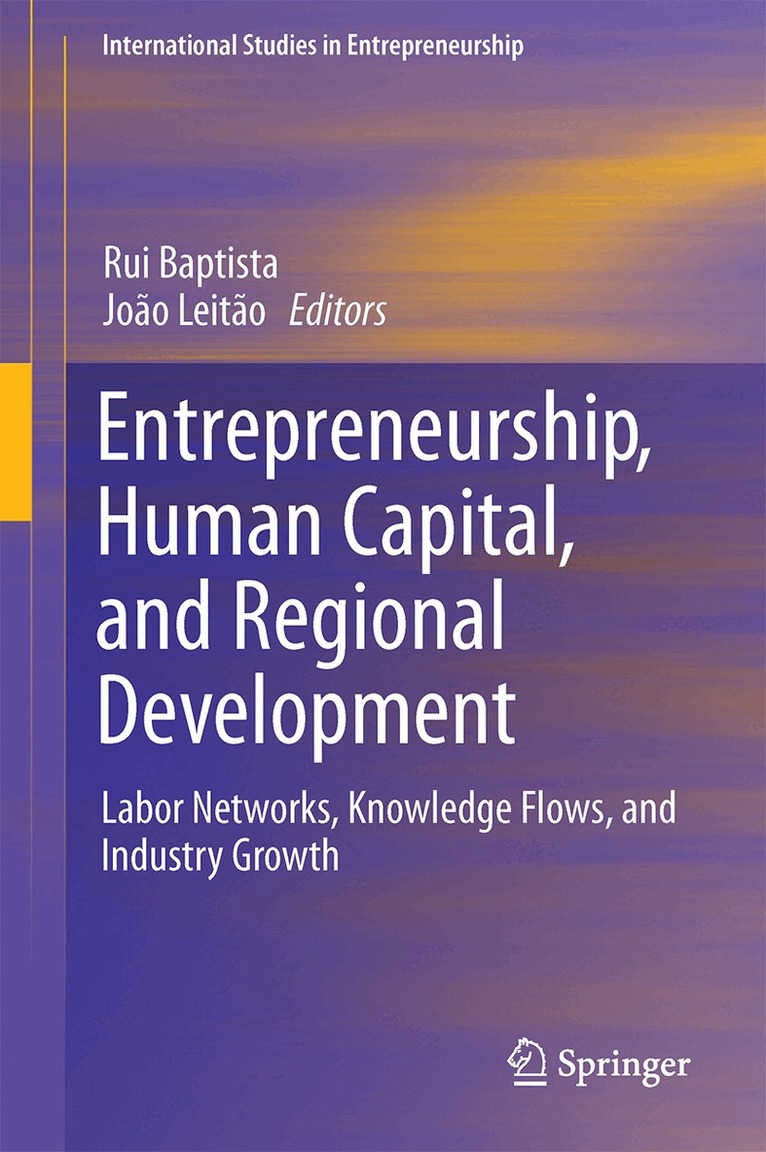
Entrepreneurship, Human Capital, and Regional Development
Labor Networks, Knowledge Flows, and Industry Growth
Inbunden, Engelska, 2015
1 096 kr
Skickas inom 10-15 vardagar
This book makes original contributions to the literature on clusters, human capital, and regional development by focusing on the link between entrepreneurship and economic growth, aiming for a better understanding of the dynamics of growth determined by the entrepreneur’s action in the regional space. The focus is therefore on critical reflection and rethinking the articulation between three levels of analysis of economic systems, namely entrepreneurship, human capital and regional development, which have not so far been perfectly articulated in the literature of reference on endogenous growth.Although there has been significant research so far into the success and failure of clusters, the implications of these multiple research efforts fail to provide political decision-makers and company managers with critical information about which mechanisms lie behind cluster success and also about how clusters survive and prosper. The innovative approaches presented in this book on entrepreneurship, human capital mobility and regional development have considerable potential to create new and original implications for decision-makers and managers. In terms of value added, this book contributes to the literature by seeking answers to the following questions: (i) Is the growth and success of clusters over time due to concentration and transmission of business competences through spin-offs located in a given regional space?(ii) Does increased density of job options outside the workplace contribute to increased mobility of human capital between firms located within clusters, and soimprove coordination in the local labor market?(iii) Do spin-offs benefit from hiring workers from successful incumbents, inasmuch as those workers are expected to perform better than other workers from different origins?Integrating theoretical frameworks, empirical research, and regional case studies (from Portugal, Spain, Norway and Turkey), the editors and contributors demonstrate that the regional dynamics of industry growth are strongly influenced by the mobility of employees towards new firms.
Del 31 - International Studies in Entrepreneurship
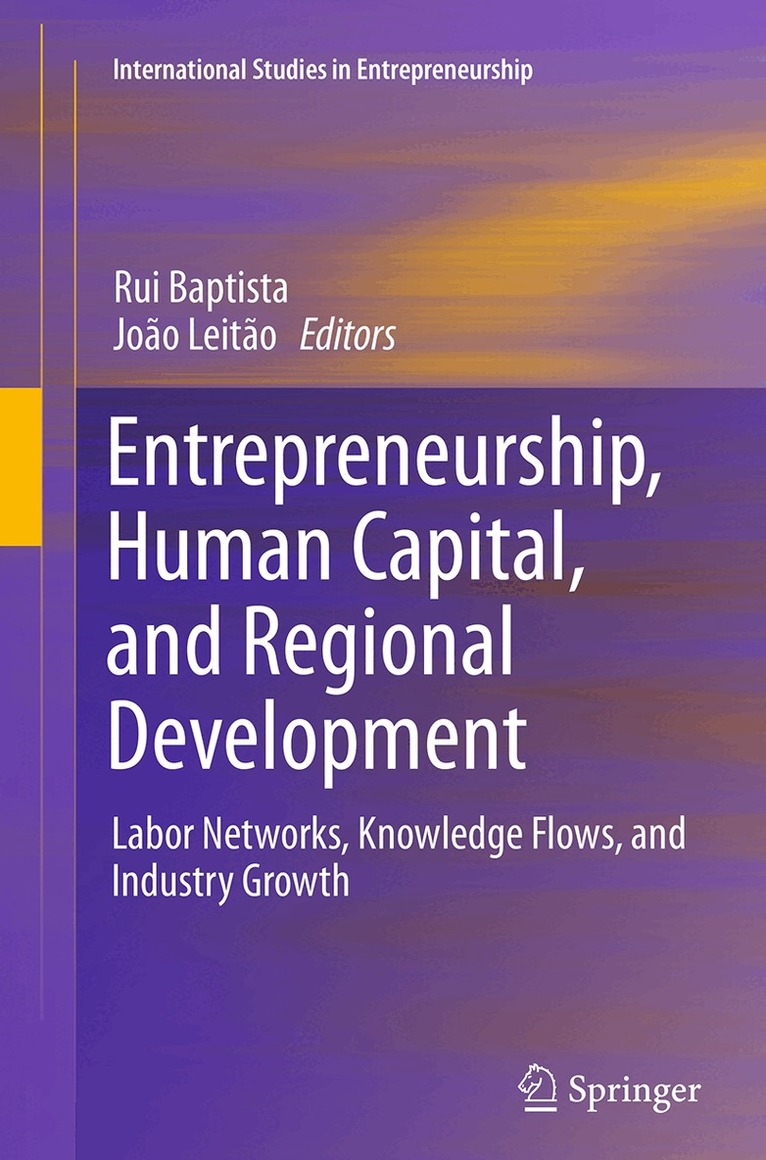
Entrepreneurship, Human Capital, and Regional Development
Labor Networks, Knowledge Flows, and Industry Growth
Häftad, Engelska, 2016
1 096 kr
Skickas inom 10-15 vardagar
This book makes original contributions to the literature on clusters, human capital, and regional development by focusing on the link between entrepreneurship and economic growth, aiming for a better understanding of the dynamics of growth determined by the entrepreneur’s action in the regional space. The focus is therefore on critical reflection and rethinking the articulation between three levels of analysis of economic systems, namely entrepreneurship, human capital and regional development, which have not so far been perfectly articulated in the literature of reference on endogenous growth.Although there has been significant research so far into the success and failure of clusters, the implications of these multiple research efforts fail to provide political decision-makers and company managers with critical information about which mechanisms lie behind cluster success and also about how clusters survive and prosper. The innovative approaches presented in this book on entrepreneurship, human capital mobility and regional development have considerable potential to create new and original implications for decision-makers and managers. In terms of value added, this book contributes to the literature by seeking answers to the following questions: (i) Is the growth and success of clusters over time due to concentration and transmission of business competences through spin-offs located in a given regional space?(ii) Does increased density of job options outside the workplace contribute to increased mobility of human capital between firms located within clusters, and soimprove coordination in the local labor market?(iii) Do spin-offs benefit from hiring workers from successful incumbents, inasmuch as those workers are expected to perform better than other workers from different origins?Integrating theoretical frameworks, empirical research, and regional case studies (from Portugal, Spain, Norway and Turkey), the editors and contributors demonstrate that the regional dynamics of industry growth are strongly influenced by the mobility of employees towards new firms.