
R.W. Farebrother – författare
Visar alla böcker från författaren . Handla med fri frakt och snabb leverans.
8 produkter
8 produkter
E-bok
PDF, Engelska, 20021 194 kr
Läs direkt efter köp
Examines classic algorithms, geometric diagrams, and mechanical principles for enhancing visualization of statistical estimation procedures and mathematical concepts in physics, engineering, and computer programming.
Häftad, Engelska, 2020
997 kr
Skickas inom 10-15 vardagar
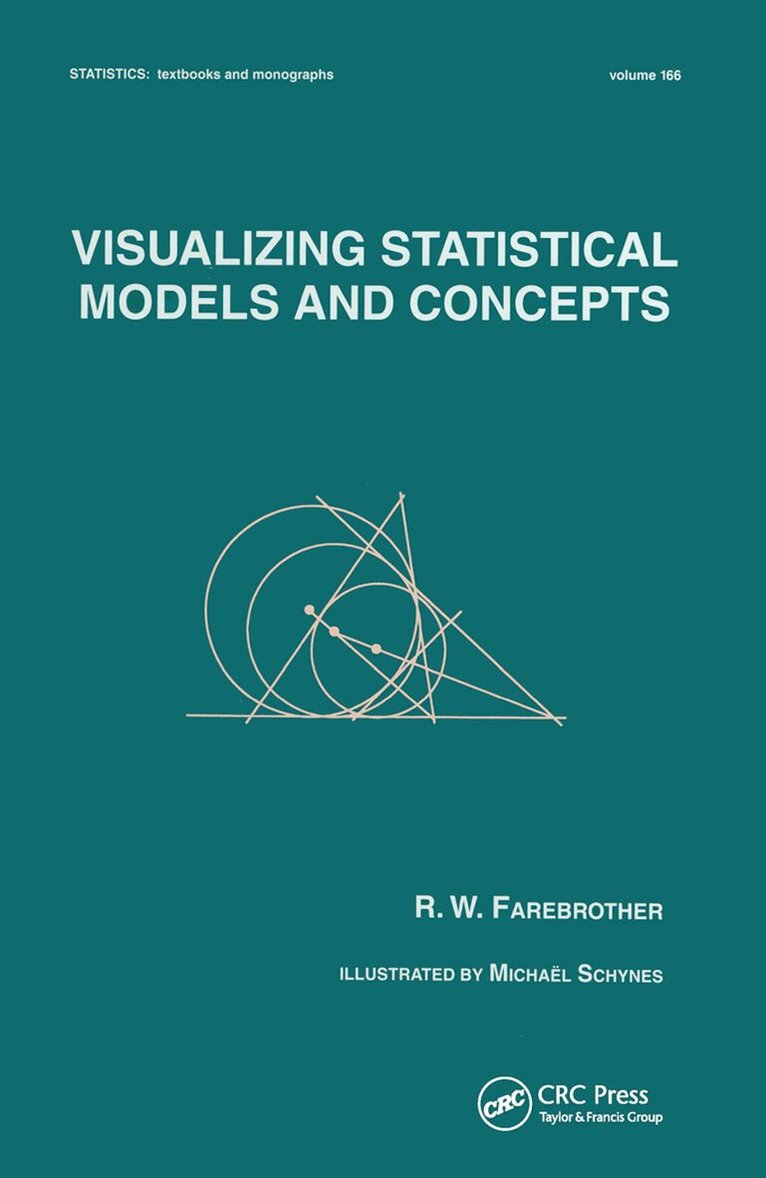
Examines classic algorithms, geometric diagrams, and mechanical principles for enhancing visualization of statistical estimation procedures and mathematical concepts in physics, engineering, and computer programming.
Inbunden, Engelska, 1998
1 079 kr
Skickas inom 10-15 vardagar
This book is intended for students of mathematical statistics who are interested in the early history of their subject. It gives detailed algebraic descriptions of the fitting of linear relationships by the method of least squares (L ) and the related least absolute 2 deviations (L ) and minimax absolute deviations (Loo) procedures. These traditional line J fitting procedures are, of course, also addressed in conventional statistical textbooks, but the discussion of their historical background is usually extremely slight, if not entirely absent. The present book complements the analysis of these procedures given in S.M. Stigler'S excellent work The History of Statistics: The Quantification of Uncertainty before 1900. However, the present book gives a more detailed account of the algebraic structure underlying these traditional fitting procedures. It is anticipated that readers of the present book will obtain a clear understanding of the historical background to these and other commonly used statistical procedures. Further, a careful consideration of the wide variety of distinct approaches to a particular topic, such as the method of least squares, will give the reader valuable insights into the essential nature of the selected topic.
Inbunden, Engelska, 2002
2 104 kr
Skickas inom 10-15 vardagar
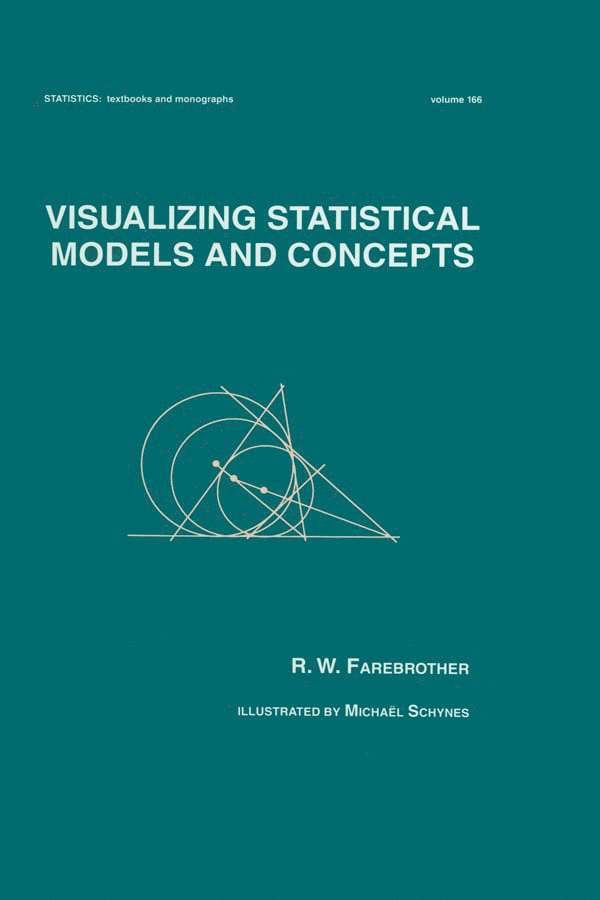
Examines classic algorithms, geometric diagrams, and mechanical principles for enhancing visualization of statistical estimation procedures and mathematical concepts in physics, engineering, and computer programming.
Inbunden, Engelska, 1988
2 935 kr
Skickas inom 10-15 vardagar
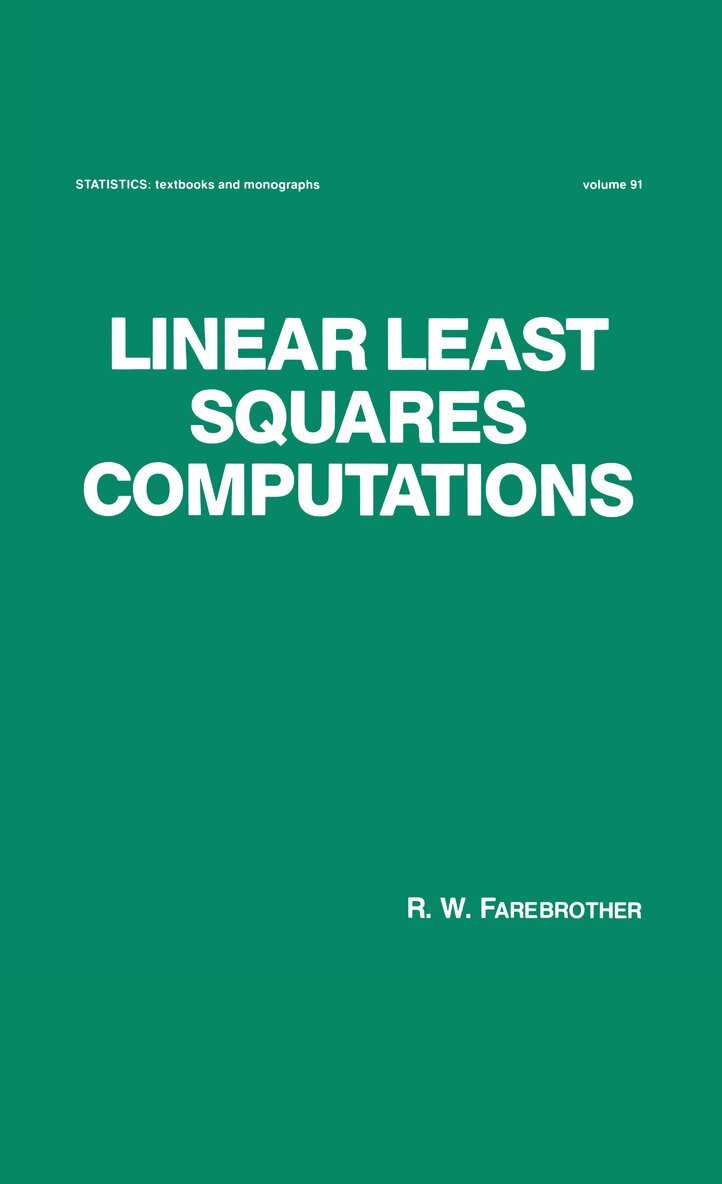
Presenting numerous algorithms in a simple algebraic form so that the reader can easilytranslate them into any computer language, this volume gives details of several methodsfor obtaining accurate least squares estimates. It explains how these estimates may beupdated as new information becomes available and how to test linear hypotheses.Linear Least Squares Computations features many structured exercises that guidethe reader through the available algorithms, plus a glossary of commonly used terms anda bibliography of supplementary reading ... collects "ancient" and modem results onlinear least squares computations in a convenient single source . . . develops the necessarymatrix algebra in the context of multivariate statistics . .. only makes peripheral use ofconcepts such as eigenvalues and partial differentiation .. . interprets canonical formsemployed in computation ... discusses many variants of the Gauss, Laplace-Schmidt,Givens, and Householder algorithms ... and uses an empirical approach for the appraisalof algorithms.Linear Least Squares Computations serves as an outstanding reference forindustrial and applied mathematicians, statisticians, and econometricians, as well as atext for advanced undergraduate and graduate statistics, mathematics, and econometricscourses in computer programming, linear regression analysis, and applied statistics.
E-bok
Engelska, 20021 194 kr
Läs direkt efter köp
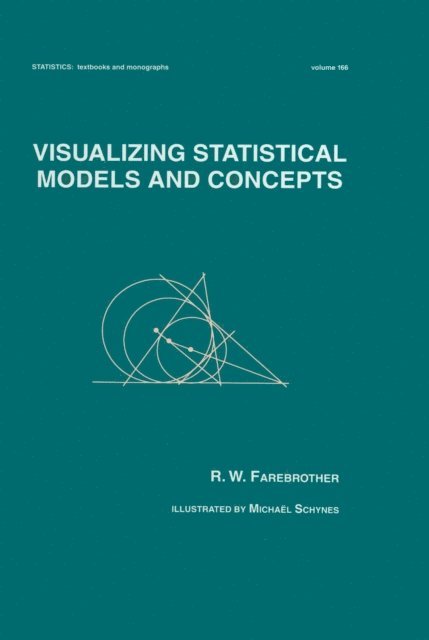
Examines classic algorithms, geometric diagrams, and mechanical principles for enhancing visualization of statistical estimation procedures and mathematical concepts in physics, engineering, and computer programming.
E-bok
PDF, Engelska, 20121 416 kr
Läs direkt efter köp
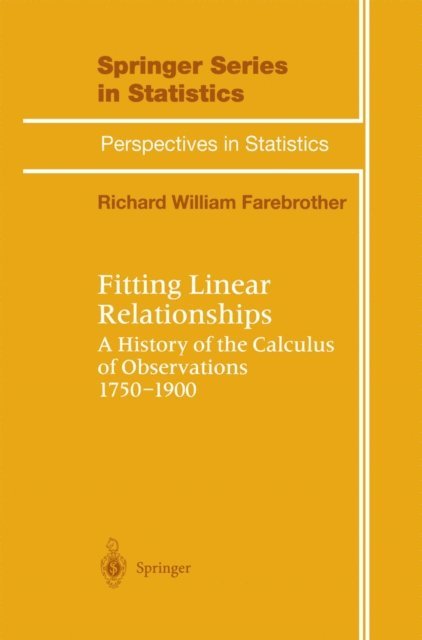
This book is intended for students of mathematical statistics who are interested in the early history of their subject. It gives detailed algebraic descriptions of the fitting of linear relationships by the method of least squares (L ) and the related least absolute 2 deviations (L ) and minimax absolute deviations (Loo) procedures. These traditional line J fitting procedures are, of course, also addressed in conventional statistical textbooks, but the discussion of their historical background is usually extremely slight, if not entirely absent. The present book complements the analysis of these procedures given in S.M. Stigler''S excellent work The History of Statistics: The Quantification of Uncertainty before 1900. However, the present book gives a more detailed account of the algebraic structure underlying these traditional fitting procedures. It is anticipated that readers of the present book will obtain a clear understanding of the historical background to these and other commonly used statistical procedures. Further, a careful consideration of the wide variety of distinct approaches to a particular topic, such as the method of least squares, will give the reader valuable insights into the essential nature of the selected topic.
Häftad, Engelska, 2012
1 079 kr
Skickas inom 10-15 vardagar
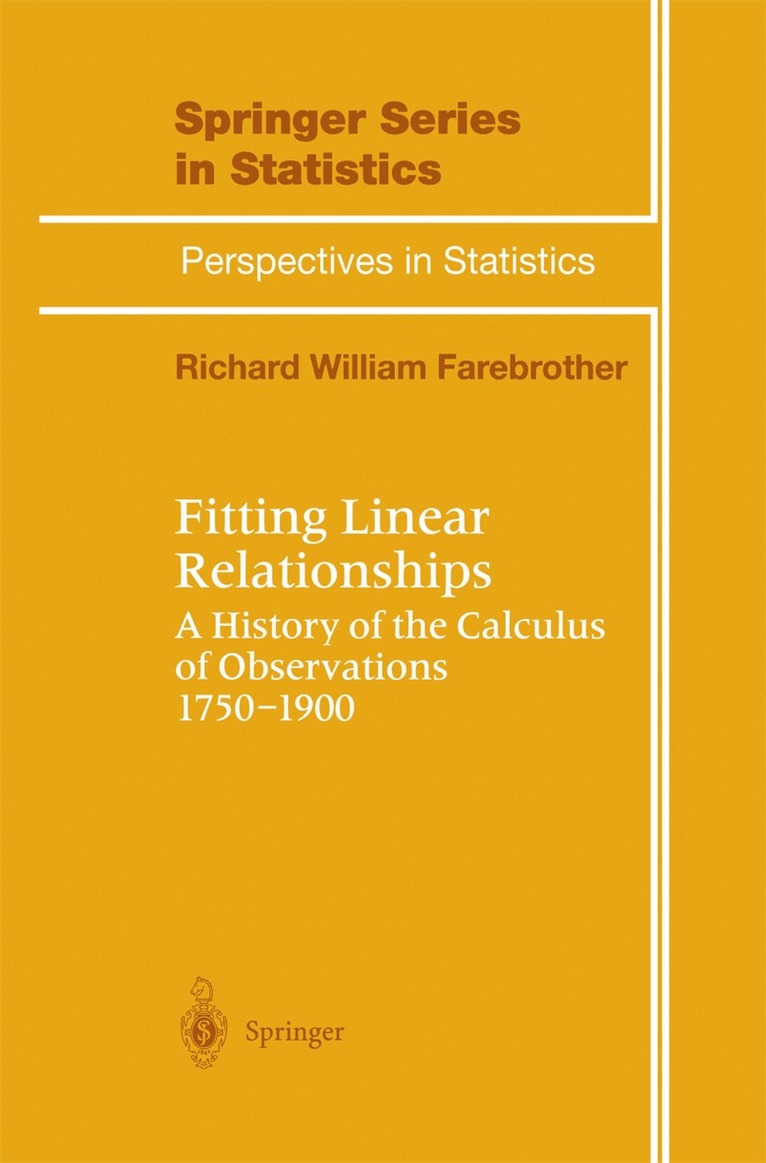
This book is intended for students of mathematical statistics who are interested in the early history of their subject. It gives detailed algebraic descriptions of the fitting of linear relationships by the method of least squares (L ) and the related least absolute 2 deviations (L ) and minimax absolute deviations (Loo) procedures. These traditional line J fitting procedures are, of course, also addressed in conventional statistical textbooks, but the discussion of their historical background is usually extremely slight, if not entirely absent. The present book complements the analysis of these procedures given in S.M. Stigler'S excellent work The History of Statistics: The Quantification of Uncertainty before 1900. However, the present book gives a more detailed account of the algebraic structure underlying these traditional fitting procedures. It is anticipated that readers of the present book will obtain a clear understanding of the historical background to these and other commonly used statistical procedures. Further, a careful consideration of the wide variety of distinct approaches to a particular topic, such as the method of least squares, will give the reader valuable insights into the essential nature of the selected topic.