S. Alan Stern - Böcker
Visar alla böcker från författaren S. Alan Stern. Handla med fri frakt och snabb leverans.
4 produkter
4 produkter
737 kr
Skickas inom 7-10 vardagar
With the development of space-travel, we have begun to explore worlds beyond Earth. Ten planetary scientists have come together to describe their favourite planet, what they have discovered, and what drives them to explore. Each tells a personal story, ranging across the breadth of the solar system - from hellish Mercury to the snows of Pluto; from telescopic to robotic exploration; from adventures in Antarctica to painting planetary landscapes; from the frustrations of failure to the joys of success. Worlds Beyond is the third in a series of extraordinary books bringing together leading space scientists to describe their work. Our Worlds was the first of its kind in revealing the inner motivations of planetary scientists. In Our Universe, leading astronomers and cosmologists explored the vastness of the Universe itself. Now with Worlds Beyond we return to our home - the solar system - to visit those fascinating new worlds beyond our own.
Search for Extra-Solar Terrestrial Planets: Techniques and Technology
Proceedings of a Conference held in Boulder, Colorado, May 14–17, 1995
Inbunden, Engelska, 1997
1 064 kr
Skickas inom 10-15 vardagar
J 2 J. MICHAEL SHl:LL , HARLEY A. THRO:\SOX, JR. , A:'>D S. ALAN STER:\3 I University of Colorado, Dept. of Astrophysical. Planetary, &. Atmospheric Sciences 2 University of Wyoming and KASA Headquarters, Code SR 3 Southwest Research Institute, Boulder Office On May 15-17. 1995, three Rocky Motultain research institutions hosted a confererJce to dis- cuss the scientific basis, teclmological options, and programmatic implications of a large-scale effort to find and study Earth-like planets outside the Solar System. Our workshop attracted scientists, erJgineers, space agency administrators, and the public media to discuss and debate the most promising teclmological options and opportunities. Major programs and proposals to search for and study exo-planets were preserJted and discussed. In addition, our meeting - incided *with NASA's "roadmap" study for the Exploration of Neighboring Planetary Systems (~"'\PS). Our meeting was the first international confererJce on this subject, affording an op- portunity for several members of this study to participate in the debates over new technologies. Our meeting proyed to be timely.Shortly thereafter, in late 199*5 and early 1996, two groups of astronomers annotulced the first discoveries of planetary companions to nearby stars. using high-precision radial velocity measuremerJts to detect the gravitational reflex motion of the star. The first three detections include a Jupiter-mass companion to the solar-like star. 51 Pegasi, and two remarkable objects of mass at least 2. 3 and 6.
714 kr
Skickas inom 7-10 vardagar
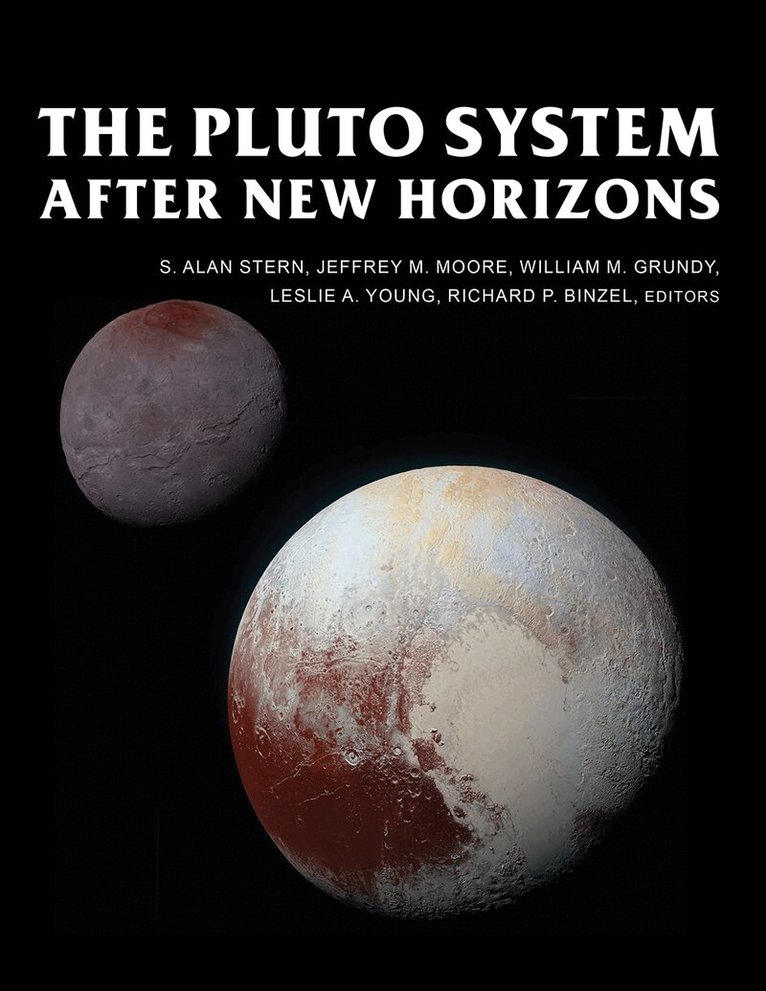
Once perceived as distant, cold, dark, and seemingly unknowable, Pluto had long been marked as the farthest and most unreachable frontier for solar system exploration. After Voyager accomplished its final planetary reconnaissance at Neptune in 1989, Pluto and its cohort in the Kuiper Belt beckoned as the missing puzzle piece for completing the first reconnaissance of our solar system. In the decades following Voyager, a mission to the Pluto system was not only imagined but also achieved, culminating with the historic 2015 flyby by the New Horizons spacecraft. Pluto and its satellite system ('the Pluto system'), including its largest moon, Charon, have been revealed to be worlds of enormous complexity that fantastically exceed preconceptions.The Pluto System After New Horizons seeks to become the benchmark for synthesizing our understanding of the Pluto system. The volume's lead editor is S. Alan Stern, who also serves as NASA's New Horizons Principal Investigator; co-editors Richard P. Binzel, William M. Grundy, Jeffrey M. Moore, and Leslie A. Young are all co-investigators on New Horizons. Leading researchers from around the globe have spent the last five years assimilating Pluto system flyby data returned from New Horizons. The chapters in this volume form an enduring foundation for ongoing study and understanding of the Pluto system. The volume also advances insights into the nature of dwarf planets and Kuiper Belt objects, providing a cornerstone for planning new missions that may return to the Pluto system and explore others of the myriad important worlds beyond Neptune.
Search for Extra-Solar Terrestrial Planets: Techniques and Technology
Proceedings of a Conference held in Boulder, Colorado, May 14–17, 1995
Häftad, Engelska, 2012
1 064 kr
Skickas inom 10-15 vardagar
J 2 J. MICHAEL SHl:LL , HARLEY A. THRO:\SOX, JR. , A:'>D S. ALAN STER:\3 I University of Colorado, Dept. of Astrophysical. Planetary, &. Atmospheric Sciences 2 University of Wyoming and KASA Headquarters, Code SR 3 Southwest Research Institute, Boulder Office On May 15-17. 1995, three Rocky Motultain research institutions hosted a confererJce to dis- cuss the scientific basis, teclmological options, and programmatic implications of a large-scale effort to find and study Earth-like planets outside the Solar System. Our workshop attracted scientists, erJgineers, space agency administrators, and the public media to discuss and debate the most promising teclmological options and opportunities. Major programs and proposals to search for and study exo-planets were preserJted and discussed. In addition, our meeting - incided *with NASA's "roadmap" study for the Exploration of Neighboring Planetary Systems (~"'\PS). Our meeting was the first international confererJce on this subject, affording an op- portunity for several members of this study to participate in the debates over new technologies. Our meeting proyed to be timely.Shortly thereafter, in late 199*5 and early 1996, two groups of astronomers annotulced the first discoveries of planetary companions to nearby stars. using high-precision radial velocity measuremerJts to detect the gravitational reflex motion of the star. The first three detections include a Jupiter-mass companion to the solar-like star. 51 Pegasi, and two remarkable objects of mass at least 2. 3 and 6.