S. G. Rajeev – författare
Visar alla böcker från författaren S. G. Rajeev. Handla med fri frakt och snabb leverans.
4 produkter
4 produkter
1 025 kr
Skickas inom 5-8 vardagar
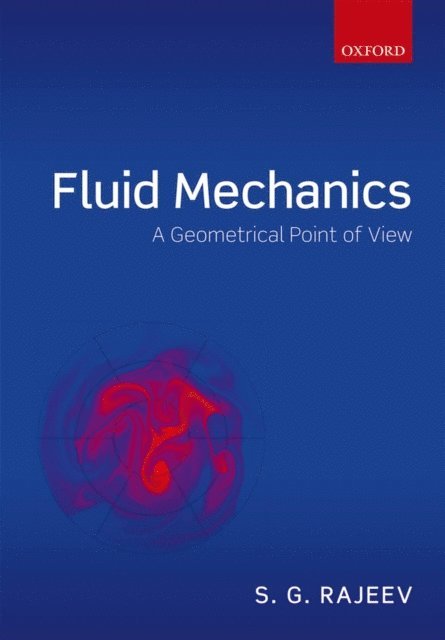
Fluid Mechanics: A Geometrical Point of View emphasizes general principles of physics illustrated by simple examples in fluid mechanics. Advanced mathematics (e.g., Riemannian geometry and Lie groups) commonly used in other parts of theoretical physics (e.g. General Relativity or High Energy Physics) are explained and applied to fluid mechanics. This follows on from the author's book Advanced Mechanics (Oxford University Press, 2013). After introducing the fundamental equations (Euler and Navier-Stokes), the book provides particular cases: ideal and viscous flows, shocks, boundary layers, instabilities, and transients. A restrained look at integrable systems (KdV) leads into a formulation of an ideal fluid as a hamiltonian system. Arnold's deep idea, that the instability of a fluid can be understood using the curvature of the diffeomorphism group, will be explained. Leray's work on regularity of Navier-Stokes solutions, and the modern developments arising from it, will be explained in language for physicists.Although this is a book on theoretical physics, readers will learn basic numerical methods: spectral and finite difference methods, geometric integrators for ordinary differential equations. Readers will take a deep dive into chaotic dynamics, using the Smale horse shoe as an example. Aref's work on chaotic advection is explained. The book concludes with a self-contained introduction to renormalization, an idea from high energy physics which is expected to be useful in developing a theory of turbulence.
491 kr
Skickas inom 5-8 vardagar
Fluid Mechanics: A Geometrical Point of View emphasizes general principles of physics illustrated by simple examples in fluid mechanics. Advanced mathematics (e.g., Riemannian geometry and Lie groups) commonly used in other parts of theoretical physics (e.g. General Relativity or High Energy Physics) are explained and applied to fluid mechanics. This follows on from the author's book Advanced Mechanics (Oxford University Press, 2013). After introducing the fundamental equations (Euler and Navier-Stokes), the book provides particular cases: ideal and viscous flows, shocks, boundary layers, instabilities, and transients. A restrained look at integrable systems (KdV) leads into a formulation of an ideal fluid as a hamiltonian system. Arnold's deep idea, that the instability of a fluid can be understood using the curvature of the diffeomorphism group, will be explained. Leray's work on regularity of Navier-Stokes solutions, and the modern developments arising from it, will be explained in language for physicists.Although this is a book on theoretical physics, readers will learn basic numerical methods: spectral and finite difference methods, geometric integrators for ordinary differential equations. Readers will take a deep dive into chaotic dynamics, using the Smale horse shoe as an example. Aref's work on chaotic advection is explained. The book concludes with a self-contained introduction to renormalization, an idea from high energy physics which is expected to be useful in developing a theory of turbulence.
1 608 kr
Skickas inom 3-6 vardagar
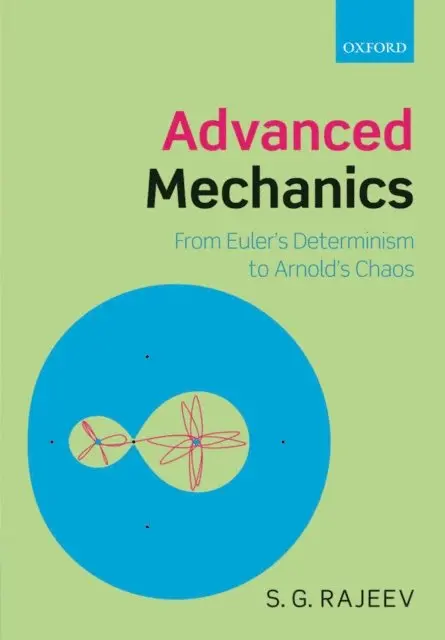
Classical Mechanics is the oldest and best understood part of physics. This does not mean that it is cast in marble yet, a museum piece to be admired from a distance. Instead, mechanics continues to be an active area of research by physicists and mathematicians. Every few years, we need to re-evaluate the purpose of learning mechanics and look at old material in the light of modern developments.Once you have learned basic mechanics (Newton's laws, the solution of the Kepler problem) and quantum mechanics (the Schrödinger equation, hydrogen atom) it is time to go back and relearn classical mechanics in greater depth. It is the intent of this book to take you through the ancient (the original meaning of "classical ") parts of the subject quickly: the ideas started by Euler and ending roughly with Poincare. We then take up the developments of twentieth century physics that have largely to do with chaos and discrete time evolution (the basis of numerical solutions). Along the way you will learn about elliptic functions and their connection to the Arithmetico-Geometric-Mean; Einstein's calculation of the perihelion shift of Mercury; that spin is really a classical phenomenon; how Hamilton came very close to guessing wave mechanics when he developed a unified theory of optics and mechanics; how Riemannian geometry is useful to understand the impossibility of long range weather prediction; why the maximum of the potential is a stable point of equilibrium in certain situations; the similarity of the orbits of particles in atomic traps and of the Trojan asteroids; about Julia sets and the Mandelblot; what Feigenbaum constants are and how Newton's iterations help establish the Kolmogorov-Arnold-Moser theorem. By the end you should be ready to absorb modern research in mechanics.
576 kr
Skickas inom 7-10 vardagar
Classical Mechanics is the oldest and best understood part of physics. This does not mean that it is cast in marble yet, a museum piece to be admired from a distance. Instead, mechanics continues to be an active area of research by physicists and mathematicians. Every few years, we need to re-evaluate the purpose of learning mechanics and look at old material in the light of modern developments.Once you have learned basic mechanics (Newton's laws, the solution of the Kepler problem) and quantum mechanics (the Schrödinger equation, hydrogen atom) it is time to go back and relearn classical mechanics in greater depth. It is the intent of this book to take you through the ancient (the original meaning of "classical ") parts of the subject quickly: the ideas started by Euler and ending roughly with Poincare. We then take up the developments of twentieth century physics that have largely to do with chaos and discrete time evolution (the basis of numerical solutions). Along the way you will learn about elliptic functions and their connection to the Arithmetico-Geometric-Mean; Einstein's calculation of the perihelion shift of Mercury; that spin is really a classical phenomenon; how Hamilton came very close to guessing wave mechanics when he developed a unified theory of optics and mechanics; how Riemannian reometry is useful to understand the impossibility of long range weather prediction; why the maximum of the potential is a stable point of equilibrium in certain situations; the similarity of the orbits of particles in atomic traps and of the Trojan asteroids; about Julia sets and the Mandelblot; what Feigenbaum constants are and how Newton's iterations help establish the Kolmogorov-Arnold-Moser theorem. By the end you should be ready to absorb modern research in mechanics.