Sabina Alkire - Böcker
Visar alla böcker från författaren Sabina Alkire. Handla med fri frakt och snabb leverans.
5 produkter
5 produkter
2 193 kr
Skickas inom 5-8 vardagar
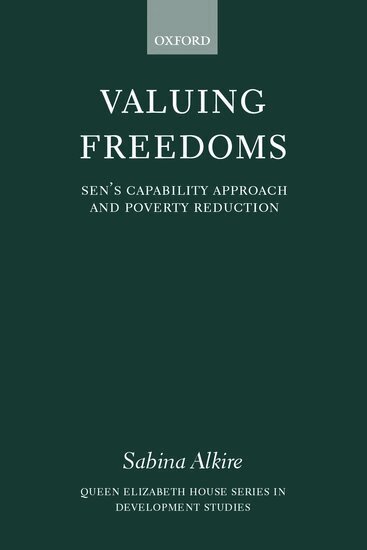
Alkire examines how Nobel Prize-winning economist Amartya Sen's capability approach can be coherently-and practically-put to work in participatory poverty reduction activities. Sen argues that economic development should expand 'valuable' capabilities. Alkire probes how we identify what is valuable.Sen deliberately left the capability approach 'incomplete' in order to ensure its relevance to persons and cultures with different understandings of the good. Part I proposes a framework for identifying valuable capabilities that retains this 'fundamental' incompleteness and space for individual and cultural diversity. Drawing on the work of John Finnis and others, Alkire addresses foundational issues regarding the identification and pursuit of 'valuable' dimensions of human development based in practical reason, then observes that much of the criticism of development arises from negative impacts on social or cultural/religious dimensions that are also deeply valued by the poor. Part I closes with a four-part 'operational definition' of basic capability that bridges 'basic needs', participation, and informed consent.Part II proposes an alternative participatory method for systematically identifying valued changes in participants' capability sets. Three case studies of women's income generation activities in Pakistan---goat-rearing, adult literacy, and rose cultivation---contrast economic cost-benefit analysis of each activity with capability analysis.
816 kr
Skickas inom 5-8 vardagar
Friendship, knowledge of foreign groups, the ability to purchase milk and shoes, the scent of summer roses: of what interest is this type of information to economists? Sabina Alkire shows how Nobel Prize-winning economist Amartya Sen's capability approach can be coherently---and practically---put to work in poverty reduction activities. Sen argues that economic development should expand 'valuable' freedoms. Alkire probes how we identify what is valuable. Foundational issues are addressed critically---dimensions of development, practical reason, culture, basic needs---drawing on Thomist authors who give central place to authentic participation. A participatory procedure for identifying capability change is then developed. Case studies of three Oxfam activities in Pakistan---goat-rearing, female literacy, and rose cultivation---illustrate this novel approach. Valuing Freedoms will be of considerable interest to economists, philosophers, development practitioners, and theologians, as well as to followers of Sen's work.
1 095 kr
Skickas inom 5-8 vardagar
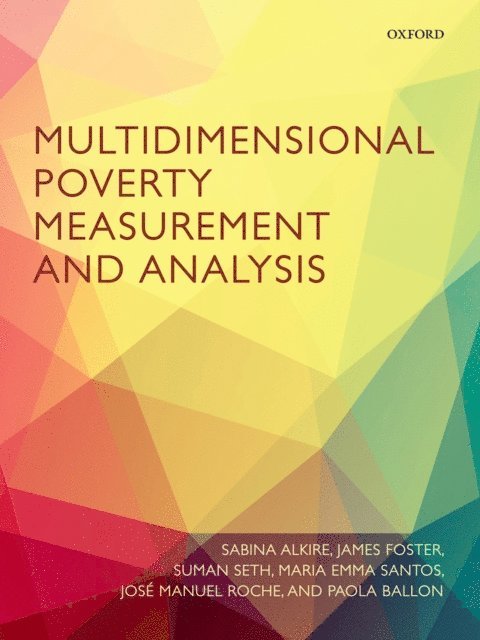
Multidimensional poverty measurement and analysis is evolving rapidly. Notably, it has informed the publication of the Multidimensional Poverty Index (MPI) estimates in the Human Development Reports of the United Nations Development Programme since 2010, and the release of national poverty measures in Mexico, Colombia, Bhutan, the Philippines and Chile. The academic response has been similarly swift, with related articles published in both theoretical and applied journals. The high and insistent demand for in-depth and precise accounts of multidimensional poverty measurement motivates this book, which is aimed at graduate students in quantitative social sciences, researchers of poverty measurement, and technical staff in governments and international agencies who create multidimensional poverty measures. The book is organized into four elements. The first introduces the framework for multidimensional measurement and provides a lucid overview of a range of multidimensional techniques and the problems each can address. The second part gives a synthetic introduction of 'counting' approaches to multidimensional poverty measurement and provides an in-depth account of the counting multidimensional poverty measurement methodology developed by Alkire and Foster, which is a straightforward extension of the well-known Foster-Greer-Thorbecke poverty measures that had a significant and lasting impact on income poverty measurement. The final two parts deal with the pre-estimation issues such as normative choices and distinctive empirical techniques used in measure design, and the post-estimation issues such as robustness tests, statistical inferences, comparisons over time, and assessments of inequality among the poor.
658 kr
Skickas inom 7-10 vardagar
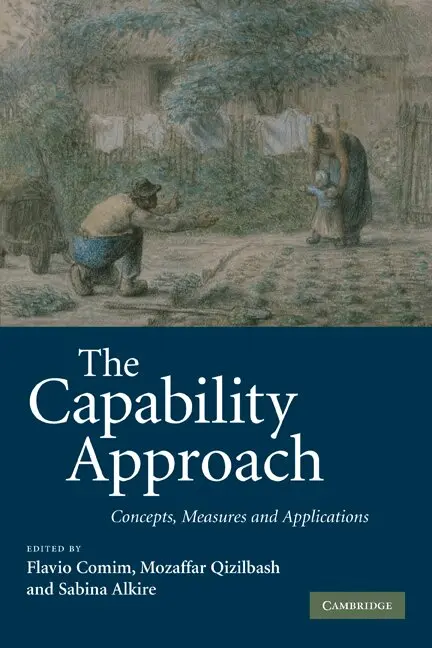
The capability approach developed by Nobel Laureate Amartya Sen has become an important new paradigm in thinking about development. However, despite its theoretical and philosophical attractiveness, it has been less easy to measure or to translate into policy. This volume addresses these issues in the context of poverty and justice. Part I offers a set of conceptual essays that debate the strength of the often misunderstood individual focus of the capability approach. Part II investigates the techniques by which we can measure and compare capabilities, and how we can integrate them into poverty comparisons and policy advice. Finally, Part III looks at how we can apply the capability approach to different regions and contexts. Written by a team of international scholars, The Capability Approach is a valuable resource for researchers and graduate students concerned with the debate over the value of the capability approach and its potential applications.
1 906 kr
Skickas inom 7-10 vardagar
The capability approach developed by Nobel Laureate Amartya Sen has become an important new paradigm in thinking about development. However, despite its theoretical and philosophical attractiveness, it has been less easy to measure or to translate into policy. This volume addresses these issues in the context of poverty and justice. Part I offers a set of conceptual essays that debate the strength of the often misunderstood individual focus of the capability approach. Part II investigates the techniques by which we can measure and compare capabilities, and how we can integrate them into poverty comparisons and policy advice. Finally, Part III looks at how we can apply the capability approach to different regions and contexts. Written by a team of international scholars, The Capability Approach is a valuable resource for researchers and graduate students concerned with the debate over the value of the capability approach and its potential applications.