• Fri frakt över 249 kr
  • •
  • Snabba leveranser
  • •
  • Billiga böcker
Kundservice

Du är på sajten för privatpersoner.

Företag, bibliotek eller offentlig verksamhet?

Du handlar på classic.bokus.com, där alla dina funktioner finns intakta.
Till classic.bokus.com
Bokus logotyp. Gå till startsidan.
  • Erbjudanden
  • Student
  • Topplistor
  • Barn & ungdom
  • Bokus Play
  • E-böcker
  • Ljudböcker
  • Pocketböcker
  • Spel & pussel

Upp till 25% på utvalda nyheter →

Sidfot

Mina sidor

    Hjälp

    • Kundservice
    • Vanliga frågor och svar
    • Frakt och leverans
    • Retur vid ångerrätt
    • Reklamera vara
    • Betalning
    • Köpvillkor
    • Allmänna villkor
    • Information om webbplatsens tillgänglighet

    Om Bokus

    • Om oss
    • Pressrum
    • För studenter
    • För företag
    • För bibliotek och offentlig verksamhet
    • För leverantörer
    • Hållbarhet

    Populärt

    • Aktuella erbjudanden
    • Presentkort
    • Studentlitteratur
    • Nya böcker
    • Topplistor
    • Signerade böcker
    • Engelska böcker

    Inspiration

    • Boktips
    • BookTok
    • Populära bokserier
    • Barnbokskaraktärer
    • Populära författare
    Logotyp för Bokus
    Följ oss på Facebook (extern länk)Följ oss på Instagram (extern länk)Följ oss på YouTube (extern länk)Följ oss på TikTok (extern länk)
    bokus @ CookiesAnpassa cookiesIntegritetspolicyKöpvillkor
    Till Citymail hemsida (extern länk)Till Budbee hemsida (extern länk)Till Postnord hemsida (extern länk)Till Schenker hemsida (extern länk)Till Early Bird hemsida (extern länk)Till Walleys hemsida (extern länk)
    1. Ekonomi och Ledarskap
    2. Nationalekonomi
    3. Internationell ekonomi

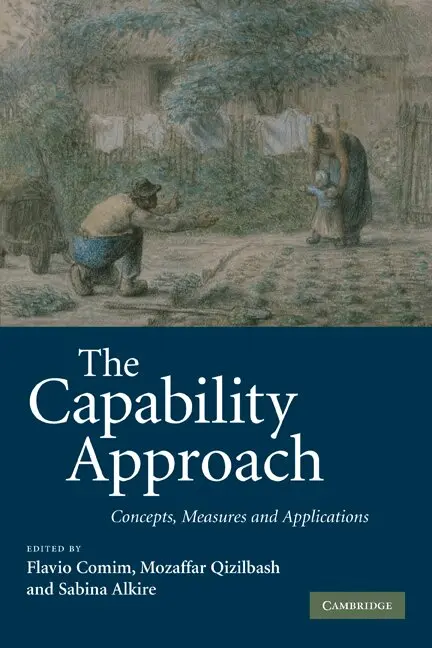
    The Capability Approach

    Concepts, Measures and Applications

    AvFlavio Comim,Mozaffar Qizilbash

    Häftad, Engelska, 2010

    698 kr

    Beställningsvara. Skickas inom 7-10 vardagar. Fri frakt över 249 kr.

    Beskrivning

    The capability approach developed by Nobel Laureate Amartya Sen has become an important new paradigm in thinking about development. However, despite its theoretical and philosophical attractiveness, it has been less easy to measure or to translate into policy. This volume addresses these issues in the context of poverty and justice. Part I offers a set of conceptual essays that debate the strength of the often misunderstood individual focus of the capability approach. Part II investigates the techniques by which we can measure and compare capabilities, and how we can integrate them into poverty comparisons and policy advice. Finally, Part III looks at how we can apply the capability approach to different regions and contexts. Written by a team of international scholars, The Capability Approach is a valuable resource for researchers and graduate students concerned with the debate over the value of the capability approach and its potential applications.

    Produktinformation

    • Utgivningsdatum:2010-06-24
    • Mått:152 x 229 x 38 mm
    • Vikt:930 g
    • Format:Häftad
    • Språk:Engelska
    • Antal sidor:634
    • Förlag:Cambridge University Press
    • ISBN:9780521154529

    Utforska kategorier

    • Internationell ekonomi inom Ekonomi och Ledarskap

    Recensioner i media

    Review of the hardback: 'Amartya Sen's notion of capabilities is a rich source of new ideas and philosophical debates about such diverse and wide ranging issues as development, poverty, inequality, human rights, gender, identity and democracy. Here is a collection of well-researched and cogently written essays discussing these many aspects and taking the debates further. It will provide a quarry of ideas for policy makers, researchers, teachers and students of these many issues.' Lord Meghnad Desai, Emeritus Professor of Economics and former director of the Centre for Global Governance, London School of Economics

    Innehållsförteckning

    • List of figures; List of tables; Introduction; 1. Using the capability approach: prospective and evaluative analyses Sabina Alkire; Part I. Concepts: 2. Amartya Sen's capability view: insightful sketch or distorted picture? Mozaffar Qizilbash; 3. Sen's capability approach and feminist concerns Ingrid Robeyns; 4. Beyond individual freedom and agency: structures of living together in the capability approach to development Séverine Deneulin; 5. Does identity matter? On the relevance of identity and interaction for capabilities Miriam Teschl and Laurent Derobert; 6. Measuring Capabilities Flavio Comim; Part II. Measures: 7. Do concepts matter? An empirical investigation of the differences between a capability and a monetary assessment of poverty Caterina Ruggeri Laderchi; 8. Social exclusion in the EU: a capability-based approach Fotis Papadopoulos and Panos Tsakloglou; 9. Complexity and vagueness in the capability approach: strengths or weaknesses? Enrica Chiappero Martinetti; 10. Operationalising Sen's capability approach: the influence of the selected technique Sara Lelli; 11. Operationalizing capabilities in a segmented society: the role of institutions Kanchan Chopra and Anantha Kumar Duraiappah; Part III. Applications: 12. Democracy, decentralisation and access to basic services: an elaboration on Sen's capability approach Santosh Mehrotra; 13. Reinforcing household's capabilities as a way to reduce vulnerability and prevent poverty in equitable terms Jean-Luc Dubois and Sophie Rousseau; 14. Capabilities over the lifecourse: at what age does poverty damage most? Shahin Yaqub; 15. Social policy and the ability to appear in public without shame: some lessons from a food relief programme in Kinshasa Tom De Herdt; 16. The capability approach and gendered education:some issues of operationalisation in the context of the HIV/AIDs epidemic in South Africa Elaine Unterhalter; 17. Women and poverty In Mozambique: is there a gender bias In capabilities, employment conditions and living standards? Pier Giogio Ardeni and Antonio Andracchio; 18. From the quantity to the quality of employment: an application of the capability approach to the Chilean labour market Kirsten Sehnbruch; Index.