Sai Ramani Garimella – författare
586 kr
Skickas inom 10-15 vardagar
2 004 kr
Skickas inom 10-15 vardagar
687 kr
Läs direkt efter köp
687 kr
Läs direkt efter köp
2 004 kr
Skickas inom 10-15 vardagar
672 kr
Läs direkt efter köp
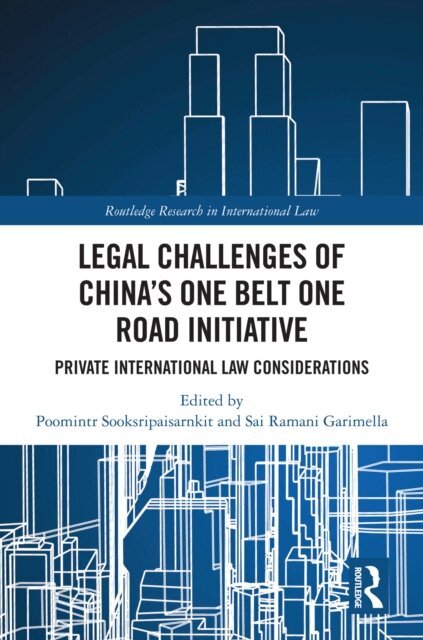
The concept of the One Belt One Road initiative (OBOR) was raised by the President of the People’s Republic of China in October 2013. The OBOR comprises the ‘Silk Road Economic Belt’ and the ‘21st Century Maritime Silk Road’, encompassing over 60 countries from Asia to Europe via Southeast Asia, South Asia, Central Asia, West Asia, and the Middle East. The overall objective of the OBOR is to encourage the economic prosperity of the countries along the Belt and Road and regional economic cooperation, encourage mutual learning between different civilizations, and promoting peace and development. However, countries along the Belt and Road routes of the OBOR project have diverse laws and legal systems. It is not difficult to envisage problems relating to harmonisation of laws and rules in trade between countries along the OBOR routes or otherwise. These problems can potentially cut through the core of the very objective of the OBOR itself.
Integration in China’s One Belt One Road Initiative explores possible challenges to the success of the OBOR arising from the situational interface of diversity of laws, with the focus primarily on issues associated with private international law. It shows the latest state of knowledge on the topic and will be of interest to researchers, academics, policymakers, and students interested in private international law issues pertaining to the OBOR routes as well as private international law in general, Asian studies, and the politics of international trade.
672 kr
Läs direkt efter köp
The concept of the One Belt One Road initiative (OBOR) was raised by the President of the People’s Republic of China in October 2013. The OBOR comprises the ‘Silk Road Economic Belt’ and the ‘21st Century Maritime Silk Road’, encompassing over 60 countries from Asia to Europe via Southeast Asia, South Asia, Central Asia, West Asia, and the Middle East. The overall objective of the OBOR is to encourage the economic prosperity of the countries along the Belt and Road and regional economic cooperation, encourage mutual learning between different civilizations, and promoting peace and development. However, countries along the Belt and Road routes of the OBOR project have diverse laws and legal systems. It is not difficult to envisage problems relating to harmonisation of laws and rules in trade between countries along the OBOR routes or otherwise. These problems can potentially cut through the core of the very objective of the OBOR itself.
Integration in China’s One Belt One Road Initiative explores possible challenges to the success of the OBOR arising from the situational interface of diversity of laws, with the focus primarily on issues associated with private international law. It shows the latest state of knowledge on the topic and will be of interest to researchers, academics, policymakers, and students interested in private international law issues pertaining to the OBOR routes as well as private international law in general, Asian studies, and the politics of international trade.
2 200 kr
Skickas inom 10-15 vardagar
1 960 kr
Läs direkt efter köp
This book shows how, with the increasing interaction between jurisdictions spearheaded by globalization, it is gradually becoming impossible to confine transactions to a single jurisdiction. Presented in the form of a compendium of essays by eminent academics and practitioners in the field, it provides a detailed overview of private, international law practice in South Asian nations, addressing contemporary discourse within this knowledge domain. Conflict of laws/private international law arises from the universal acknowledgment that it is difficult to govern human transactions solely by the local law. The research presented addresses the three major threads of private international law – jurisdiction, choice of law and enforcement – within each of the South Asian countries in the areas of family law and commercial law. The research in family law domain includes traditional areas such as marriage, divorce and maintenance, as well as some of the contemporary concerns in this region –inter-country child retrieval, surrogacy, and the country statement on accession to the Hague Conventions related to this domain. In commercial law the research explores the concerns raised with regard to choice of law issues in transnational contracts, and also enforcement of foreign judgment/arbitral awards in the nations of this region.
1 552 kr
Skickas inom 10-15 vardagar
1 402 kr
Skickas inom 10-15 vardagar
1 694 kr
Läs direkt efter köp
The book will not only be a useful resource for policy makers, students and researchers interested in international commercial arbitration, and private international law, but also for practitioners working on dispute resolution in trans-jurisdictional disputes in South Asia and beyond.
“…The present book is not just another book contributing to the endless list of literature already widely used in International Commercial Arbitration on public policy but, in myopinion, is unique in many respects. The distinguishing factor of this book is its regional perspective…"- Justice Deepak Verma, Former Judge of Supreme Court of India and Arbitrator
“…This book addresses this core element of the success story of arbitration: enforcement and refusal to enforce and, hence, its relevance cannot be overstated…”
- Csongor István Nagy, Professor of Law and Head, Department of Private International Law, University of Szeged, Hungary
Detailed Forewords are available in the book and can be freely downloaded from https://link.springer.com/book/10.1007/978-981-16-2634-0
1 402 kr
Skickas inom 10-15 vardagar