Sarah B. Shear - Böcker
Visar alla böcker från författaren Sarah B. Shear. Handla med fri frakt och snabb leverans.
5 produkter
5 produkter
646 kr
Skickas inom 7-10 vardagar
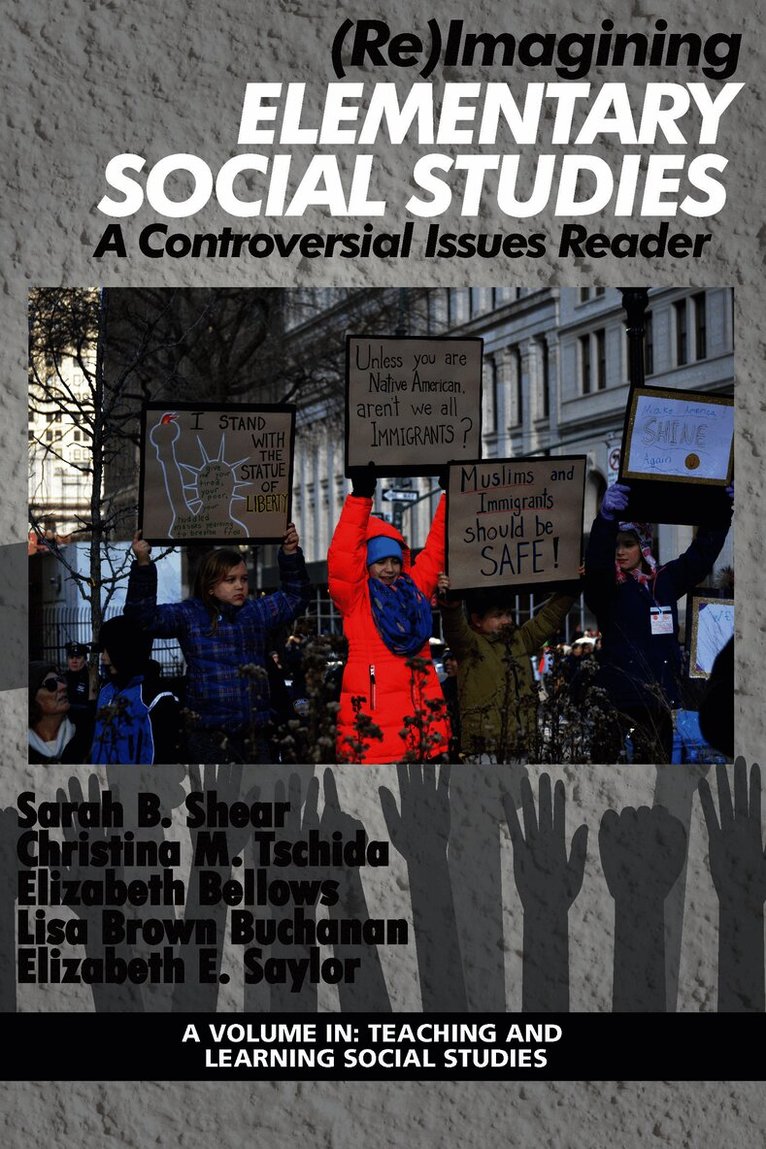
The field of elementary social studies is a specific space that has historically been granted unequal value in the larger arena of social studies education and research. This reader stands out as a collection of approaches aimed specifically at teaching controversial issues in elementary social studies. This reader challenges social studies education (i.e., classrooms, teacher education programs, and research) to engage controversial issues--those topics that are politically, religiously, or are otherwise ideologically charged and make people, especially teachers, uncomfortable--in profound ways at the elementary level. This reader, meant for elementary educators, preservice teachers, and social studies teacher educators, offers an innovative vision from a new generation of social studies teacher educators and researchers fighting against the forces of neoliberalism and the marginalization of our field.The reader is organized into three sections: 1) pushing the boundaries of how the field talks about elementary social studies, 2) elementary social studies teacher education, and 3) elementary social studies teaching and learning. Individual chapters either A) conceptually unpack a specific controversial issue (e.g. Islamophobia, Indian Boarding Schools, LGBT issues in schools) and how that issue should be/is incorporated in an elementary social studies methods courses and classrooms or B) present research on elementary preservice teachers or how elementary teachers and students engage controversial issues. This reader unpacks specific controversial issues for elementary social studies for readers to gain critical content knowledge, teaching tips, lesson ideas, and recommended resources.
1 093 kr
Skickas inom 7-10 vardagar
The field of elementary social studies is a specific space that has historically been granted unequal value in the larger arena of social studies education and research. This reader stands out as a collection of approaches aimed specifically at teaching controversial issues in elementary social studies. This reader challenges social studies education (i.e., classrooms, teacher education programs, and research) to engage controversial issues--those topics that are politically, religiously, or are otherwise ideologically charged and make people, especially teachers, uncomfortable--in profound ways at the elementary level. This reader, meant for elementary educators, preservice teachers, and social studies teacher educators, offers an innovative vision from a new generation of social studies teacher educators and researchers fighting against the forces of neoliberalism and the marginalization of our field.The reader is organized into three sections: 1) pushing the boundaries of how the field talks about elementary social studies, 2) elementary social studies teacher education, and 3) elementary social studies teaching and learning. Individual chapters either A) conceptually unpack a specific controversial issue (e.g. Islamophobia, Indian Boarding Schools, LGBT issues in schools) and how that issue should be/is incorporated in an elementary social studies methods courses and classrooms or B) present research on elementary preservice teachers or how elementary teachers and students engage controversial issues. This reader unpacks specific controversial issues for elementary social studies for readers to gain critical content knowledge, teaching tips, lesson ideas, and recommended resources.
901 kr
Skickas inom 7-10 vardagar
Substantial research has been put forth calling for the field of social studies education to engage in work dealing with the influence of race and racism within education and society (Branch, 2003; Chandler, 2015; Chandler & Hawley, 2017; Husband, 2010; King & Chandler, 2016; Ladson-Billings, 2003; Ooka Pang, Rivera & Gillette, 1998). Previous contributions have examined the presence and influence of race/ism within the field of social studies teaching and research (e.g. Chandler, 2015, Chandler & Hawley, 2017; Ladson-Billings, 2003; Woyshner & Bohan, 2012). In order to challenge the presence of racism within social studies, research must attend to the control that whiteness and white supremacy maintain within the field. This edited volume builds from these previous works to take on whiteness and white supremacy directly in social studies education.In Marking the “Invisible”, editors assemble original contributions from scholars working to expose whiteness and disrupt white supremacy in the field of social studies education. We argue for an articulation of whiteness within the field of social studies education in pursuit of directly challenging its influences on teaching, learning, and research. Across 27 chapters, authors call out the strategies deployed by white supremacy and acknowledge the depths by which it is used to control, manipulate, confine, and define identities, communities, citizenships, and historical narratives. This edited volume promotes the reshaping of social studies education to: support the histories, experiences, and lives of Students and Teachers of Color, challenge settler colonialism and color-evasiveness, develop racial literacy, and promote justice-oriented teaching and learning.
1 285 kr
Skickas inom 7-10 vardagar
Substantial research has been put forth calling for the field of social studies education to engage in work dealing with the influence of race and racism within education and society (Branch, 2003; Chandler, 2015; Chandler & Hawley, 2017; Husband, 2010; King & Chandler, 2016; Ladson-Billings, 2003; Ooka Pang, Rivera & Gillette, 1998). Previous contributions have examined the presence and influence of race/ism within the field of social studies teaching and research (e.g. Chandler, 2015, Chandler & Hawley, 2017; Ladson-Billings, 2003; Woyshner & Bohan, 2012). In order to challenge the presence of racism within social studies, research must attend to the control that whiteness and white supremacy maintain within the field. This edited volume builds from these previous works to take on whiteness and white supremacy directly in social studies education.In Marking the “Invisible”, editors assemble original contributions from scholars working to expose whiteness and disrupt white supremacy in the field of social studies education. We argue for an articulation of whiteness within the field of social studies education in pursuit of directly challenging its influences on teaching, learning, and research. Across 27 chapters, authors call out the strategies deployed by white supremacy and acknowledge the depths by which it is used to control, manipulate, confine, and define identities, communities, citizenships, and historical narratives. This edited volume promotes the reshaping of social studies education to: support the histories, experiences, and lives of Students and Teachers of Color, challenge settler colonialism and color-evasiveness, develop racial literacy, and promote justice-oriented teaching and learning.
441 kr
Skickas inom 7-10 vardagar
Social studies education over its hundred-year history has focused predominantly on white and male narratives. This has not only been detrimental to the increasingly diverse population of the U.S., but it has also meant that social studies as a field of scholarship has systematically excluded and marginalized the voices, teaching, and research of women, scholars of color, queer scholars, and scholars whose politics challenge the dominant traditions of history, geography, economics, and civics education.This is increasingly no longer the case. Teachers and scholars have the power -- through pedagogy, curriculum, and community activism – and use it to actively resist injustice while also working towards a more radically just world. It is of great importance to the discipline—and to the children who are being educated now and will be in the future—that the work of these pioneers be collected and shared.Insurgent Social Studies disrupts the current state of social education by highlighting those whose work has often been deemed “too radical.” The contributions cover voices marginalized by race, ethnicity, sexual orientation, religion, political and socio-economic status. They honor the different viewpoints while building solidarity via a shared call to change.Theoretically grounded and abounding in examples of practice, this book is essential reading to all researchers and practitioners in social studies, and is perfect as an adopted text in the social studies curriculum at Colleges of Education.