Sarah de Sanctis – författare
Visar alla böcker från författaren Sarah de Sanctis. Handla med fri frakt och snabb leverans.
4 produkter
4 produkter
2 095 kr
Skickas inom 3-6 vardagar
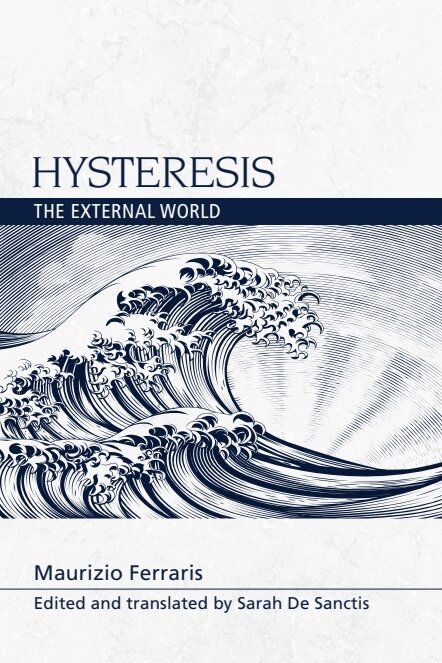
Since the 1780s, Western philosophy has been largely under the spell of Immanuel Kant's transcendental philosophy. In this book, Maurizio Ferraris offers a number of important criticisms of Kant in a book of two parts, written 21 years apart. The first part of the book, 'Observation', originally published in 2001, lays the foundations of Ferraris' New Realism, foreshadowing the realist turn that has become characteristic of 21st century philosophy. The second part, 'Speculation', written in 2021, outlines a complete metaphysical theory of realism. What ties both parts of the book together is the the notion of hysteresis, the ability of effects to survive even when their causes have ceased to exist.
359 kr
Skickas inom 7-10 vardagar
Since the 1780s, Western philosophy has been largely under the spell of Immanuel Kant's transcendental philosophy. In this book, Maurizio Ferraris offers a number of important criticisms of Kant in a book of two parts, written 21 years apart. The first part of the book, 'Observation', originally published in 2001, lays the foundations of Ferraris' New Realism, foreshadowing the realist turn that has become characteristic of 21st century philosophy. The second part, 'Speculation', written in 2021, outlines a complete metaphysical theory of realism. What ties both parts of the book together is the the notion of hysteresis, the ability of effects to survive even when their causes have ceased to exist.
1 694 kr
Skickas inom 5-8 vardagar
No detailed description available for "Nietzsche´s Pragmatism".
1 355 kr
Skickas inom 5-8 vardagar
Ranging from Antiquity to contemporary analytic philosophy, it provides a concise but thorough analysis of the arguments developed by some of the most outstanding philosophers of all times. Besides the aesthetics of music proper, the volume touches upon metaphysics, ethics, philosophy of language, psychology, anthropology, and scientific developments that have influenced the philosophical explanations of music. Starting from the very origins of philosophy in Western thought (Pythagoras, Plato, Aristotle) the book talks about what music is according to Augustine, Descartes, Leibniz, Rousseau, Kant, Hegel, the Romantics, Schopenhauer, Nietzsche, Wittgenstein, Susanne Langer, Bloch, Adorno, and many others. Recent developments within the analytic tradition are illustrated with particular attention to the ontology of the musical artwork and to the problem of music and emotions. A fascinating idea which recurs throughout the book is that philosophers allow for a sort of a secret kinship between music and philosophy, as means to reveal complementary aspects of truth.