Sarah E. Igo – författare
Visar alla böcker från författaren Sarah E. Igo. Handla med fri frakt och snabb leverans.
5 produkter
5 produkter
1 284 kr
Kommande
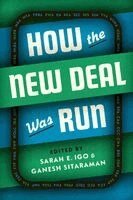
Notable historians delve into the brass tacks of launching and sustaining federal agencies.Critics regularly complain that the United States government can’t do big things. While their explanations differ, there is now a growing sense that American institutions are not delivering solutions to the problems of our time. The New Deal offers a striking contrast. During the 1930s, the United States created a wealth of new agencies, departments, offices, and programs—and in very short order.This illuminating collection brings together leading American historians to offer fifteen detailed accounts of how this remarkable expansion of state capacity actually happened. From the Civilian Conservation Corps to the Rural Electrification Administration to the Securities and Exchange Commission, the authors dig into the nuts and bolts of how exactly the New Dealers did so much all at once. They detail the choices before state builders who, operating under the pressure and immediacy of the era, made decisions that held even greater consequences in the longer term.In a time when federal agencies are under stress like never before, the contributors offer critical insights about what future administrations can learn from the New Deal’s extraordinary achievements and how they can build state capacity and deliver for Americans once again.Features contributions by W. Tanner Allread, Mary Bridges, Brent Cebul, Sarah E. Igo, Meg Jacobs, Richard R. John, Neil M. Maher, Sharon Ann Musher, Sarah T. Phillips, Kathryn Olmsted and Eric Rauchway, Alex Platt, Jason Scott Smith, Ganesh Sitaraman, Abby Spinak, Chloe Thurston, and Mason B. Williams.
398 kr
Kommande
Notable historians delve into the brass tacks of launching and sustaining federal agencies.Critics regularly complain that the United States government can’t do big things. While their explanations differ, there is now a growing sense that American institutions are not delivering solutions to the problems of our time. The New Deal offers a striking contrast. During the 1930s, the United States created a wealth of new agencies, departments, offices, and programs—and in very short order.This illuminating collection brings together leading American historians to offer fifteen detailed accounts of how this remarkable expansion of state capacity actually happened. From the Civilian Conservation Corps to the Rural Electrification Administration to the Securities and Exchange Commission, the authors dig into the nuts and bolts of how exactly the New Dealers did so much all at once. They detail the choices before state builders who, operating under the pressure and immediacy of the era, made decisions that held even greater consequences in the longer term.In a time when federal agencies are under stress like never before, the contributors offer critical insights about what future administrations can learn from the New Deal’s extraordinary achievements and how they can build state capacity and deliver for Americans once again.Features contributions by W. Tanner Allread, Mary Bridges, Brent Cebul, Sarah E. Igo, Meg Jacobs, Richard R. John, Neil M. Maher, Sharon Ann Musher, Sarah T. Phillips, Kathryn Olmsted and Eric Rauchway, Alex Platt, Jason Scott Smith, Ganesh Sitaraman, Abby Spinak, Chloe Thurston, and Mason B. Williams.
309 kr
Skickas inom 10-15 vardagar
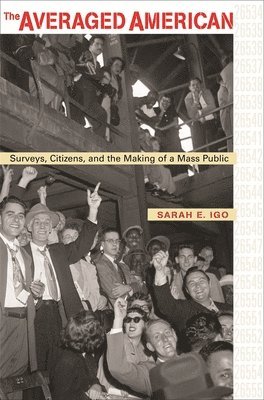
Americans today “know” that a majority of the population supports the death penalty, that half of all marriages end in divorce, and that four out of five prefer a particular brand of toothpaste. Through statistics like these, we feel that we understand our fellow citizens. But remarkably, such data—now woven into our social fabric—became common currency only in the last century. Sarah Igo tells the story, for the first time, of how opinion polls, man-in-the-street interviews, sex surveys, community studies, and consumer research transformed the United States public.Igo argues that modern surveys, from the Middletown studies to the Gallup Poll and the Kinsey Reports, projected new visions of the nation: authoritative accounts of majorities and minorities, the mainstream and the marginal. They also infiltrated the lives of those who opened their doors to pollsters, or measured their habits and beliefs against statistics culled from strangers. Survey data underwrote categories as abstract as “the average American” and as intimate as the sexual self. With a bold and sophisticated analysis, Igo demonstrates the power of scientific surveys to shape Americans’ sense of themselves as individuals, members of communities, and citizens of a nation. Tracing how ordinary people argued about and adapted to a public awash in aggregate data, she reveals how survey techniques and findings became the vocabulary of mass society—and essential to understanding who we, as modern Americans, think we are.
219 kr
Skickas inom 5-8 vardagar
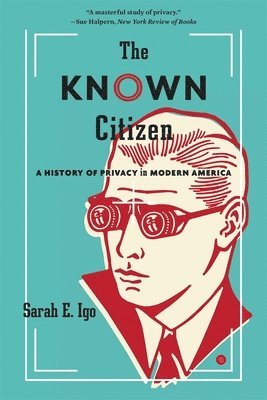
A Washington Post Book of the YearWinner of the Merle Curti AwardWinner of the Jacques Barzun PrizeWinner of the Ralph Waldo Emerson Award“A masterful study of privacy.”—Sue Halpern, New York Review of Books“Masterful (and timely)…[A] marathon trek from Victorian propriety to social media exhibitionism…Utterly original.”—Washington PostEvery day, we make decisions about what to share and when, how much to expose and to whom. Securing the boundary between one’s private affairs and public identity has become an urgent task of modern life. How did privacy come to loom so large in public consciousness? Sarah Igo tracks the quest for privacy from the invention of the telegraph onward, revealing enduring debates over how Americans would—and should—be known. The Known Citizen is a penetrating historical investigation with powerful lessons for our own times, when corporations, government agencies, and data miners are tracking our every move.“A mighty effort to tell the story of modern America as a story of anxieties about privacy…Shows us that although we may feel that the threat to privacy today is unprecedented, every generation has felt that way since the introduction of the postcard.”—Louis Menand, New Yorker“Engaging and wide-ranging…Igo’s analysis of state surveillance from the New Deal through Watergate is remarkably thorough and insightful.”—The Nation
348 kr
Tillfälligt slut