Sarah Staszak - Böcker
Visar alla böcker från författaren Sarah Staszak. Handla med fri frakt och snabb leverans.
4 produkter
4 produkter
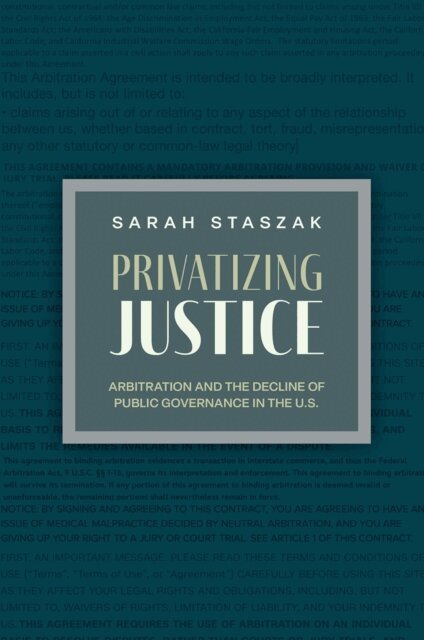
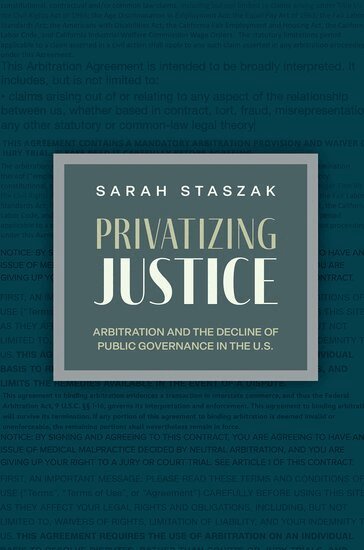
Privatizing Justice
Arbitration and the Decline of Public Governance in the U.S.
Inbunden, Engelska, 2024
875 kr
Skickas inom 7-10 vardagar
One of the primary goals of the 1970s-era conservative legal movement was to undo New Deal policies that favored labor at the expense of capital. One of the movement's most effective strategies turned out to be advancing bipartisan legislation on arbitration and convincing the courts that settling disputes that way was preferable to litigation. Today, most consumers and employees today are bound by arbitration agreements, in which they are required to submit all future grievances to a private, binding system of arbitration and forfeit access to the legal system. Arbitration as originally conceived well over a century ago, however, stands in stark contrast to the arbitration in practice today. What changed is that Congress, the Supreme Court, and the private sector began to promote its use in the late twentieth century as a means of protecting corporate and other powerful institutional defendants from the costs of litigation and government regulation itself.How did arbitration shift from providing a low cost, less adversarial, and more efficient way of handling disputes between entities of equal bargaining power to a private, non-reviewable, compulsory forum for resolving disputes between individuals and corporations, often on unilateral terms? By examining the broader institutional, political, and legal dynamics that shaped and enabled these processes of change over the past 150 years, Privatizing Justice examines how this transformation came about. The product of a broad range of actors and institutions interacting with each other--Congress, presidents, the courts, the administrative state, interest groups, and the business community-the system that emerged has not only transformed the American state in profound ways but exacerbated economic inequality and eroded democracy.
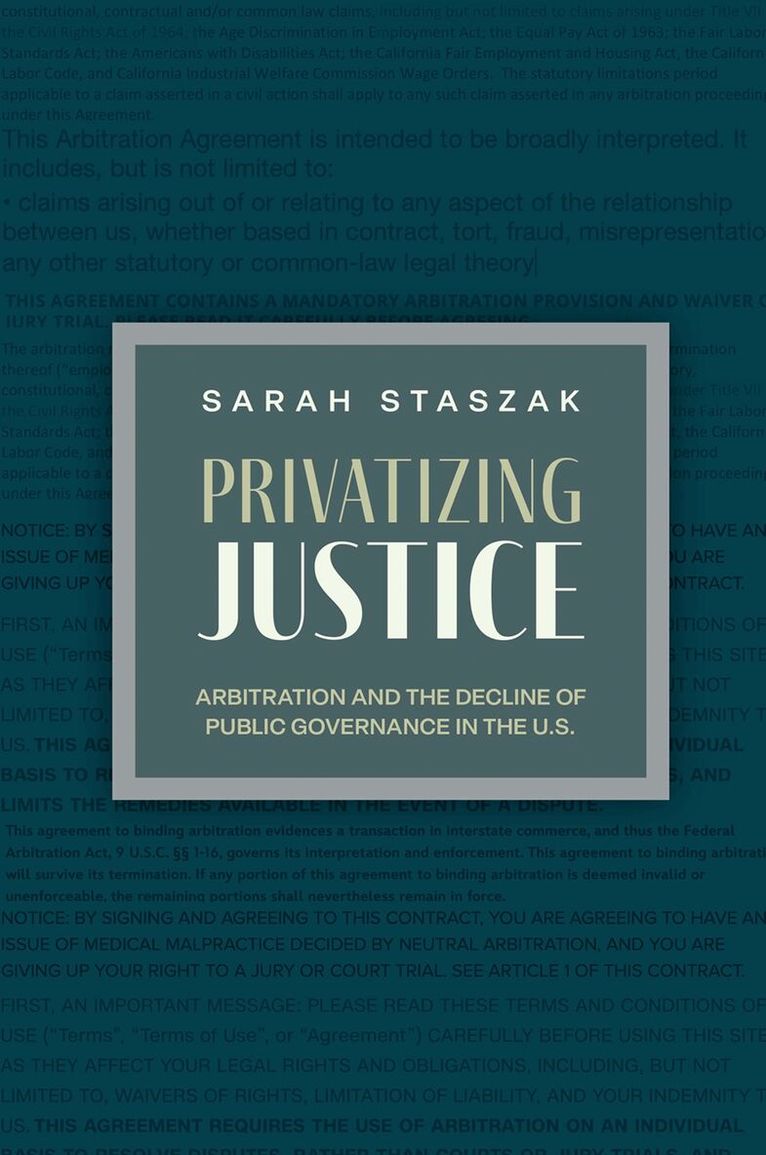
Privatizing Justice
Arbitration and the Decline of Public Governance in the U.S.
Häftad, Engelska, 2024
268 kr
Skickas inom 5-8 vardagar
One of the primary goals of the 1970s-era conservative legal movement was to undo New Deal policies that favored labor at the expense of capital. One of the movement's most effective strategies turned out to be advancing bipartisan legislation on arbitration and convincing the courts that settling disputes that way was preferable to litigation. Today, most consumers and employees today are bound by arbitration agreements, in which they are required to submit all future grievances to a private, binding system of arbitration and forfeit access to the legal system. Arbitration as originally conceived well over a century ago, however, stands in stark contrast to the arbitration in practice today. What changed is that Congress, the Supreme Court, and the private sector began to promote its use in the late twentieth century as a means of protecting corporate and other powerful institutional defendants from the costs of litigation and government regulation itself.How did arbitration shift from providing a low cost, less adversarial, and more efficient way of handling disputes between entities of equal bargaining power to a private, non-reviewable, compulsory forum for resolving disputes between individuals and corporations, often on unilateral terms? By examining the broader institutional, political, and legal dynamics that shaped and enabled these processes of change over the past 150 years, Privatizing Justice examines how this transformation came about. The product of a broad range of actors and institutions interacting with each other--Congress, presidents, the courts, the administrative state, interest groups, and the business community-the system that emerged has not only transformed the American state in profound ways but exacerbated economic inequality and eroded democracy.
1 537 kr
Skickas inom 5-8 vardagar
We are now more than half a century removed from height of the rights revolution, a time when the federal government significantly increased legal protection for disadvantaged individuals and groups, leading in the process to a dramatic expansion in access to courts and judicial authority to oversee these protections. Yet while the majority of the landmark laws and legal precedents expanding access to justice remain intact, less than two percent of civil cases are decided by a trial today. What explains this phenomenon, and why it is so difficult to get one's day in court?No Day in Court examines the sustained efforts of political and legal actors to scale back access to the courts in the decades since it was expanded, largely in the service of the rights revolution of the 1950s and 1960s. Since that time, for political, ideological, and practical reasons, a multifaceted group of actors have attempted to diminish the role that courts play in American politics. Although the conventional narrative of backlash focuses on an increasingly conservative Supreme Court trying to gut the developments of the New Deal and Civil Rights eras, and of conservative activists mobilizing to pressure Congress to do the same, there is another very important element to this story, in which access to the courts for rights claims has been scaled back by efforts that target the 'rules of the game,' the institutional and legal procedures that govern what constitutes a valid legal case, who can be sued, how a case is adjudicated, and what remedies are available through courts. These more hidden, procedural changes are pursued by far more than just conservatives, and they often go overlooked. No Day in Court explores the politics of these strategies and the effect that they have today for access to justice in the U.S.
446 kr
Skickas inom 5-8 vardagar
We are now more than half a century removed from height of the rights revolution, a time when the federal government significantly increased legal protection for disadvantaged individuals and groups, leading in the process to a dramatic expansion in access to courts and judicial authority to oversee these protections. Yet while the majority of the landmark laws and legal precedents expanding access to justice remain intact, less than two percent of civil cases are decided by a trial today. What explains this phenomenon, and why it is so difficult to get one's day in court?No Day in Court examines the sustained efforts of political and legal actors to scale back access to the courts in the decades since it was expanded, largely in the service of the rights revolution of the 1950s and 1960s. Since that time, for political, ideological, and practical reasons, a multifaceted group of actors have attempted to diminish the role that courts play in American politics. Although the conventional narrative of backlash focuses on an increasingly conservative Supreme Court trying to gut the developments of the New Deal and Civil Rights eras, and of conservative activists mobilizing to pressure Congress to do the same, there is another very important element to this story, in which access to the courts for rights claims has been scaled back by efforts that target the 'rules of the game,' the institutional and legal procedures that govern what constitutes a valid legal case, who can be sued, how a case is adjudicated, and what remedies are available through courts. These more hidden, procedural changes are pursued by far more than just conservatives, and they often go overlooked. No Day in Court explores the politics of these strategies and the effect that they have today for access to justice in the U.S.