Saul Brenner - Böcker
Visar alla böcker från författaren Saul Brenner. Handla med fri frakt och snabb leverans.
4 produkter
4 produkter
1 097 kr
Skickas inom 7-10 vardagar
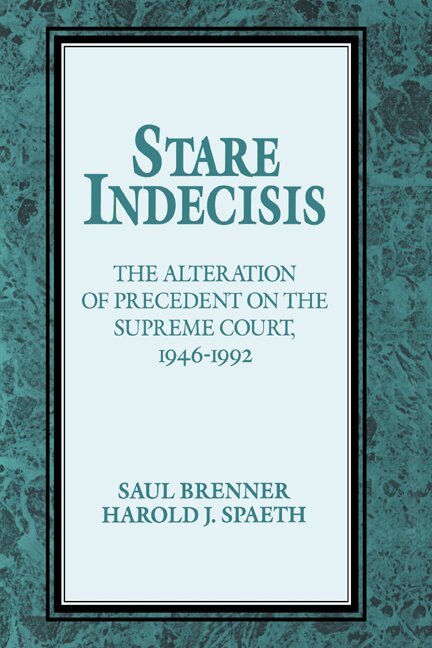
Although the concept of precedent is basic to the operation of the legal system, there has not yet been a full-length empirical study of why US Supreme Court justices have chosen to alter precedent. This book attempts to fill this gap by analyzing those decisions of the Vinson, Warren, and Burgers courts, as well as the first six terms of the Rehnquist Court - a span of 47 years (1946-1992) - which formally altered precedent. The authors summarize previous studies of precedent and the Court, assess the conference voting of justices, and compile a list of overruling and overruled cases. Additionally, the authors draw a distinction between personal and instituional stare decisis. By using the attitudinal model of Supreme Court decision making, the authors find that it is the individual justices' ideologies which explain their voting behavior.
467 kr
Skickas inom 7-10 vardagar
To what extent do the justices on the Supreme Court behave strategically? In Strategy on the United States Supreme Court, Saul Brenner and Joseph M. Whitmeyer investigate the answers to this question and reveal that justices are substantially less strategic than many Supreme Court scholars believe. By examining the research to date on each of the justice's important activities, Brenner and Whitmeyer's work shows that the justices often do not cast their certiorari votes in accord with the outcome-prediction strategy, that the other members of the conference coalition bargain successfully with the majority opinion writer in less than 6 percent of the situations, and that most of the fluidity in voting on the Court is nonstrategic. This work is essential to understanding how strategic behavior - or its absence - influences the decisions of the Supreme Court and, as a result, American politics and society.
394 kr
Skickas inom 7-10 vardagar
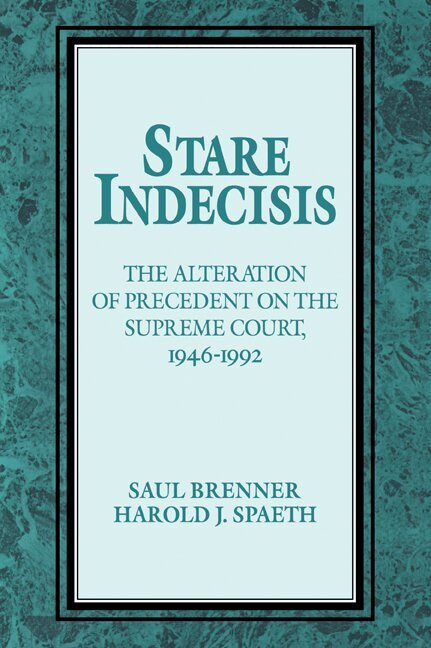
The concept of precedent is basic to the operation of the legal system, and this book is a full-length empirical study of why US Supreme Court justices have chosen to alter precedent. It attempts to analyse those decisions of the Vison, Warren and Burger Courts, as well as the first six terms of the Rehnquist Court - a span of 47 years (1946-1992) - that formally altered precedent. The authors summarize previous studies of precedent and the Court, assess the conference voting of justices and compile a list of overruling and overruled cases. Additionally the authors draw a distinction between personal and institutional stare decisis. By using the attitudinal model of Supreme Court decision-making, which is normally seen as antithetical to the legal mode of voting, the authors find that it is the individual justices' ideologies which explain their voting behavior.
284 kr
Skickas inom 7-10 vardagar
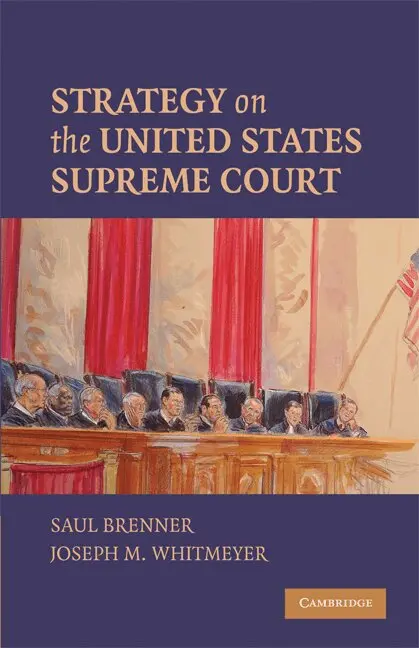
To what extent do the justices on the Supreme Court behave strategically? In Strategy on the United States Supreme Court, Saul Brenner and Joseph M. Whitmeyer investigate the answers to this question and reveal that justices are substantially less strategic than many Supreme Court scholars believe. By examining the research to date on each of the justice's important activities, Brenner and Whitmeyer's work shows that the justices often do not cast their certiorari votes in accord with the outcome-prediction strategy, that the other members of the conference coalition bargain successfully with the majority opinion writer in less than 6 percent of the situations, and that most of the fluidity in voting on the Court is nonstrategic. This work is essential to understanding how strategic behavior - or its absence - influences the decisions of the Supreme Court and, as a result, American politics and society.