
Scott Rathbone – författare
Visar alla böcker från författaren Scott Rathbone. Handla med fri frakt och snabb leverans.
2 produkter
2 produkter
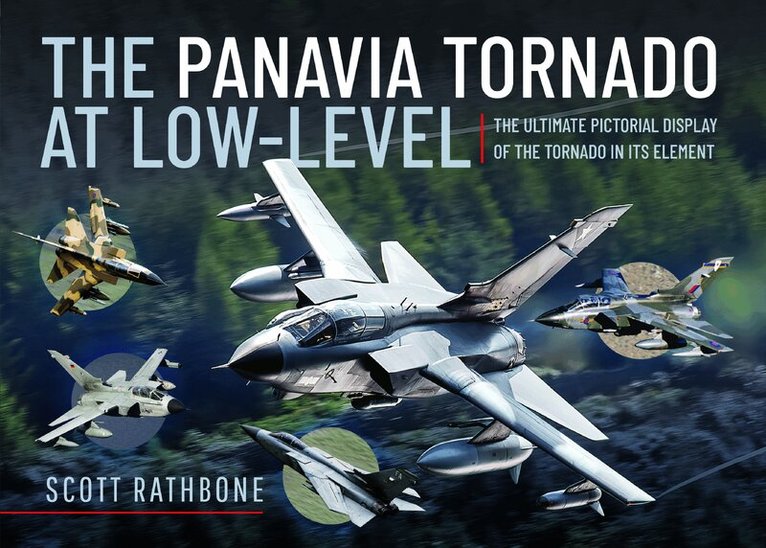
Inbunden, Engelska, 2024
376 kr
Skickas
The small group of enthusiasts and photographers who had braved the winter weather and gathered on the slopes of the Lake District’s iconic valleys on Wednesday, 9 January 2019, were witnesses to the end of an era. The RAF Tornado GR.4 that raced past them, in some cases at a lower altitude than the onlookers, made the last ever low-level flight by this aircraft in the United Kingdom Low Flying System. Never again would the ‘Mighty Fin’, an aircraft that had been a familiar sight among the valleys of the UK for around forty years, provide such a spectacle.First flown in August 1974, the Tornado arguably become of the RAF’s most important aircraft of the Cold War. Indeed, the Tornado was the mainstay of RAF strike aircraft, from its early days as a nuclear capable low-level interdiction strike fighter (the GR.1 in RAF service), through to its retirement as a more versatile medium to high-level strike fighter, the GR.4\.Along with the shorter-lived Air Defence Variant, the F.2/F.3, the Tornado was without doubt one of the best loved aircraft types amongst photographers and crews with the sheer number of the initial GR.1s allowing them to populate eleven front-line squadrons as well as the training units of the Tri-National Tornado Training Establishment and the Tornado Weapons Unit. Altogether, over twenty units flew variants of the type in the RAF alone.The Tri-National Tornado Training Establishment also catered for the other partner nations of Germany and Italy with all crews finding their way into the United Kingdom Low Flying System on a regular basis. It was, in fact, the impending introduction of the Tornado and the resulting increase in low-level activity that forced a restructuring of the UKLFS in 1979\.In this book, Scott Rathbone provides a pictorial record of the Tornado in its element, that of low-level. With images dating back to the 1980s, almost all variants are accounted for, as are the majority of RAF squadrons and units from other nations’ air arms. Colour is in abundance, with various camouflage patterns and special schemes as seen and photographed in the UKLFS and elsewhere, including the United States of America, over four decades. This, then, is a unique tribute to a remarkable aircraft.
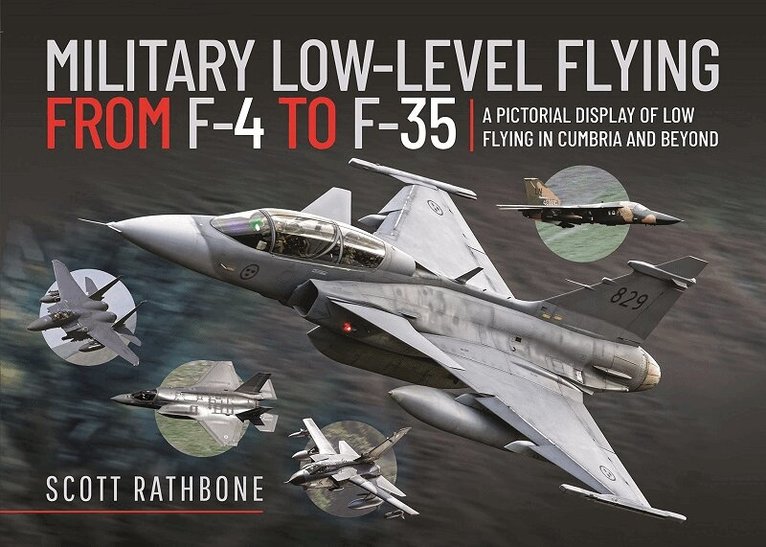
Inbunden, Engelska, 2023
354 kr
Skickas
The United Kingdom has some of the most dramatic landscapes that can be used by pilots to train in the vital skill of low flying. Aircrew preparing for operations in Afghanistan, Iraq and other potential war zones frequently hone their skills flying through the valleys of the UK, sometimes at near subsonic speed.In Cumbria, as well as other major training areas within the United Kingdom Low Flying System, such as parts of Scotland and the world-famous Mach Loop in Wales, pilots can be seen on an almost daily basis sharpening their skills as they weave their aircraft, from basic trainers to the latest high-tech fighters, between the hillsides. As a result, these locations offer remarkable opportunities for photographers to capture close-up and dramatic shots.These sights have captured the imagination of many photographers who have devoted many hours and displayed great patience in waiting to snap dynamic images on camera, the majority of these since the birth of digital photography. Whilst photographs of military low flying prior to the digital age are rare, in the pages of this book the author presents a selection of images to showcase just how things have developed since the 1980s - particularly focusing on the action to be seen over the hills and valleys of Cumbria and the Lake District which, since 1979, has been a major area in the training of military pilots.In these pages are amazing shots of scores of different types of aircraft, from Jet Provosts, Buccaneers and Hawks through to F4 Phantoms, A-10 Thunderbolts, Tornadoes, Typhoons, and F-35 Lightnings, to name but a few. Types such as the Chinook and Sea King represent the many rotary aircraft. Unlike the photographs from air shows, none of these were staged; they are all action shots taken spontaneously as the aircraft whistled by Scott Rathbone and his trusty camera.