Scott Schieman - Böcker
Visar alla böcker från författaren Scott Schieman. Handla med fri frakt och snabb leverans.
4 produkter
4 produkter
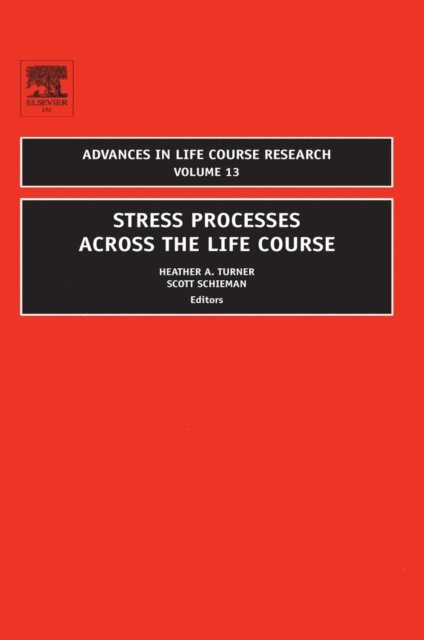
Del 13 - Advances in Life Course Research
Stress Processes across the Life Course
Inbunden, Engelska, 2008
1 151 kr
Skickas inom 7-10 vardagar
Stress researchers have become increasing aware of the ways in which structural and psychosocial variations in the life course shape exposure and vulnerability to social stress. This volume of Advances in Life Course Research explores, theoretically and empirically, stress processes both within and across specific life stages. Chapters within this volume incorporate several areas of research, including:.How physical and mental health trajectories are shaped by life course variations in stressors and resources.Stress associated with social role transitions and the significance of different role trajectories for stress exposure and outcomes .Life course variations in the quality and content of institutional contexts (such as school, work and family) and their significance for stress processes.Differences in types, levels, and effects of different stress-moderating resources within and across life course stages.Ways in which race, gender, and social class influence or condition stress processes over the life course.The relevance of "linked lives� within families and across generations for stress exposure and vulnerability.Historical variations in stress-related conditions and cohort differences in stress experiences.Methodological and theoretical advances in studying stress processes across the life course
Advances in the Conceptualization of the Stress Process
Essays in Honor of Leonard I. Pearlin
Inbunden, Engelska, 2009
1 093 kr
Skickas inom 10-15 vardagar
In 1981, Leonard Pearlin and his colleagues published an article that would ra- cally shift the sociological study of mental health from an emphasis on psychiatric disorder to a focus on social structure and its consequences for stress and psyc- logical distress. Pearlin et al. (1981) proposed a deceptively simple conceptual model that has now influenced sociological inquiry for almost three decades. With his characteristic penchant for reconsidering and elaborating his own ideas, Pearlin has revisited the stress process model periodically over the years (Pearlin 1989, 1999; Pearlin et al. 2005; Pearlin and Skaff 1996). One of the consequences of this continued theoretical elaboration of the stress process has been the development of a sociological model of stress that embraces the complexity of social life. Another consequence is that the stress process has continued to stimulate a host of empirical investigations in the sociology of mental health. Indeed, it is no exaggeration to suggest that the stress process paradigm has been primarily responsible for the growth and sustenance of sociological research on stress and mental health. Pearlin et al. (1981) described the core elements of the stress process in a brief paragraph: The process of social stress can be seen as combining three major conceptual domains: the sources of stress, the mediators of stress, and the manifestations of stress. Each of these extended domains subsumes a variety of subparts that have been intensively studied in recent years.
310 kr
Kommande
Have you ever found yourself considering what your life would be like in the absence of work? Would you feel a sense of loss past the finances? More people than ever before believe that a job is just a way of earning money – nothing more. While the popularity of this transactional mindset is understandable, I Want M.O.R.E. argues that it depletes our vision of our professional lives. Sociologist Scott Schieman has drawn upon decades of research to investigate what people think and feel about work. He has distilled the essence of that data to create M.O.R.E., which stands for Mooring, Opening, Relating, and Exceeding. Mooring navigates identity, structure, and purpose. Opening explores ability, agency, and creativity. Relating explains connection, support, and respect. And Exceeding focuses on recognition, reputation, and status. Helping readers harness their sense of self and better their quality of life, the M.O.R.E. framework catalogues each element, along with metrics to assess your current job, what you value in a job, and what you aspire to achieve. The book also features a M.O.R.E. assessment, guidance on maximizing its dimensions, and tips for navigating difficult work situations. A crucial guide for anyone who wants to get more out of their life and work, I Want M.O.R.E. energizes and empowers readers by encouraging a transformational new mindset about the purpose of work. How you see yourself is at the centre of who you are, and that is too important to leave to chance. And a little M.O.R.E. often produces big results.
Advances in the Conceptualization of the Stress Process
Essays in Honor of Leonard I. Pearlin
Häftad, Engelska, 2014
1 093 kr
Skickas inom 10-15 vardagar
In 1981, Leonard Pearlin and his colleagues published an article that would ra- cally shift the sociological study of mental health from an emphasis on psychiatric disorder to a focus on social structure and its consequences for stress and psyc- logical distress. Pearlin et al. (1981) proposed a deceptively simple conceptual model that has now influenced sociological inquiry for almost three decades. With his characteristic penchant for reconsidering and elaborating his own ideas, Pearlin has revisited the stress process model periodically over the years (Pearlin 1989, 1999; Pearlin et al. 2005; Pearlin and Skaff 1996). One of the consequences of this continued theoretical elaboration of the stress process has been the development of a sociological model of stress that embraces the complexity of social life. Another consequence is that the stress process has continued to stimulate a host of empirical investigations in the sociology of mental health. Indeed, it is no exaggeration to suggest that the stress process paradigm has been primarily responsible for the growth and sustenance of sociological research on stress and mental health. Pearlin et al. (1981) described the core elements of the stress process in a brief paragraph: The process of social stress can be seen as combining three major conceptual domains: the sources of stress, the mediators of stress, and the manifestations of stress. Each of these extended domains subsumes a variety of subparts that have been intensively studied in recent years.