Sean Holly - Böcker
Visar alla böcker från författaren Sean Holly. Handla med fri frakt och snabb leverans.
7 produkter
7 produkter
441 kr
Skickas inom 7-10 vardagar
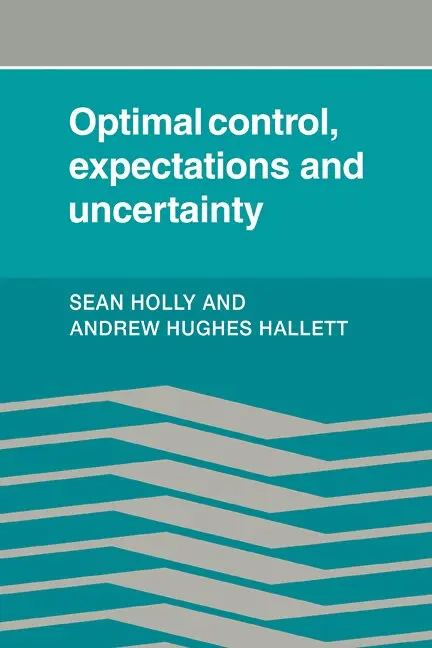
The rational expectations revolution and other developments in economics (notably game theory) have fundamentally altered the application of optimal control theory to economic forecasting and planning. In particular, they have shown that economic systems cannot be modelled simplistically on physical systems. However, as the authors of this volume show, these developments have greatly enhanced our understanding of how an economy functions, and now make it possible for optimal control theory to be applied much more effectively to economic modelling and planning. This book is divided into two parts. The first presents the orthodox framework but extends it to allow for multiplicative uncertainty, risk and non-linearities in the econometric model. The second part looks explicitly at the question of expectations. It provides methods by which forward-looking expectations can be treated jointly with the determination of economic policy. It also examines game-theoretic considerations - where, for instance, policy makers may have incentive to renege on their commitments.
1 417 kr
Skickas inom 7-10 vardagar
The rational expectations revolution and other developments in economics (notably game theory) have fundamentally altered the application of optimal control theory to economic forecasting and planning. In particular, they have shown that economic systems cannot be modelled simplistically on physical systems. However, as the authors of this volume show, these developments have greatly enhanced our understanding of how an economy functions, and now make it possible for optimal control theory to be applied much more effectively to economic modelling and planning. This book is divided into two parts. The first presents the orthodox framework but extends it to allow for multiplicative uncertainty, risk and non-linearities in the econometric model. The second part looks explicitly at the question of expectations. It provides methods by which forward-looking expectations can be treated jointly with the determination of economic policy. It also examines game-theoretic considerations - where, for instance, policy makers may have incentive to renege on their commitments.
Del 41 - National Institute of Economic and Social Research Economic and Social Studies
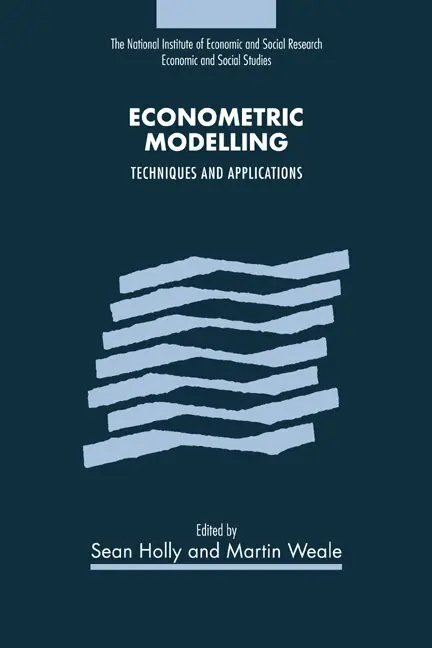
Econometric Modelling
Techniques and Applications
Inbunden, Engelska, 2000
1 363 kr
Skickas inom 7-10 vardagar
Macroeconomic modelling has been one of the most important and influential areas of economic research. This book presents contributions from the leading researchers working in this area as part of the ongoing research project sponsored by the Economic and Social Research Council, Bank of England and UK Treasury. The papers combine a description of the latest techniques used in modelling the economy with an account of the way that models can be used for purposes of policy analysis. Designed for use by advanced students and professional economists, the book considers issues including: why 'bad' forecasters, i.e. those with no coherent and properly articulated view of the functioning of the macroeconomy, do so well; reconciling short term dynamics with economic theory; modelling tax policy; and the stabilisation costs of European Monetary Union.
1 324 kr
Skickas inom 7-10 vardagar
The Bank of England was given operational independence by the UK Parliament in 1997. The key feature of this independence is that the Bank's Monetary Policy Committee has sole responsibility for setting interest rates to achieve the Government's inflation target. Featuring contributions from leading academics and practitioners, Reflections on Monetary Policy after twenty-five years of the MPC assesses and reflects on this independence, particularly in relation to the activities of the Monetary Policy Committee. The book is organised around four main themes: the remit given to the Bank of England in 1997, the decision-making process by which the Bank determines monetary policy, the use of unconventional policy after the financial crisis of 2007–11, and the scale and scope of the communication that the Bank uses to inform the public. It argues that the economy works best when agents understand why the central bank behaves in a particular way.
1 417 kr
Skickas inom 7-10 vardagar
Many of the assumptions that underpin mainstream macroeconomic models have been challenged as a result of the traumatic events of the recent financial crisis. Thus, until recently, it was widely agreed that although the stock of money had a role to play, in practice it could be ignored as long as we used short-term nominal interest rates as the instrument of policy because money and other credit markets would clear at the given policy rate. However, very early on in the financial crisis interest rates effectively hit zero percent and so central banks had to resort to a wholly new set of largely untested instruments to restore order, including quantitative easing and the purchase of toxic financial assets. This book brings together contributions from economists working in academia, financial markets and central banks to assess the effectiveness of these policy instruments and explore what lessons have so far been learned.
550 kr
Skickas inom 7-10 vardagar
Many of the assumptions that underpin mainstream macroeconomic models have been challenged as a result of the traumatic events of the recent financial crisis. Thus, until recently, it was widely agreed that although the stock of money had a role to play, in practice it could be ignored as long as we used short-term nominal interest rates as the instrument of policy because money and other credit markets would clear at the given policy rate. However, very early on in the financial crisis interest rates effectively hit zero percent and so central banks had to resort to a wholly new set of largely untested instruments to restore order, including quantitative easing and the purchase of toxic financial assets. This book brings together contributions from economists working in academia, financial markets and central banks to assess the effectiveness of these policy instruments and explore what lessons have so far been learned.
1 876 kr
Skickas inom 7-10 vardagar
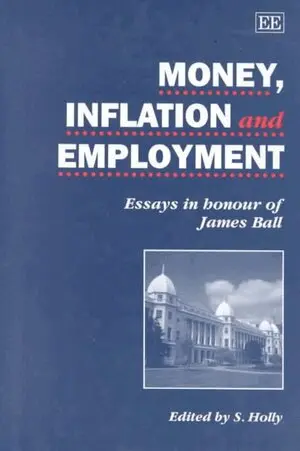
Money, Inflation and Employment examines issues of economic policy and theory through a series of original essays written in recognition of Sir James Ball's seminal contribution to macroeconomic modelling, forecasting and economic policy making.Contributions by leading policymakers focus primarily on the UK economy, with papers by Jeremy Bray, MP, on managing the economy, Alan Budd, Chief Economic Adviser to the Treasury, on exchange rate policy, Sir Terence Burns, Permanent Secretary to the Treasury, on the Treasury's responsibilities and character, and Bill Robinson on the effects of North Sea oil. Later contributions address technical questions, with papers by David Currie and Steven Hall on expectations and learning, D.F. Hendry and M.P. Clements on a theory of intercept corrections in macroeconomic forecasting, Lawrence Klein on economic forecasting and decision making under uncertainty, Ken Wallis and Keith Church on price homogeneity and the supply side in a number of models of the UK economy.